
Loading, please wait...


LOT 0765
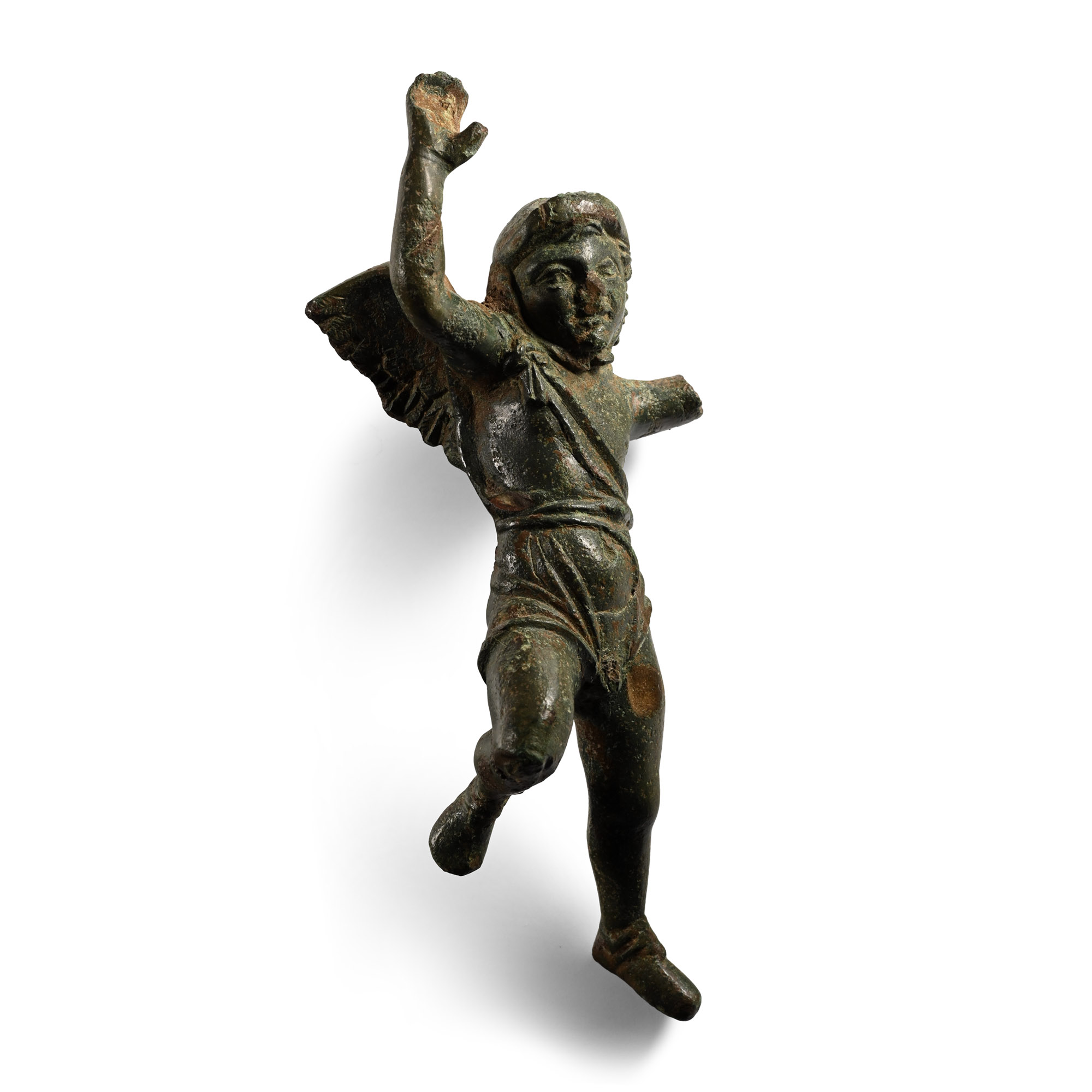
Large Gallo-Roman Bronze Statuette of Cupid
1ST-3RD CENTURY A.D.
6 1/4 in. (403 grams, 16 cm high).
Modelled in the round leaping and winged, his right hand reaching above his head seemingly gesturing to retrieve arrows from a quiver once carried on his back, dressed in an exomis tunic leaving him naked below the torso, wearing a helmet or cap and ankle boots.
ProvenanceAcquired in Europe before 1994.
Private collection, Europe.
Accompanied by an academic report by Dr Raffaele D’Amato.
This lot has been checked against the Interpol Database of stolen works of art and is accompanied by search certificate no.11808-206795.
Cf. Daremberg - Saglio, Dictionnaire des Antiquités Grecques et Romaines, Paris, 1873-1917; Rolland, H., Bronzes Antiques De Haute Provence, Paris, 1965, items 112-118, and especially 116bis, for similar Gallo-Roman examples; Boucher, S. and Tassinari, S., Bronzes Antiques I, Inscriptions, Statuaire, Vaisselle, Paris, 1976, p.31, no.23, for similar; Jashemski, W.J., The gardens of Pompeii: Herculaneum and the villas destroyed by Vesuvius, II volumes, New York, 1979.
FootnotesOften the statues of puttos or amorini (small loves) depicting personifications of Eros were covered with gold leaf. This was a frequent practice and the figures, when represented with wings, were known as chrysopteroi, meaning 'with golden wings'.
CONDITIONTimeLine Auctions follows a vetting process to ensure the authenticity and legality of all items, reinforcing our commitment to integrity and responsible trading. Each antiquity, antique, and coin lot undergoes thorough examination by a vetting committee of at least ten external specialists, professional trade association members, scientists, and archaeologists: Our Vetting Process
AUCTIONS:
TimeLine is a leading auction house specialising in antiquities, ancient art, collectables, natural history, coins, medals, and books. Our auctions offer museums, collectors, historians, and enthusiasts the opportunity to acquire unique and historically significant pieces.
LOT 0765
Large Gallo-Roman Bronze Statuette of Cupid
Estimate £3,000 - 4,000€3,480 - 4,640 (for guidance only)$4,050 - 5,400 (for guidance only)
-
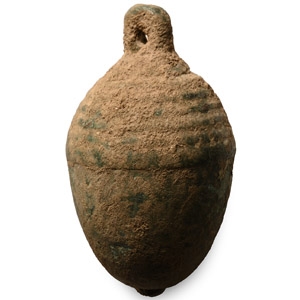
Roman Mason's Acorn-Shaped Plumb Bob Weight
1st-3rd century A.D.Sold for (Inc. bp): £208
Substantial lead-filled bronze with loop above and ribbed cup. 325 grams, 62 mm
From the private collection of the late Victor Brox. -
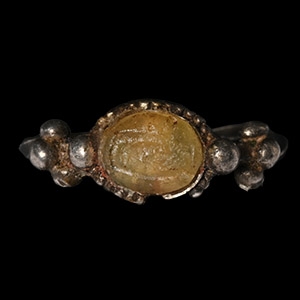
Roman Silver Ring with Cabochon
4th-5th century A.D.Sold for (Inc. bp): £169
Formed as a twisted square-section shank with granule clusters to the shoulders, ellipsoid plaque with beaded wire cell and inset aqua glass cabochon with incuse rectangle motif. 2.39 grams, 21.87 mm overall, 18.10 mm internal diameter (approximate size British M 1/2, USA 6 1/4, Europe 13.09, Japan 12)
UK private collection before 2000. Acquired on the UK art market. Property of a London gentleman. -
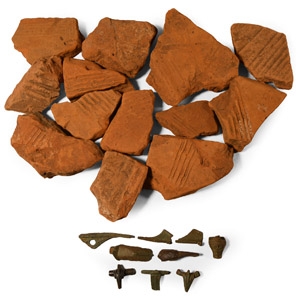
Roman Terracotta Roof Tile and Bronze Brooch Fragment Group
1st-4th century A.D.Sold for (Inc. bp): £13
Mixed group of terracotta tile fragments; offered with fragments of bronze bow brooches and other items. 1.08 kg total, 21-98 mm
Found whilst searching in Devon, Somerset and Wiltshire, UK.
