
Loading, please wait...
LOT 0478
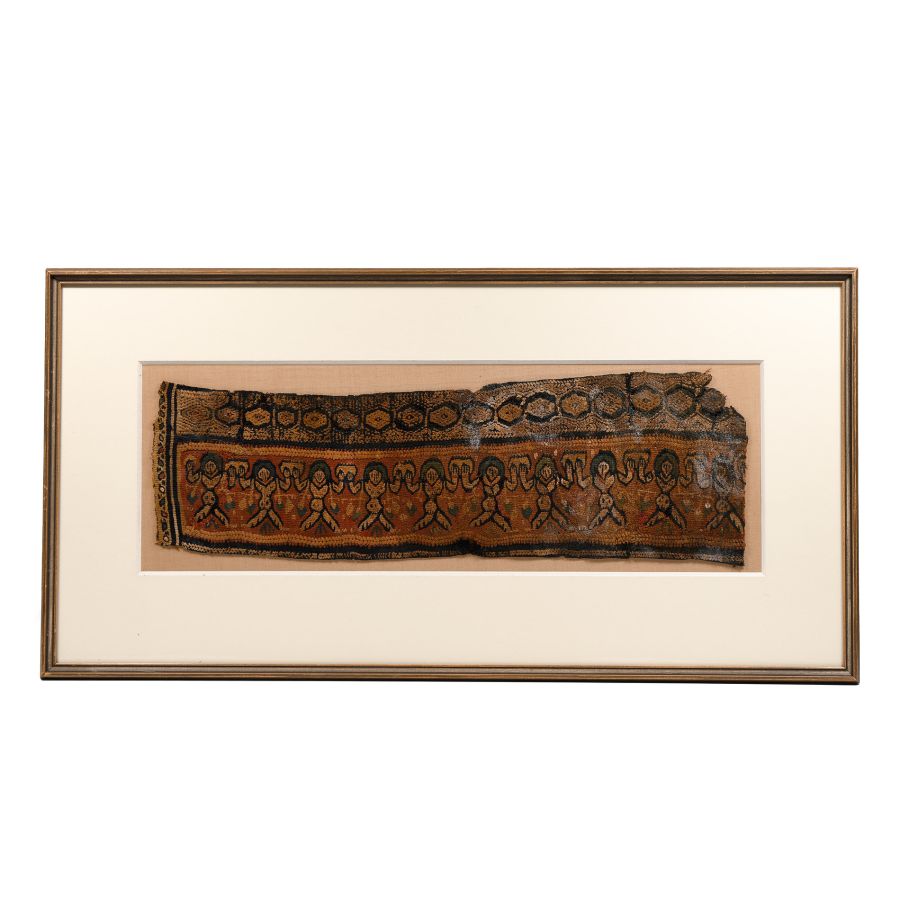
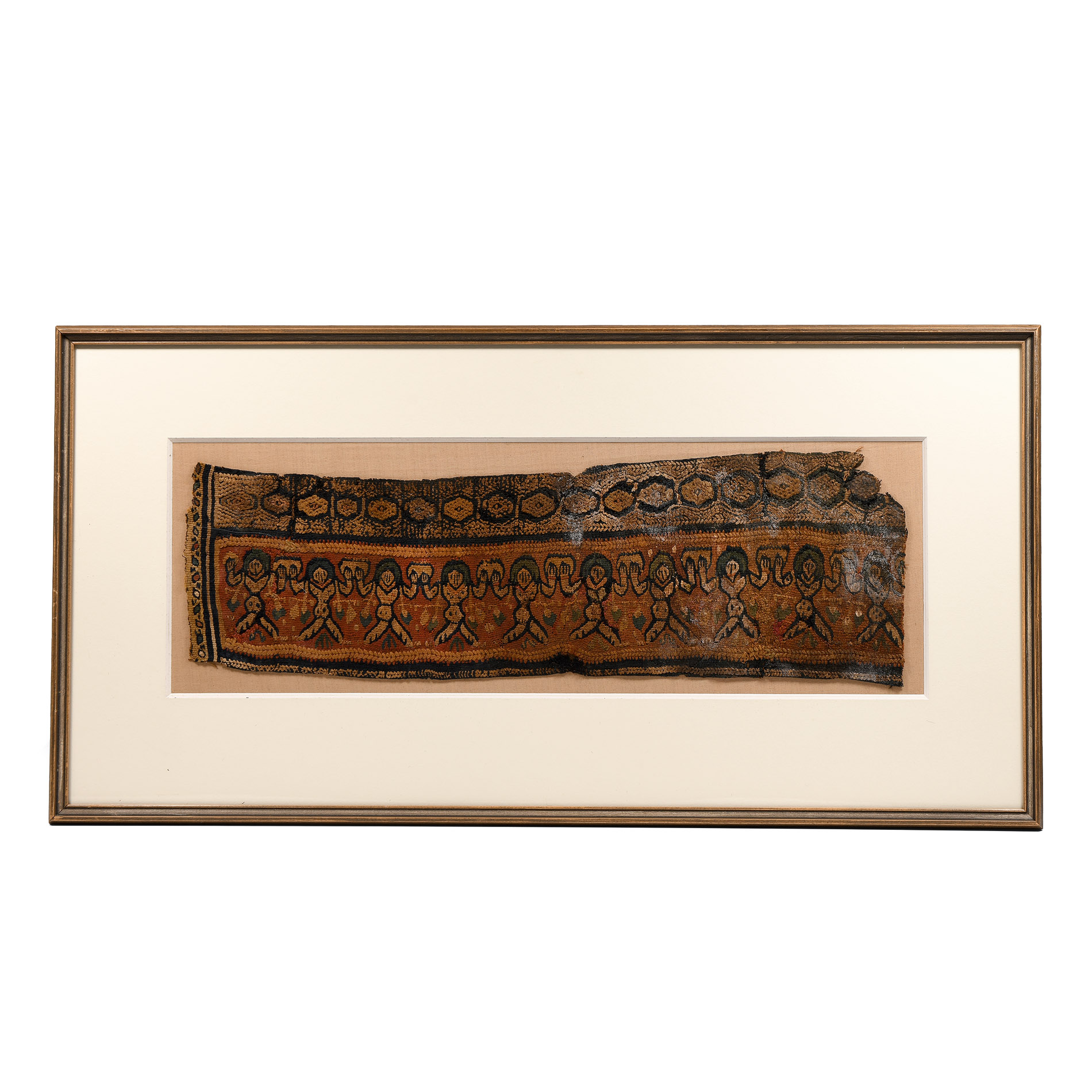
Large Framed Coptic Wool Garment Fragment with Dancing Nymphs
CIRCA 6TH-7TH CENTURY A.D.
28 x 14 in. (2.1 kg total, 71 x 36 cm including frame).
Comprising a series of nude female figures on red background, probably maenads or nymphs, dancing to the sounds of cymbals held in their outstretched hands, each wearing a green proploma; wide band of geometric decoration above; mounted in a custom-made glazed frame. [No Reserve]
ProvenanceEx Dutch collection, 1960s.
UK collection 2018.
Cf. Del Francia Barocas, L., Museo dell'Alto Medioevo, Roma, I materiali Copti, p.160,186, nos.38, 49, for similar textile figures and warp.
FootnotesThe band is probably the terminal part of a large wall carpet. The warp material is raw natural twisted wool in one strand, with weft in linen and raw wool in red, orange, ochre yellow, blue green, olive green, blue. The motif still echoes themes of the pagan world, despite being made in the Christian Roman Empire.
CONDITIONTimeLine Auctions follows a vetting process to ensure the authenticity and legality of all items, reinforcing our commitment to integrity and responsible trading. Each antiquity, antique, and coin lot undergoes thorough examination by a vetting committee of at least ten external specialists, professional trade association members, scientists, and archaeologists: Our Vetting Process
AUCTIONS:
TimeLine is a leading auction house specialising in antiquities, ancient art, collectables, natural history, coins, medals, and books. Our auctions offer museums, collectors, historians, and enthusiasts the opportunity to acquire unique and historically significant pieces.
LOT 0478
Large Framed Coptic Wool Garment Fragment with Dancing Nymphs
Sold for (Inc. bp): £520
-
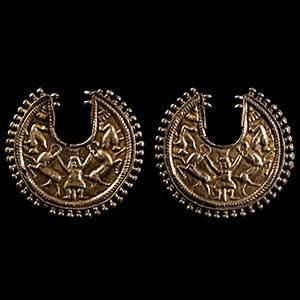
Egypto-Persian Silver-Gilt Earring Pair with Bes Holding Two Ibexes
Circa 530-330 B.C.Sold for (Inc. bp): £2,340
Each with bifacial repoussé decoration depicting the Egyptian god Bes controlling two ibexes, above them two geese or storks facing stylised lotus flowers, projecting knops to the perimeter, four loops to the inner edge. 26.73 grams total, 4.7 cm each
with Riyahi Gallery, London, prior to 1996. Private collection, Switzerland, acquired from the above, 1 July 1996. Acquired from the above, 23 December 2010. Accompanied by a copy of an Art Loss Register certificate, no 5068.C.V. -
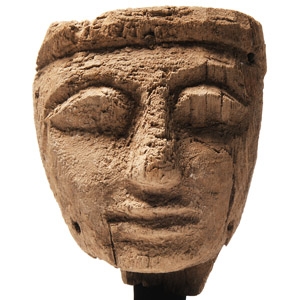
Egyptian Wooden Mask
Late Dynastic Period, after 500 B.C.Sold for (Inc. bp): £1,300
Wooden face from a coffin lid, D-shaped in plan with large almond-shaped eyes, holes for mounting pegs; accompanied by the original dealer's ticket from Phocion J. Tano of Cairo with handwritten description and signature 'Small masque of wood of the end of the Saïtic Period some four hundred years B.C. It is found close to the pyramid of Meïdun and it is genuine guaranteed and nothing ticked. It is as is found. Cairo the 14/4/65.'; mounted on a custom-made stand. 357 grams total, 20.8 cm high including stand
Ex Phocion J. Tano, Cairo, Egypt, 1965. Phocion Jean Tano (1898-1972) belonged to a family dynasty who founded and ran one of the oldest antiquities shops in Egypt, located in front of the old Shepheard's Hotel in Cairo. From a private UK family collection. Accompanied by an original handwritten and signed card receipt dated 14 April 1965 from Phocion J. Tano Antiquities Gallery, Cairo, Egypt. -
.jpg)
Egyptian Black Hardstone Scarab with Ankh
Late New Kingdom, circa 1070 B.C.Sold for (Inc. bp): £845
Carved with stylised features and the base carved with a scarab beetle flanked by two ankh symbols and a ra sign beneath; drilled for suspension. 2.71 grams, 18 mm
Acquired 1969-1999. From the private collection of the late Mr S.M., London, UK, thence by descent.
