
Loading, please wait...
_900x900.jpg "Large Egyptian Faience Thoth as a Baboon Amulet")
_200x200.jpg "Large Egyptian Faience Thoth as a Baboon Amulet")
_900x900.jpg "Large Egyptian Faience Thoth as a Baboon Amulet")
_200x200.jpg "Large Egyptian Faience Thoth as a Baboon Amulet")
.jpg "Large Egyptian Faience Thoth as a Baboon Amulet")
.jpg "Large Egyptian Faience Thoth as a Baboon Amulet")
LOT 0021
Large Egyptian Faience Thoth as a Baboon Amulet
LATE PERIOD, 664-332 B.C.
3 1/8 in. (31.51 grams total, 80 mm including stand).
Modelled in the round as the god in baboon-form crouching holding a wedjat-eye in his forepaws; ribbed suspension loop on back; mounted on a custom-made stand.
ProvenanceEx private UK, collection formed since the 1960s.
This lot has been cleared against the Art Loss Register database, and is accompanied by an illustrated lot declaration signed by the Head of the Antiquities Department, Dr Raffaele D'Amato.
Cf. Petrie, W.M.F., Amulets. Illustrated by the Egyptian Collection in University College, London, 1914, pl.XXXVII, no. 206k, for a similar example.
CONDITIONTimeLine Auctions follows a vetting process to ensure the authenticity and legality of all items, reinforcing our commitment to integrity and responsible trading. Each antiquity, antique, and coin lot undergoes thorough examination by a vetting committee of at least ten external specialists, professional trade association members, scientists, and archaeologists: Our Vetting Process
AUCTIONS:
TimeLine is a leading auction house specialising in antiquities, ancient art, collectables, natural history, coins, medals, and books. Our auctions offer museums, collectors, historians, and enthusiasts the opportunity to acquire unique and historically significant pieces.
LOT 0021
Large Egyptian Faience Thoth as a Baboon Amulet
Estimate £1,500 - 2,000€1,740 - 2,320 (for guidance only)$2,030 - 2,700 (for guidance only)
-
.jpg)
Egyptian Turquoise Glazed Faience Four Sons of Horus Mount Set
25th Dynasty, circa 747-656 B.C.Sold for (Inc. bp): £5,200
Set of four flat-backed plaques depicting the standing figures of the four sons of Horus (from left to right: Duamutef, Imsety, Hapy, and Qebehsenuef) in profile, each wearing a tripartite wig, broad collars, and holding a long folded cloth; mounted on a stand. 81 grams total, 95 x 80 mm including stand
Gunther Markert collection, Germany/Switzerland, 1954 or 1961. with Robert Bigler, Switzerland. Private collection, London, UK, acquired from the above on 12 October 2001. Accompanied by a copy of the Robert Bigler invoice. This lot has been cleared against the Art Loss Register database, and is accompanied by an illustrated lot declaration signed by the Head of the Antiquities Department, Dr Raffaele D'Amato.
The Four Sons of Horus were deities tasked with protecting the internal organs of the deceased. The human-headed Imsety safeguarded the liver, the baboon-headed Hapy looked after the lungs, the jackal-headed Duamutef defended the stomach, and the falcon-headed Qebehsenuef protected the intestines. Amulets featuring these deities were included within the mummy wrappings. -
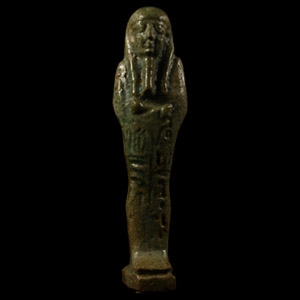
Egyptian Faience Shabti for Hor-sa-Iset
Late Period, circa 4th century B.C.Sold for (Inc. bp): £975
Of mummiform type, wearing a tripartite wig and long plaited divine beard; holding a pick in the left hand, a hoe in the right, and the cord of a seed bag hanging over his left shoulder; standing on an integral plinth, a plain back pillar terminating at the base of the wig; two vertical panels of hieroglyphic inscription to the front, including dedication: sḥḏ wsỉr ḥr sꜢ Ꜣst, ‘The illuminated, the Osiris, Hor-sa-Iset’; mounted on a custom-made display stand. 124 grams, 15.2 cm
Jacques René Fiechter, Switzerland (1920-1950). with Auction Martin, Egyptian collection of André Bircher, 1949. with Cahn Auktionen AG, Basel, 5 November 2011, no.20. Private collection, Europe. Accompanied by copies of the relevant Cahn catalogue pages. This lot is accompanied by an illustrated lot declaration signed by the Head of the Antiquities Department, Dr Raffaele D'Amato. -
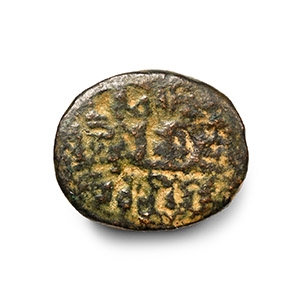
Phoenician Inscribed Bronze Scaraboid Seal
Late 1st millennium B.C.Sold for (Inc. bp): £52
Plain domed body pierced longitudinally, inscribed underside. 8.9 grams, 17 mm
Ex London, UK, gentleman, 1990. This lot is accompanied by an illustrated lot declaration signed by the Head of the Antiquities Department, Dr Raffaele D'Amato.
Although it is difficult to make out for certain, the outer design appears to be composed of the 'a-n-r' hieroglyphs. The signs do not form a word and are thought to have been a decorative device used by Asiatic scarab makers, employing recognisably Egyptian hieroglyphs.
