
Loading, please wait...
LOT 0489
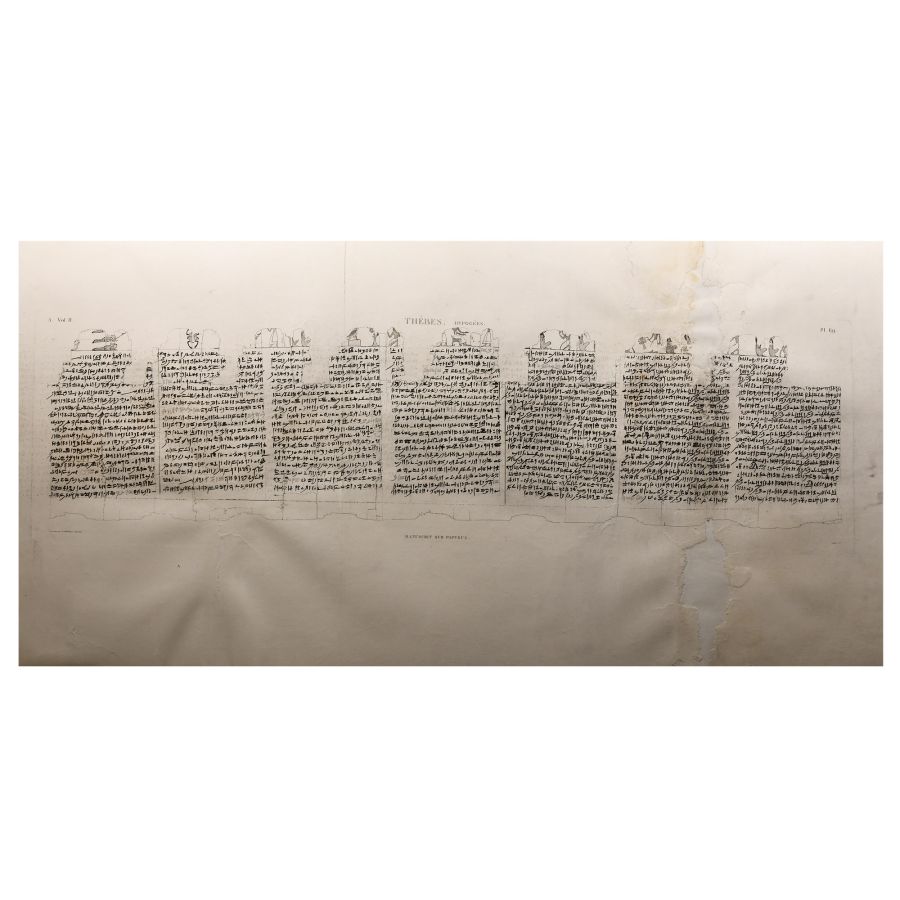
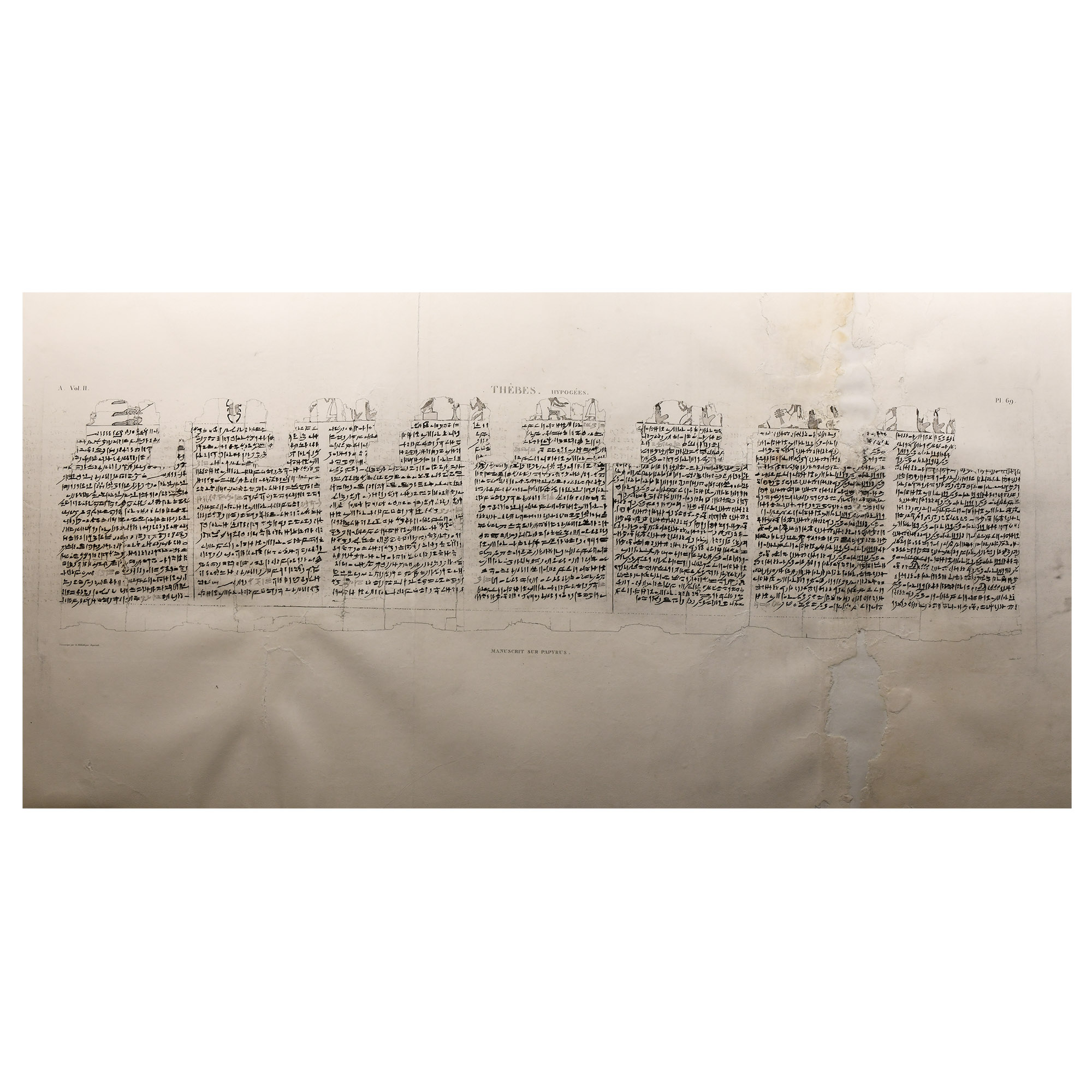
Large Egyptian Expedition Lithograph Print of Hieroglyphs
1820 A.D.
52 x 25 1/2 in. (350 grams, 132 x 65 cm).
Leclerc - Thèbes - Hypogées - Manuscrit sur papyrus - Proof etching on laid paper of plate 69 from La Description de l’Égypte: Antiquités, Volume II: Commission des sciences et arts d’Égypte with later backing sheet.
ProvenanceFrom the collection of a North American priest.
Acquired between 1981-1996.
Property of a North American collector.
Cf. Description de l'Égypte: ou recueil des observations et des recherches qui ont été faites en Égypte pendant l'expédition de l'armée française, publié par les ordres de Sa Majesté l'Empereur Napoléon le Grand, Antiquités, planches, tome deuxième, Paris, 1822, planche 69.
LiteratureCf. Description de l'Égypte publié par les ordres de Napoléon Bonaparte, Köln, 1994, pp.244-245.
FootnotesProduced between February 1802 and 1830 on the orders of Napoleon Bonaparte; published between 1809 and 1828. Just 1,000 copies were distributed to various institutions, printed on on laid paper with an 'Égypte ancienne et moderne' watermark. The book is subtitled Recueil des observations et des recherches qui ont été faites en Égypte pendant l’expédition de l’Armée française, publié par les ordres de Sa Majesté l’Empereur Napoléon le Grand (Gathering of observations and discoveries which were made in Egypt during the expedition of the French army, published on the orders of His Majesty the Emperor Napoleon the Great). It was the world's first encyclopedia devoted exclusively to the remains of ancient Egypt. The plates of this book are the first to present the archaeological sites of Thebes (Luxor). The papyrus manuscript was recovered from the underground chambers (hypogea). The papyrus is now in the Bibliothèque Nationale, Paris.
CONDITIONTimeLine Auctions follows a vetting process to ensure the authenticity and legality of all items, reinforcing our commitment to integrity and responsible trading. Each antiquity, antique, and coin lot undergoes thorough examination by a vetting committee of at least ten external specialists, professional trade association members, scientists, and archaeologists: Our Vetting Process
AUCTIONS:
TimeLine is a leading auction house specialising in antiquities, ancient art, collectables, natural history, coins, medals, and books. Our auctions offer museums, collectors, historians, and enthusiasts the opportunity to acquire unique and historically significant pieces.
LOT 0489
Large Egyptian Expedition Lithograph Print of Hieroglyphs
Estimate £150 - 200€170 - 230 (for guidance only)$200 - 270 (for guidance only)
-
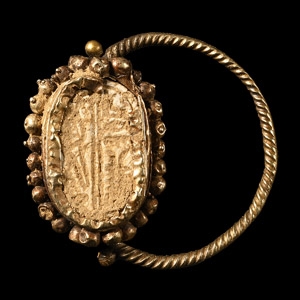
Egyptian Limestone Scarab in Gold Ring
Circa 1750-1550 B.C. and laterSold for (Inc. bp): £572
The scarab carved with simple anatomical detailing with two columns of hieroglyphs to base, including a djed pillar; set in a later gold swivel bezel with beaded edge supported by a tapering, round-section grooved hoop. 2.91 grams, 24.16 mm overall, 21.04 mm internal diameter
Collected from 1970-1999. From the collection of the late Mr S.M., London, UK. Accompanied by a previous catalogue information card.
The djed pillar was associated with the god Ptah, and from the New Kingdom onwards it was associated with the god Osiris, meaning stability, rejuvenation and regeneration. Thus it was used by both the living and the dead, formed of a variety of materials. -
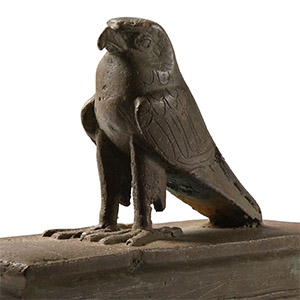
Egyptian Bronze Horus Falcon on Shrine-Shaped Base
Late Period-Ptolemaic Period, 664-31 B.C.Sold for (Inc. bp): £4,680
Naturalistically modelled falcon with incised feathers and detailing; standing on a shrine-shaped rectangular box with slightly battered sides and cornice moulding; inked note on the inside of each long side 'E.311' and 'Collection R.L.' respectively. 521 grams, 15 cm
Collected between the 1950s-1990s. Ex Roger Liechti (1934-2010) collection, Geneva, Switzerland. This lot has been checked against the Interpol Database of stolen works of art and is accompanied by search certificate no.12133-211848.
This box almost certainly once contained the mummified remains of a falcon. The falcon was principally identified with the sun-god Horus, and associated with the living king. Numerous falcon cults existed throughout Egypt, but the most spectacular was found at Saqqara, where many thousands of birds were mummified and buried in an extensive complex of underground galleries. -
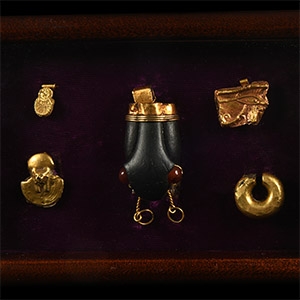
Egyptian Gold Pendant Collection
New Kingdom-Ptolemaic Period, 1550-30 B.C.Sold for (Inc. bp): £4,420
Comprising: a sheet-gold wedjat eye; a gold sheet penannular ring, possibly a wig ornament; a sheet-gold bead formed as a granulated female bust; gold aegis of Sekhmet wearing a broad collar and sun disc; a black snake's head mounted in gold with red carnelian eyes, possibly later replacements; mounted in display frame with purple velvet backing. 235 grams total, 15.3 x 10 cm
with Christie’s, London, 10 December 1986, no.64 (part). Property of a gentleman. Accompanied by copies of the relevant Christie's catalogue pages. This lot has been checked against the Interpol Database of stolen works of art and is accompanied by search certificate no.12130-214291.
