
Loading, please wait...
LOT 0435
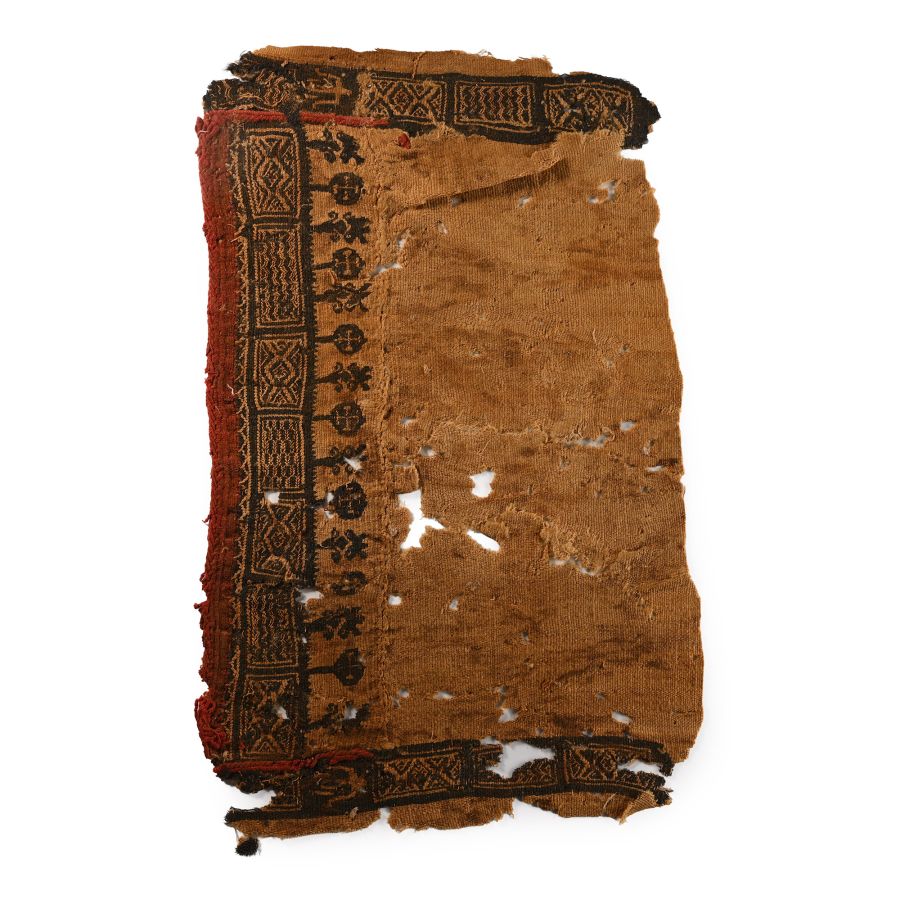
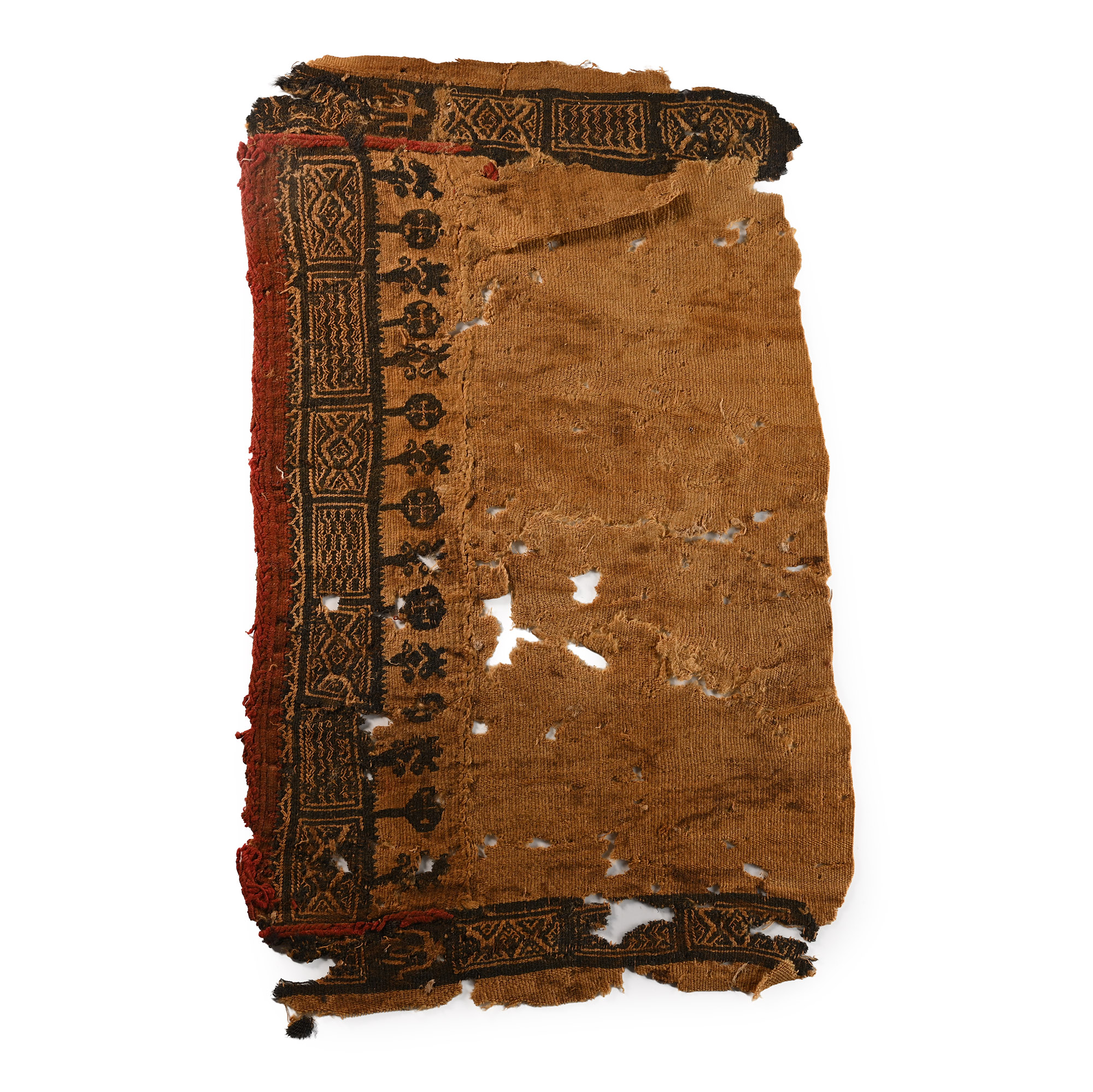
Large Egyptian Coptic Textile Fragment
CIRCA 5TH-9TH CENTURY A.D.
14 1/8 in. (103 grams total including package, 36 cm).
A very large tunic fragment from the upper part of the garment, in purple and red wool over linen, S torsion, a horizontal band with geometric patterns alternating with zig-zag lines, and descending on the breast with two clavi, patterned in similar way; red border with cords in the upper part, dentilled border with floral and vegetal ornaments (plants, flowers and buds with cross) in the lower part.
ProvenanceAcquired 1970s-1996.
Property of a North American collector.
London collection, 2016.
Cf. Seagrott, M., Coptic Weaves, Merseyside County Museums, 1978, pl.18, for a fragment of a similar band.
FootnotesThese decorative bands had a ground weave in purple wool, with natural linen and red forming the inlaid design of formal sprigs and zig-zag patterns. The double woven selvedge of the tunic’s neck has been preserved in the upper part.
CONDITIONTimeLine Auctions follows a vetting process to ensure the authenticity and legality of all items, reinforcing our commitment to integrity and responsible trading. Each antiquity, antique, and coin lot undergoes thorough examination by a vetting committee of at least ten external specialists, professional trade association members, scientists, and archaeologists: Our Vetting Process
AUCTIONS:
TimeLine is a leading auction house specialising in antiquities, ancient art, collectables, natural history, coins, medals, and books. Our auctions offer museums, collectors, historians, and enthusiasts the opportunity to acquire unique and historically significant pieces.
-
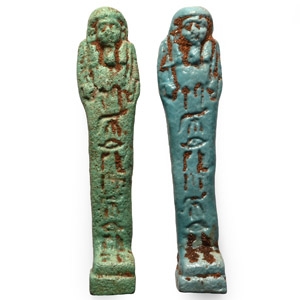
Egyptian Faience Shabti Group for Ha-bener-Re
Late-Ptolemaic Period, 664-30 B.C.Sold for (Inc. bp): £234
Two mummiform shabtis from the same mould, wearing a lappet wig and false beard, and holding a pick, hoe, and miniscule seed bag; inscribed with a column of hieroglyphic text on the front repeating the opening dedication "The illuminated one, the Osiris" ( sḥḏ wsỉr), and another on the dorsal pillar giving the name of the deceased, possibly to be read as Ha-bener-Re (ḥꜢ-bnr-rꜤ), a Ka-priest (ḥm-kꜢ). 16.4 grams total, 72 mm each
From the collection of a gentleman, acquired on the London art market in the 1990s. -
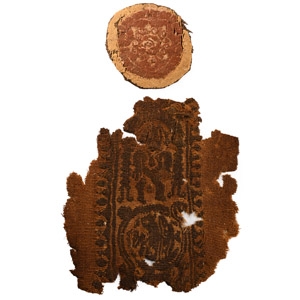
Egyptian Coptic Textile Fragment Group
Circa 5th-6th century A.D.Sold for (Inc. bp): £91
Comprising a fragment of a large segmentum in linen and wool, embroidered with a dancer, followed by a tondo with a Nereid riding a dolphin, borders with geometric decorations; an orbiculus decorated with vegetal patterns. 37 grams total including package, 6.7-14 cm
Acquired 1970s-1996. Property of a North American collector. London collection, 2016.
The segmentum was probably part of the vertical clavus of a tunic; it is highly probable that the embroidery refers to the Dionysian cycle with dancers, animals and probably, in the missing parts, hunters. -
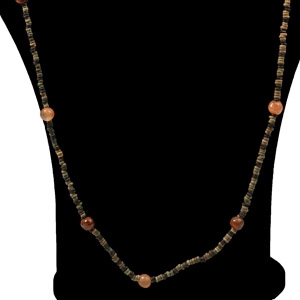
Egyptian Faience Mummy Bead Necklace with Carnelian Feature Beads
Late-Ptolemaic Period, 664-30 B.C.Sold for (Inc. bp): £59
A long, restrung designer necklace of annular beads with spherical, tubular and other types. 2.2.28 grams, 96 cm
From an old deceased estate. Property of an East London lady collector, acquired at auction before 1995.
