
Loading, please wait...
_900x900.jpg "Large Egyptian Bronze Statue of Khonsu")
_200x200.jpg "Large Egyptian Bronze Statue of Khonsu")
_900x900.jpg "Large Egyptian Bronze Statue of Khonsu")
_200x200.jpg "Large Egyptian Bronze Statue of Khonsu")
.jpg "Large Egyptian Bronze Statue of Khonsu")
.jpg "Large Egyptian Bronze Statue of Khonsu")
LOT 0014
Large Egyptian Bronze Statue of Khonsu
LATE PERIOD, 26TH DYNASTY, 664-525 B.C.
10 3/4 in. (896 grams total, 27 cm including stand).
Standing in advancing pose on a rectangular base; the god modelled with a disk representing the full-moon surmounting a crescent new moon atop his head and fronted by a uraeus, the falcon-head sports a finely striated tripartite wig and with beaded silver wire frames to the (once inlaid) eyes; wearing a broad wesekh collar; the left arm bent and fist drilled to grip a staff, right arm straight to the side with similar drilled fist; pleated shendyt kilt and belt to the hips; mounted on a tiered socle base.
ProvenanceSmith family collection, Cambridge, UK since 1949.
Private UK collection since 1978.
Accompanied by a scholarly note by Egyptologist Paul Whelan.
This lot has been checked against the Interpol Database of stolen works of art and is accompanied by search certificate number no.11033-183985.
Cf. for a near identical example from Memphis and now in the Walters Art Museum, Baltimore, inventory no. 54.395.
FootnotesThe moon god Khonsu (whose name means 'wanderer', referring to the passage of the moon across the sky) is known as a blood-thirsty sky-deity in the Pyramid Texts. In New Kingdom Thebes, however, he was regarded as a far more benevolent deity, being the child of Amun and Mut, and provided with his own temple at Karnak. There, he was considered to control destiny. Khonsu can appear in human form with a side-lock of youth, wearing an enveloping garment, and holding royal regalia, and also as a falcon-headed man with the full moon and crescent new moon headdress, as with this fine example. In his falcon-headed form he frequently holds an ankh symbol and a was-sceptre, for which the hands of this piece were drilled to accept the god's well-known attributes.
CONDITIONTimeLine Auctions follows a vetting process to ensure the authenticity and legality of all items, reinforcing our commitment to integrity and responsible trading. Each antiquity, antique, and coin lot undergoes thorough examination by a vetting committee of at least ten external specialists, professional trade association members, scientists, and archaeologists: Our Vetting Process
AUCTIONS:
TimeLine is a leading auction house specialising in antiquities, ancient art, collectables, natural history, coins, medals, and books. Our auctions offer museums, collectors, historians, and enthusiasts the opportunity to acquire unique and historically significant pieces.
-
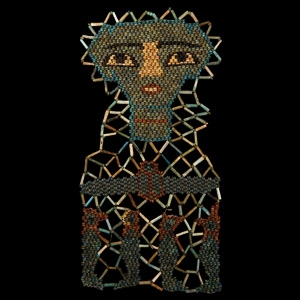
Egyptian Faience Bead Mummy Face Mask
Ptolemaic Period, 332-30 B.C.Sold for (Inc. bp): £390
Restrung; a netted beadwork panel of annular and tubular glazed composition beads in blues, greens, black, cream and red-brown colours, depicting a mummy face mask with false beard, a scarab with extended wings below, the 'Four Sons of Horus’ beneath the scarab, joined together with areas of open netting of tubular beads. 67 grams, 24 cm high
Acquired 1990s. Ex Mariaud des Serres, Paris, France.
The 'Four Sons of Horus' protected the internal organs of the deceased. Depicted from left to right: the falcon-headed Qebhesenuef protected the intestines; human-headed Imsety, the liver; baboon-headed Hapi, the lungs; jackal-headed Duamutef, the stomach. -
.jpg)
Romano-Egyptian Bronze Frog and Turtle Collection
Roman Period, 30 B.C.-323 A.D.Estimate: £800 - 1,000 (+bp*)
Opening Bid: £444
Comprising five frogs in different styles, including one example in relief on a square base; two turtles with simple shell detailing. 127 grams total, 16-34 mm
‘The Ancient Menagerie Collection’ formerly the property of a Cambridgeshire lady, collected since the 1990s and acquired from auctions and dealers throughout Europe and the USA, now ex London collection. -
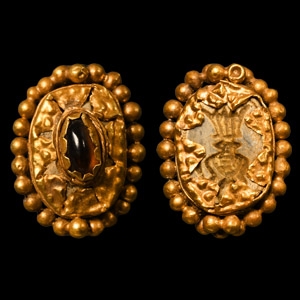
Egyptian Gold Mounted Scarab with Bes
Late Period, 664-332 B.C.Sold for (Inc. bp): £585
The stone or faience scarab decorated with a pale blue glaze with figure of the god Bes; gold bulbs to the perimeter; gold setting inlaid with a polished garnet cabochon to the domed upper face. 1.82 grams, 16 mm
From an early 20th century collection.
