
Loading, please wait...
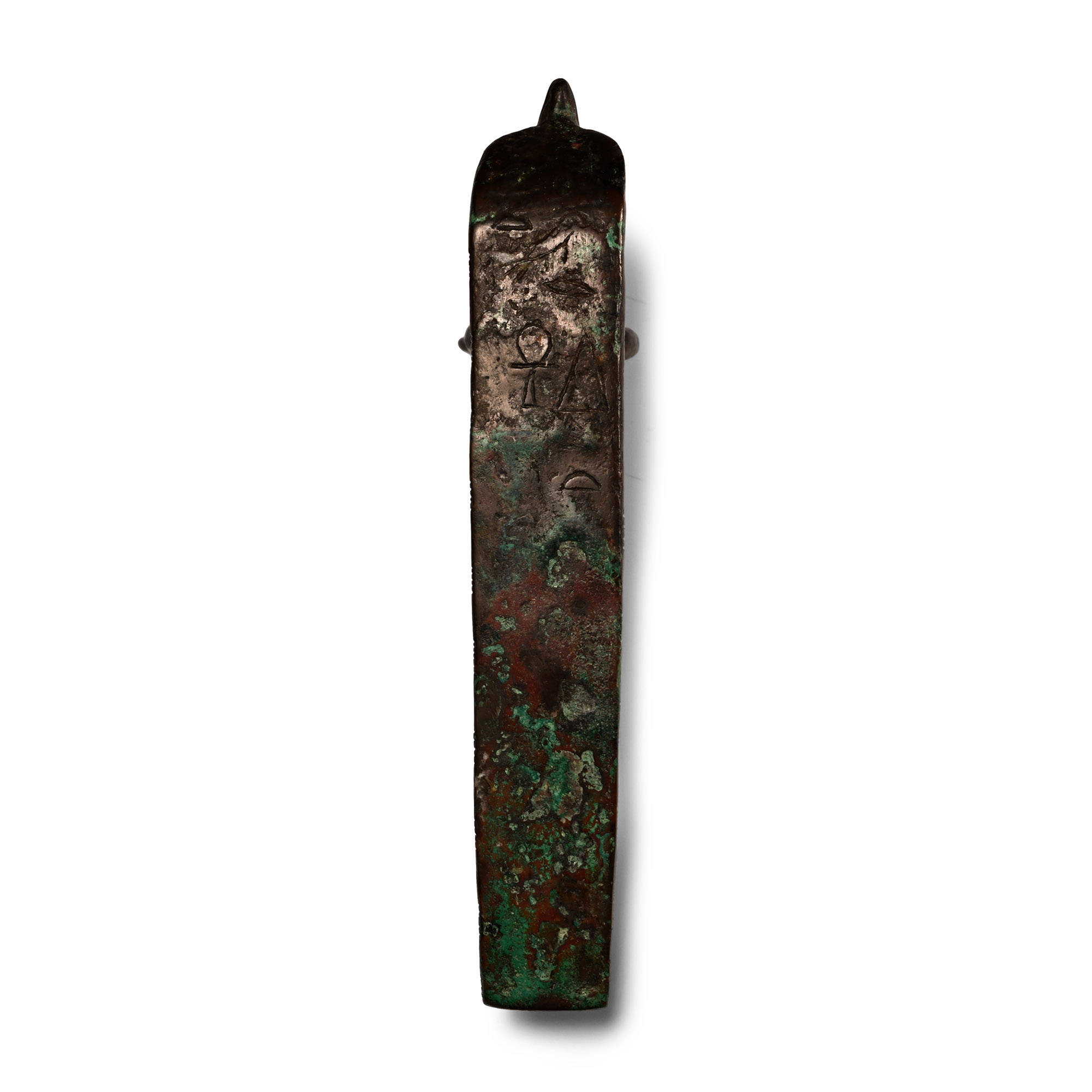
LOT 0028
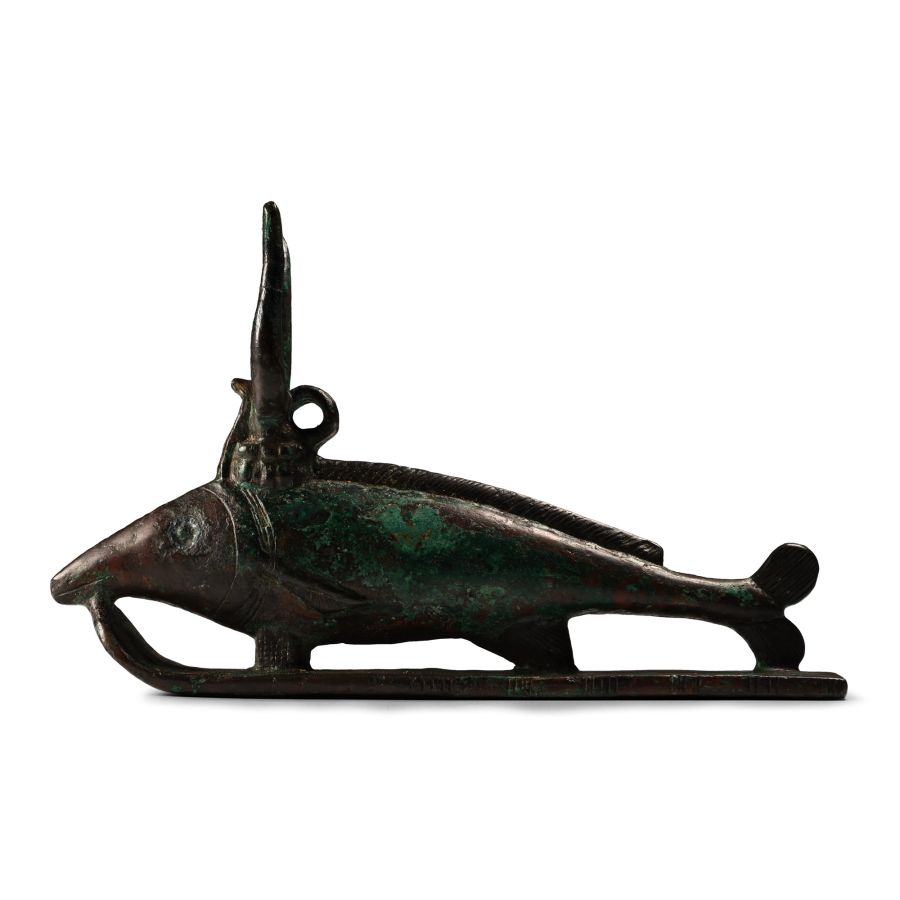
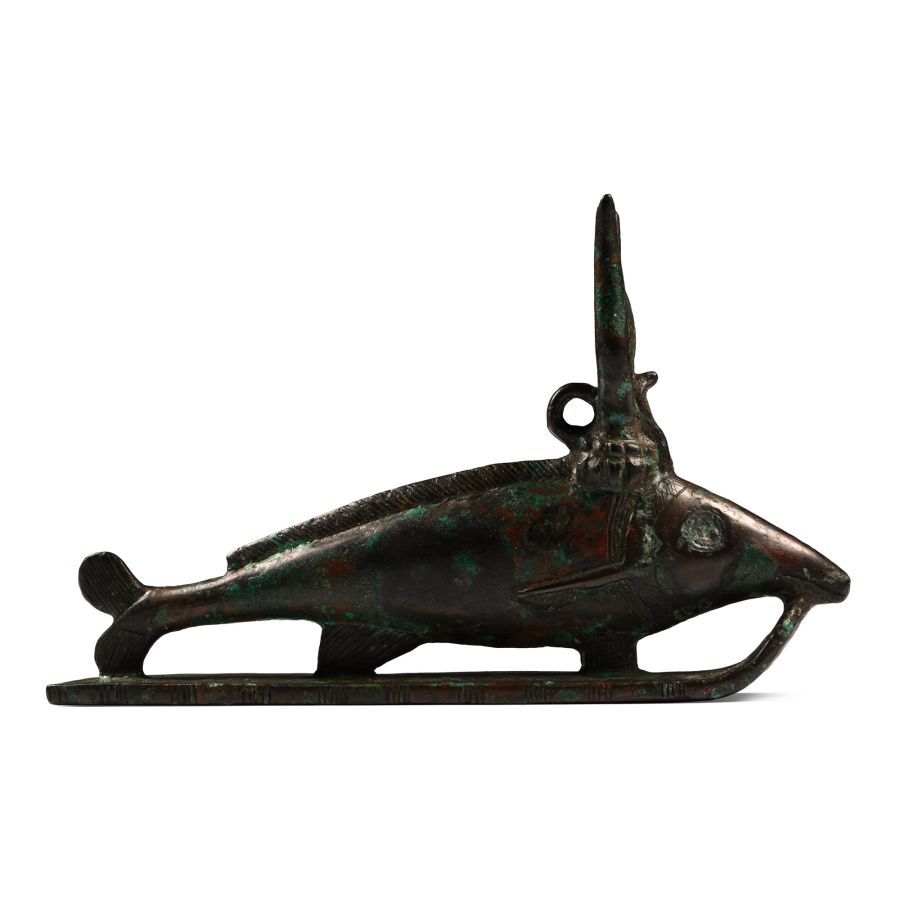
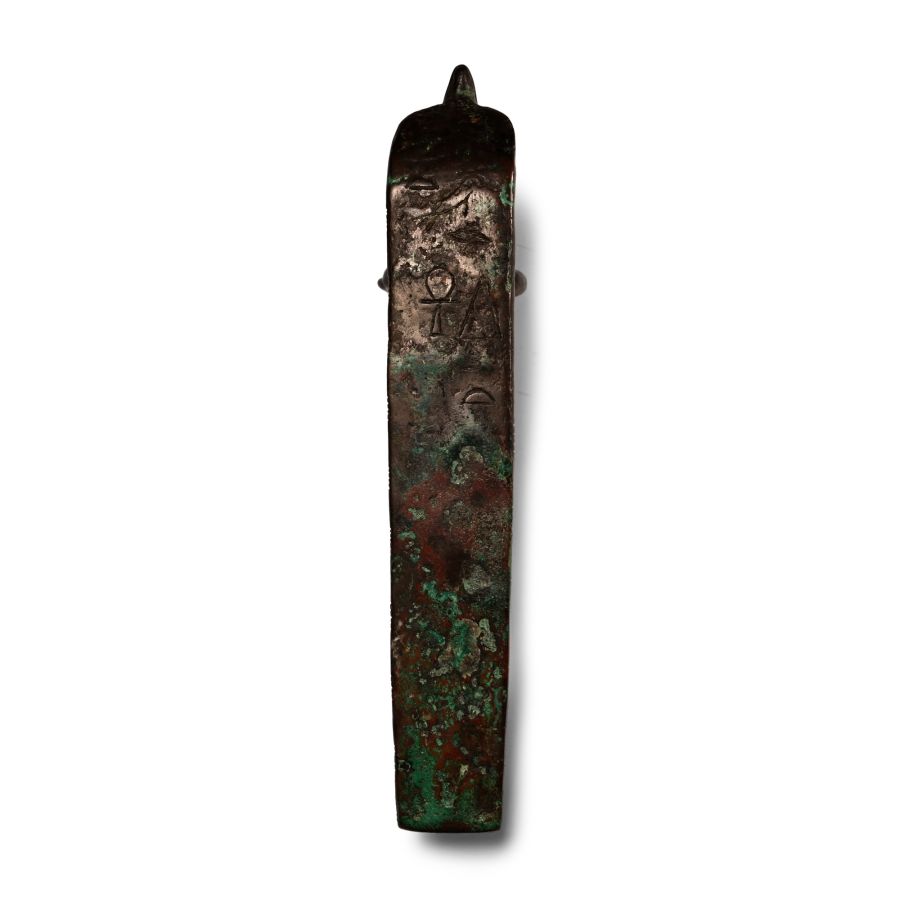
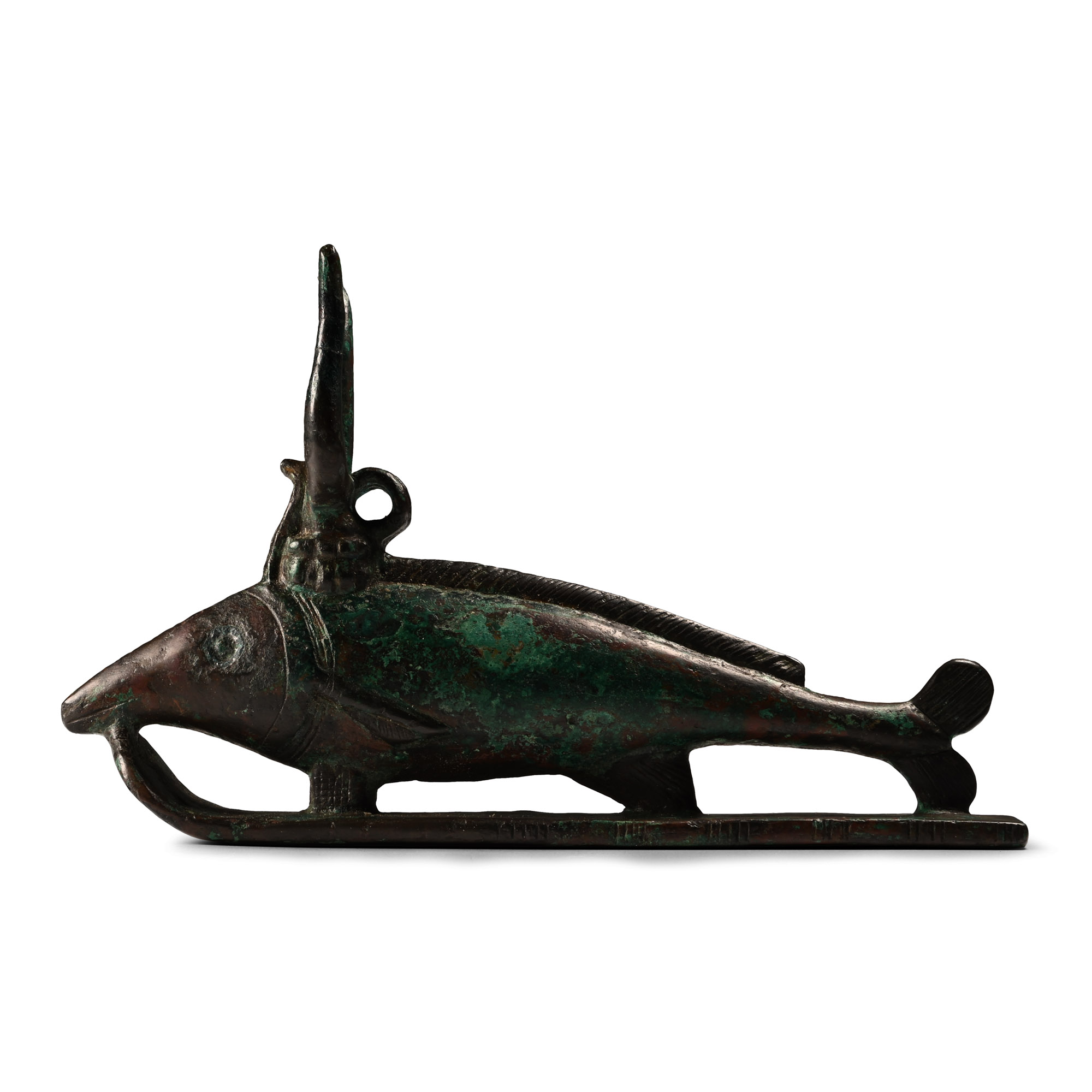
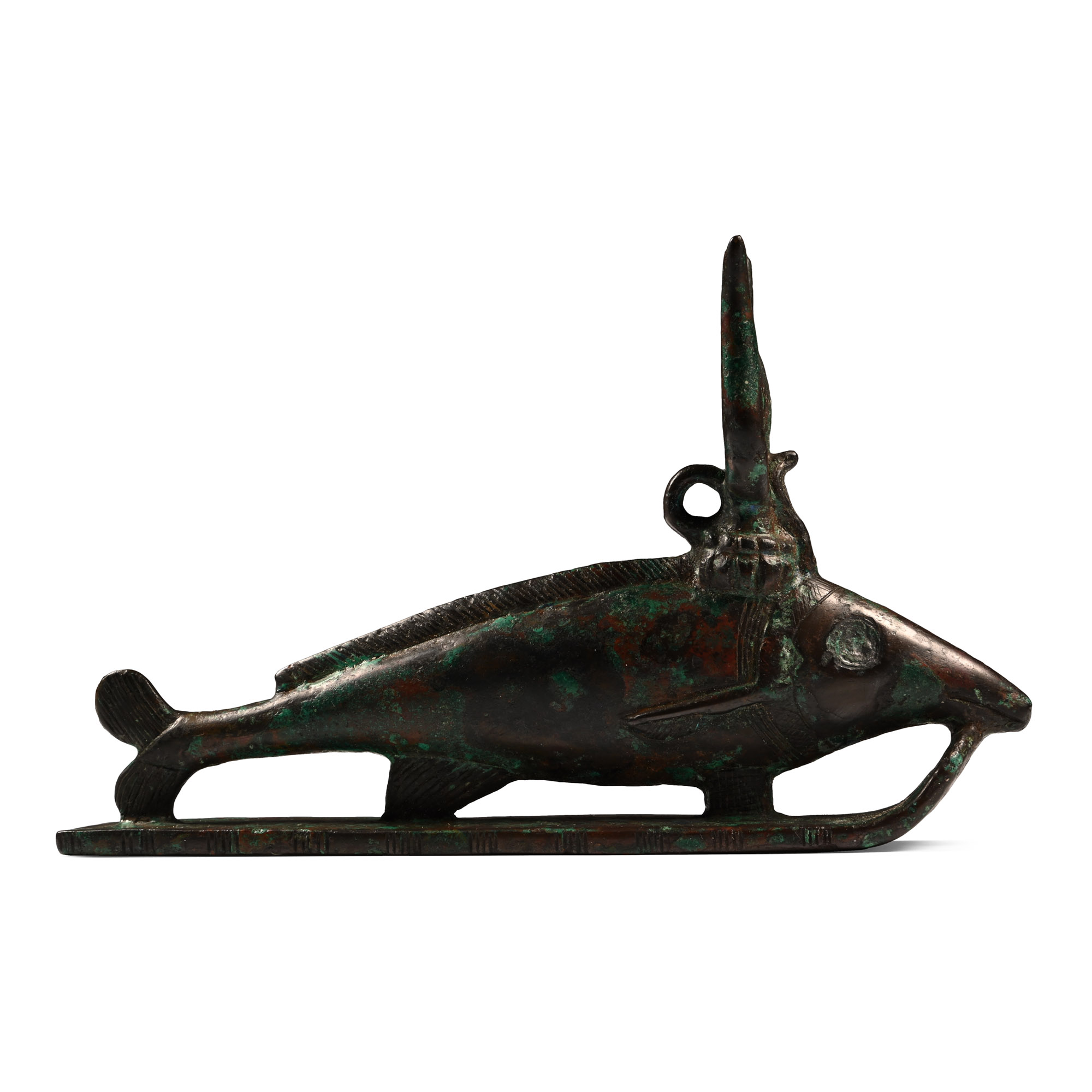
Large Egyptian Bronze Oxyrhynchus Fish of Per-Medjed with Hieroglyphic Inscription
LATE-PTOLEMAIC PERIOD, 664-30 B.C.
6 3/4 in. (585 grams, 17 cm).
Modelled in the round on a sledge attached by ventral and pectoral fins, a forked tail, a dorsal ridge, and a tapering nose, featuring recessed circular eyes filled with enamel, a horned sun disc headdress fronted by a uraeus, and a suspension loop behind; a few hieroglyphs of a dedication remain visible on the underside of the sledge, which may be interpreted as ‘….the great give life (to)…’ (…t wr rdi͗ Ꜥnḫ t….); presumably, 'the great' followed the name of a deity, now lost.
ProvenanceAcquired from Gallery Reiner, Paris, France, 1981.
Private collection, Europe.
Accompanied by a copy of French passport no.150583 dated 29 November 2013.
This lot has been checked against the Interpol Database of stolen works of art and is accompanied by a search certificate number no.12375-226676.
This lot has been cleared against the Art Loss Register database, and is accompanied by an illustrated lot declaration signed by the Head of the Antiquities Department, Dr Raffaele D'Amato.
Cf. Kozloff, A.P., Animals in Ancient Art from the Leo Mildenberg Collection, Mainz am Rhein, 1981, fig. 60, for a similar example; Tiribilli, E., The bronze figurines of the Petrie Museum from 2000 BC to AD 400, London, 2018, p.229, for discussion.
FootnotesThe Medjed, a type of elephant-snout fish (Mormyrus kannume), was revered in ancient Egyptian religion, particularly in Per-Medjed, better known by its Greek name, Oxyrhynchus Polis. This version of the name, meaning "city of the sharp-nosed," reflects the fish's distinctive appearance as depicted in Egyptian art. These fish were believed to have consumed the penis of Osiris, the god who was dismembered and scattered by his brother Seth. As sacred creatures, figurines of the Medjed were often adorned with a horned sun-disc headdress worn by the goddesses Hathor and Isis, suggesting a close association with both. Some figurines, like this example, featured suspension loops, allowing them to be worn as pendant amulets.
CONDITIONTimeLine Auctions follows a vetting process to ensure the authenticity and legality of all items, reinforcing our commitment to integrity and responsible trading. Each antiquity, antique, and coin lot undergoes thorough examination by a vetting committee of at least ten external specialists, professional trade association members, scientists, and archaeologists: Our Vetting Process
AUCTIONS:
TimeLine is a leading auction house specialising in antiquities, ancient art, collectables, natural history, coins, medals, and books. Our auctions offer museums, collectors, historians, and enthusiasts the opportunity to acquire unique and historically significant pieces.
LOT 0028
Large Egyptian Bronze Oxyrhynchus Fish of Per-Medjed with Hieroglyphic Inscription
Estimate £5,000 - 7,000€5,800 - 8,120 (for guidance only)$6,750 - 9,450 (for guidance only)
-
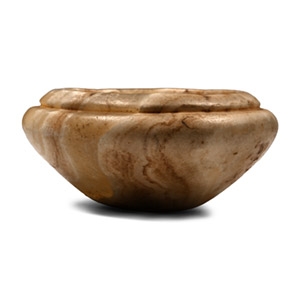
Egyptian Alabaster Bowl
1st Dynasty, circa 3000 B.C.Sold for (Inc. bp): £1,300
Of conical profile with flattened base, carinated shoulder and stepped rounded rim, possibly for accepting a lid. 380 grams, 11.6 cm wide
Property from an American deceased estate, acquired between 1970-1989. with Bonhams, London, 28 October 2009, no.16 (Part). Private European collection. Accompanied by copies of the relevant Bonhams catalogue pages. This lot has been checked against the Interpol Database of stolen works of art and is accompanied by a search certificate number no.12071-215259. This lot is accompanied by an illustrated lot declaration signed by the Head of the Antiquities Department, Dr Raffaele D'Amato. -
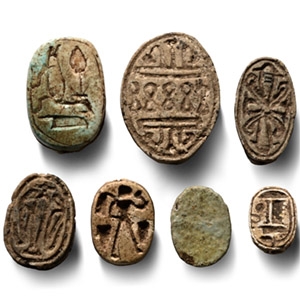
Egyptian Mixed Scarab and Scaraboid Collection
2nd-1st millennium B.C.Estimate: £500 - 700 (+bp*)
Opening Bid: £250
Comprising (from left to right, top to bottom): 1) a scarab with an oval border containing a goose, nefer(?), and a reed leaf; 2) a scarab with an oval border featuring a triple lotus flower motif at the top and bottom, with a middle row of floral bundles; 3) a scaraboid with a long oval border containing a cross pattern incorporating scrolls, coiled cords, and floral elements; 4) a scarab with an oval border featuring a hes-jar flanked by two cobras; 5) a scarab with a standing male figure holding a sceptre/mace and a flail, flanked by two highly stylised rearing cobras; 6) a plain scarab; 7) and a scarab with an oval border containing the name Amun-Re, a neb symbol, and a lotus flower. 13 grams total, 11-23 mm
From the collection of a gentleman, acquired on the London art market in the 1990s. This lot is accompanied by an illustrated lot declaration signed by the Head of the Antiquities Department, Dr Raffaele D'Amato. -
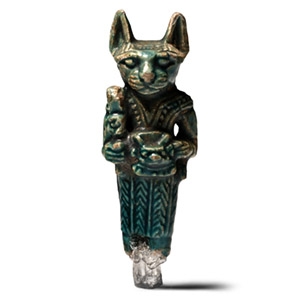
Egyptian Glazed Steatite Amulet of Bastet
Late Period, circa 664-332 B.C.Sold for (Inc. bp): £1,820
Modelled in advancing pose wearing a tight-fitting robe, cat-headed, with a sistrum in one hand and a Bes head emblem in the other; suspension loop between shoulders. 3.75 grams, 38 mm
François de Ricqlès, Paris, Archéologie, 30 September-1 October 1996, no.332. Private collection, London, UK, acquired from the above sale. Accompanied by a copy of a French cultural passport, dated 2 October 1996. This lot is accompanied by an illustrated lot declaration signed by the Head of the Antiquities Department, Dr Raffaele D'Amato.
Bastet is typically depicted with the head of a lioness or domestic cat. The cat symbolises protection, motherhood, and, later, gentleness and domesticity, qualities associated with Bastet, especially in her later evolution from a fierce lioness to a more benevolent feline goddess. The sistrum she holds is a ritual musical instrument associated with Hathor and other birth goddesses and is linked to joy, music, and divine protection. Bastet was often invoked during music and dance ceremonies, and the sistrum reinforces her role in celebration and protection. Bes was a dwarf god known for guarding households, particularly mothers and children. His image on Bastet’s amulet emphasises her protective role, especially at home and during childbirth.
