
Loading, please wait...
LOT 0486
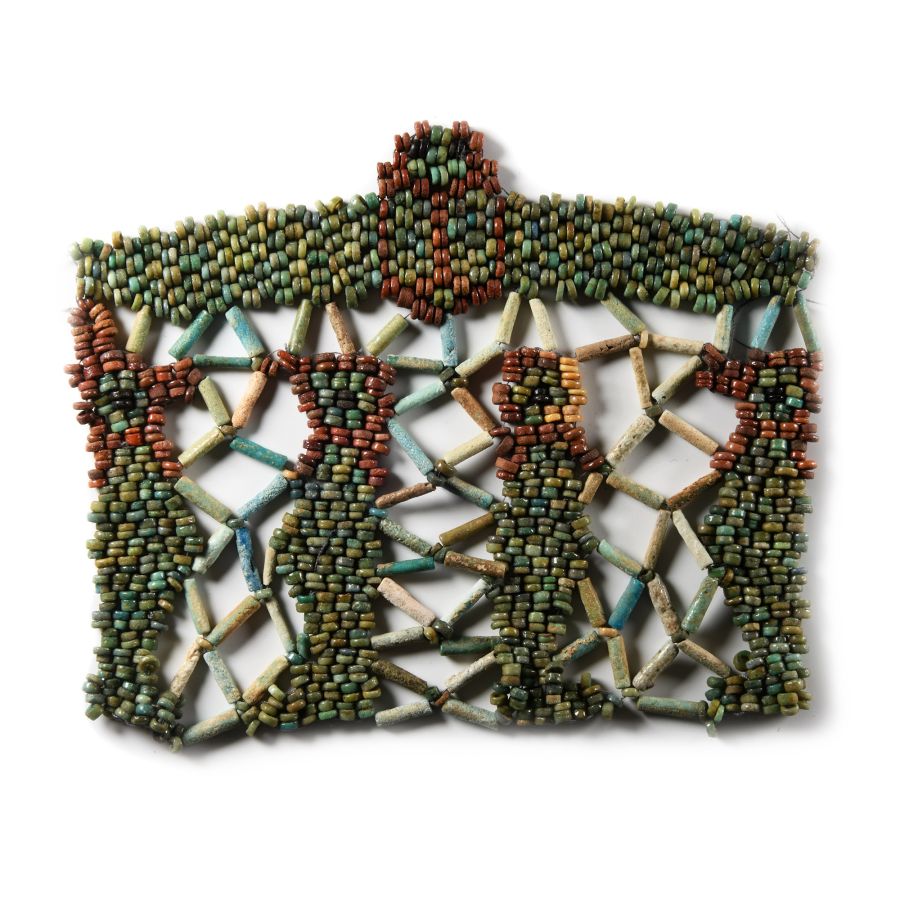
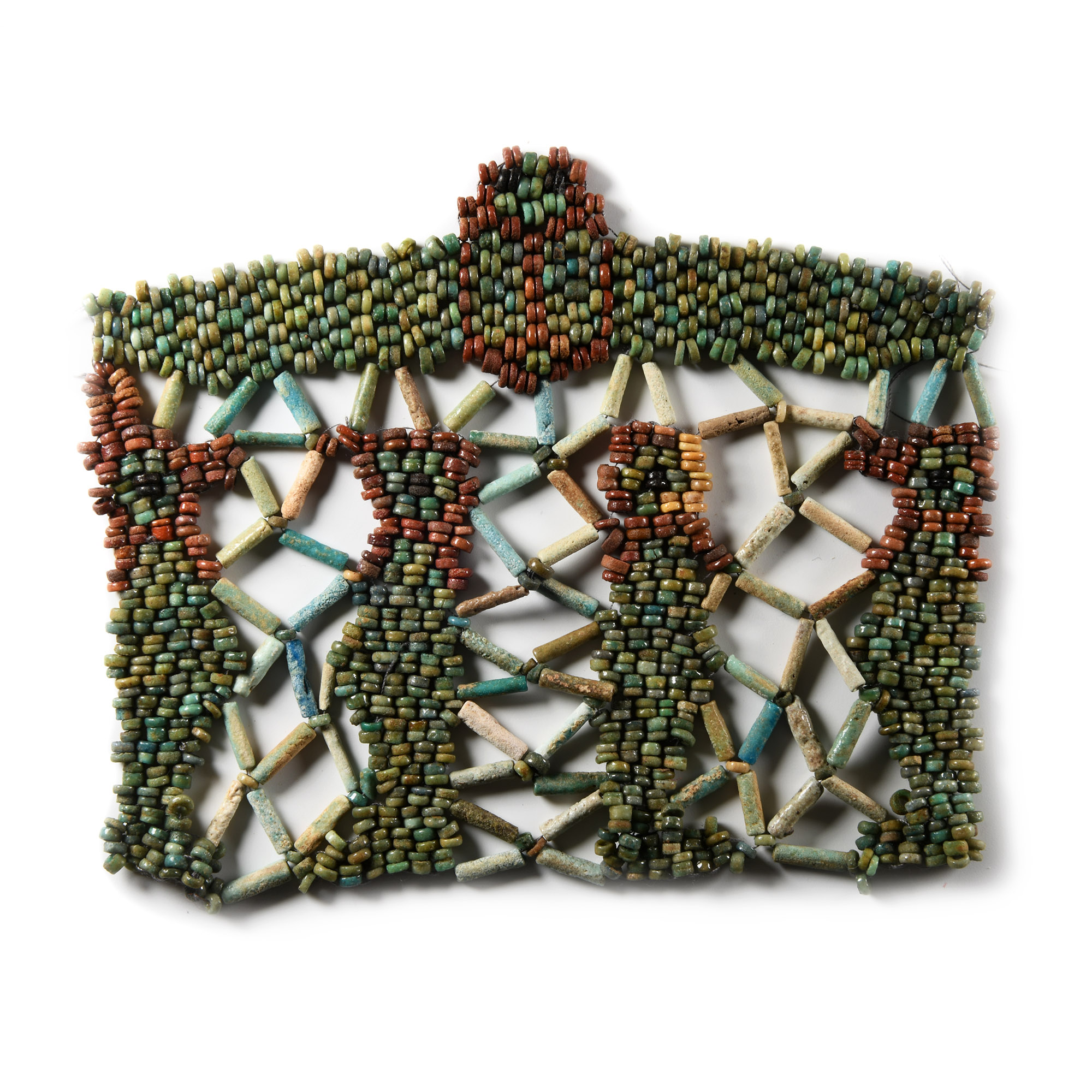
Large Egyptian Bead Panel with Four Sons of Horus and Winged Scarab
PTOLEMAIC PERIOD, 332-30 B.C.
5 1/2 in. (33 grams, 14 cm).
Restrung as an openwork panel with a winged scarab above and the Four Sons of Horus below as two opposing pairs; restrung with some later beads.
ProvenanceEx Mariaud de Serres, Paris, France, 1980-1990s.
From a London, UK, collection.
Cf. Manley, B., and Dodson, A., Life Everlasting. National Museum of Scotland Collection of Ancient Egyptian Coffins, Edinburgh, 2010, p.114, no.43, for a bead-work shroud incorporating a winged scarab and Four Sons of Horus.
FootnotesThe Four Sons of Horus were deities responsible for protecting the internal organs of the deceased. The human-headed Imsety protected the liver, the baboon-headed Hapy protected the lungs, the jackal-headed Duamutef protected the stomach, and the falcon-headed Qebehsenuef protected the intestines.
CONDITIONTimeLine Auctions follows a vetting process to ensure the authenticity and legality of all items, reinforcing our commitment to integrity and responsible trading. Each antiquity, antique, and coin lot undergoes thorough examination by a vetting committee of at least ten external specialists, professional trade association members, scientists, and archaeologists: Our Vetting Process
AUCTIONS:
TimeLine is a leading auction house specialising in antiquities, ancient art, collectables, natural history, coins, medals, and books. Our auctions offer museums, collectors, historians, and enthusiasts the opportunity to acquire unique and historically significant pieces.
LOT 0486
Large Egyptian Bead Panel with Four Sons of Horus and Winged Scarab
Sold for (Inc. bp): £117
-
.jpg)
Egyptian Wooden Mummy Mask with Egyptian Blue Inlaid Eyebrows
Third Intermediate Period, 22nd-24th Dynasty, 944-716 B.C.Sold for (Inc. bp): £14,950
D-shaped in plan with finely carved facial detailing, slender nose and full lips, sockets to the eyes; eyebrows recessed to accept inserts still partly in situ; pierced to reverse for attachment. 972 grams, 20 cm
Old mounting to the reverse. From a private estate, Suffolk, UK. Acquired from a UK antiques fair. Property of Mr E.D., a UK professional. This lot has been checked against the Interpol Database of stolen works of art and is accompanied by a search certificate number no.12076-217420. -
.jpg)
Egyptian Amethyst Scarab in Gold Frame
Late Period, 664-332 B.C. and laterSold for (Inc. bp): £572
Carved with lightly incised carapace, chipped to the obverse; set in a 19th century gold frame. 12.45 grams, 52 mm
From an early 20th century collection. -
Egyptian Blue Glazed Hieroglyphic Shabti Fragment for Neith
26th Dynasty, 664-525 B.C.Estimate: £400 - 600 (+bp*)
Opening Bid: £200
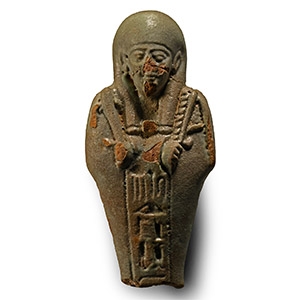
Pale grey-green composition fragment of the upper half of a mummiform shabti wearing a tripartite wig, holding a pick, hoe, and cord for a seed bag, which hangs over the left shoulder; a vertical band to the chest and lower body inscribed with hieroglyphic text giving the opening 'The illuminated one, the Osiris' and the name or title beginning with 'Neith'. 62 grams, 89 mm
Acquired on the German art market, 1989-1995. with The Museum Gallery, 19 Bury Place, London, WC1, UK, 1998-2003. Property of a London based academic, 2003-present.
