
Loading, please wait...
LOT 0508
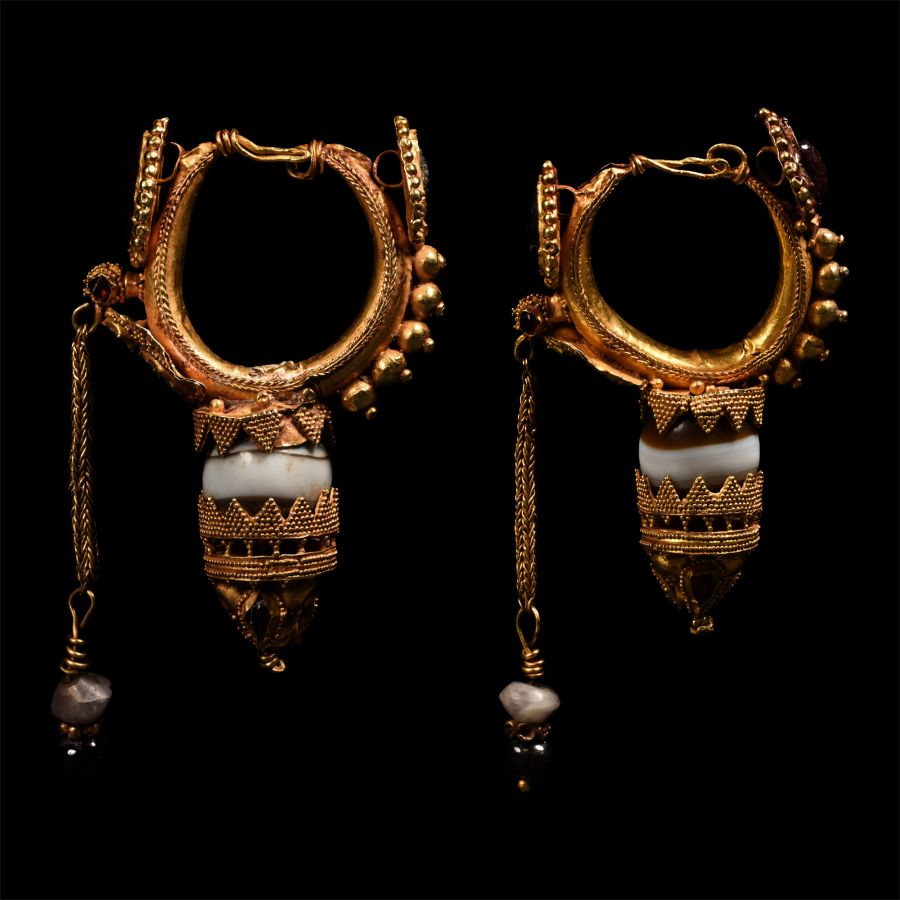
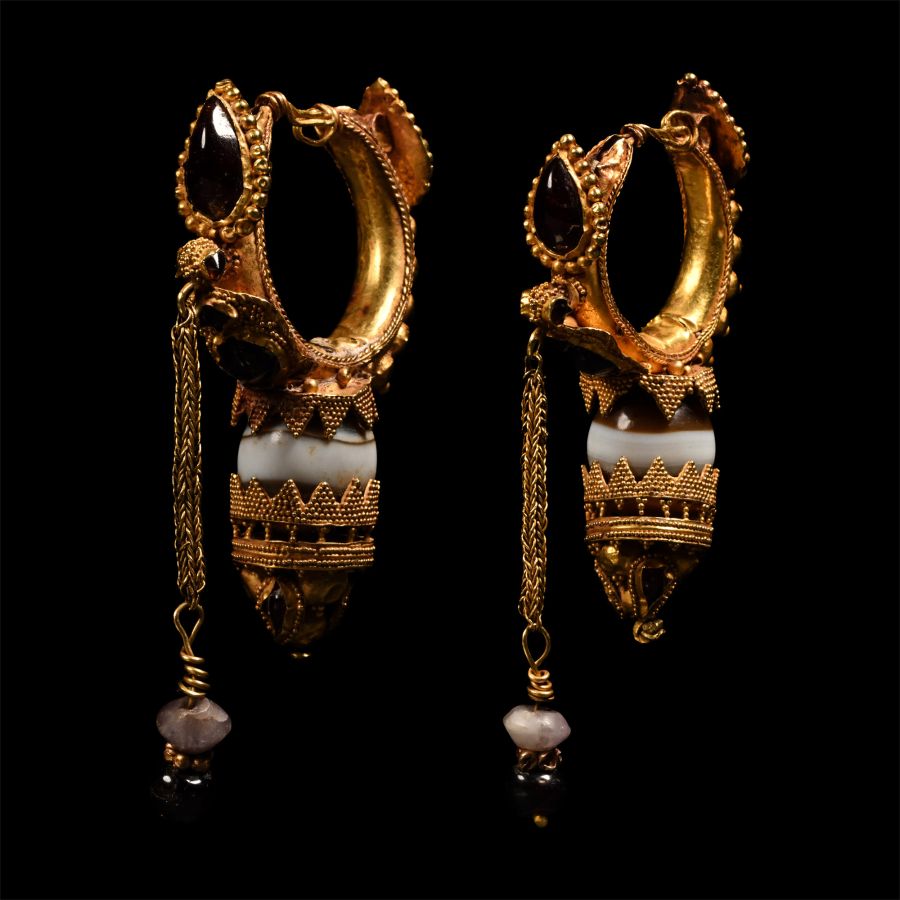
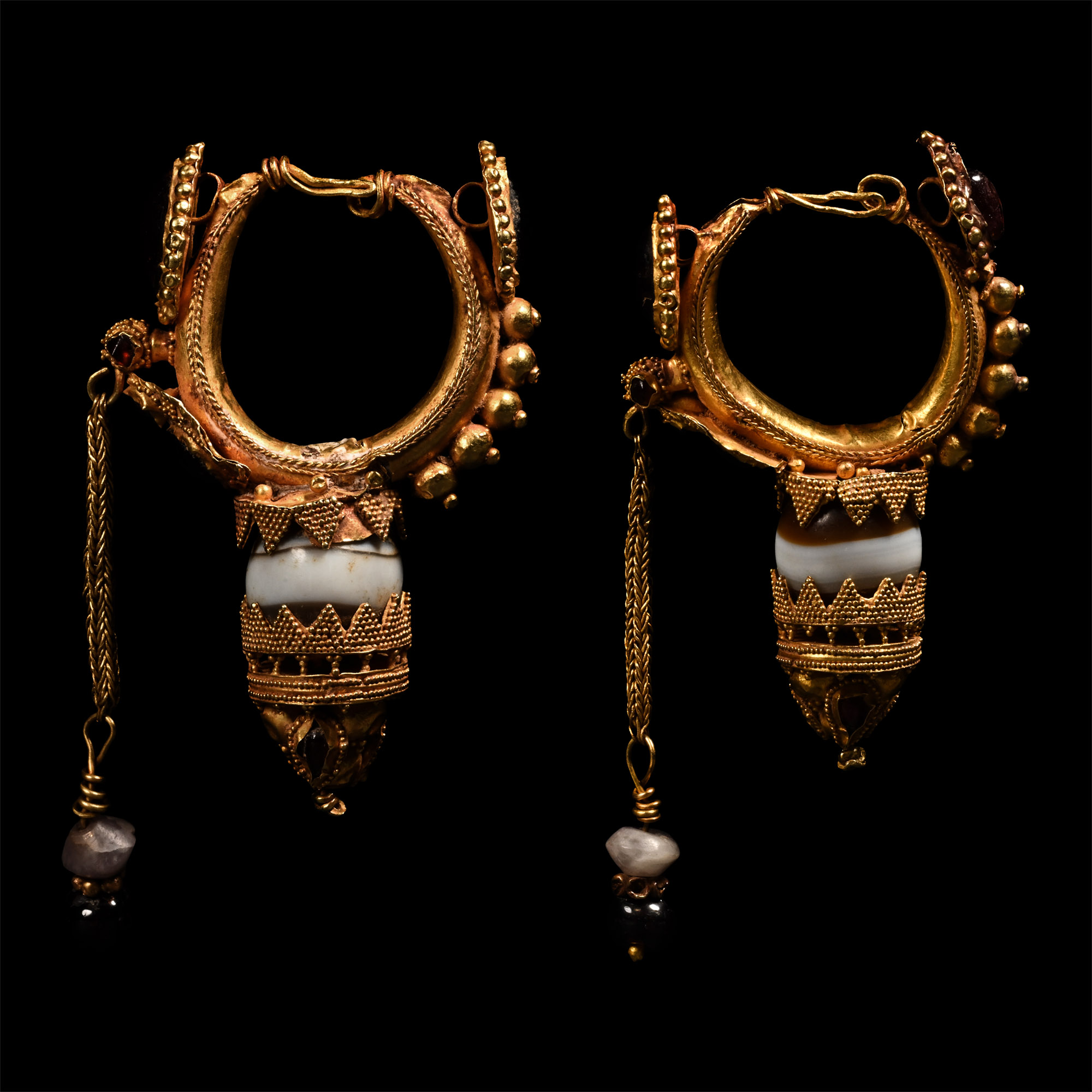
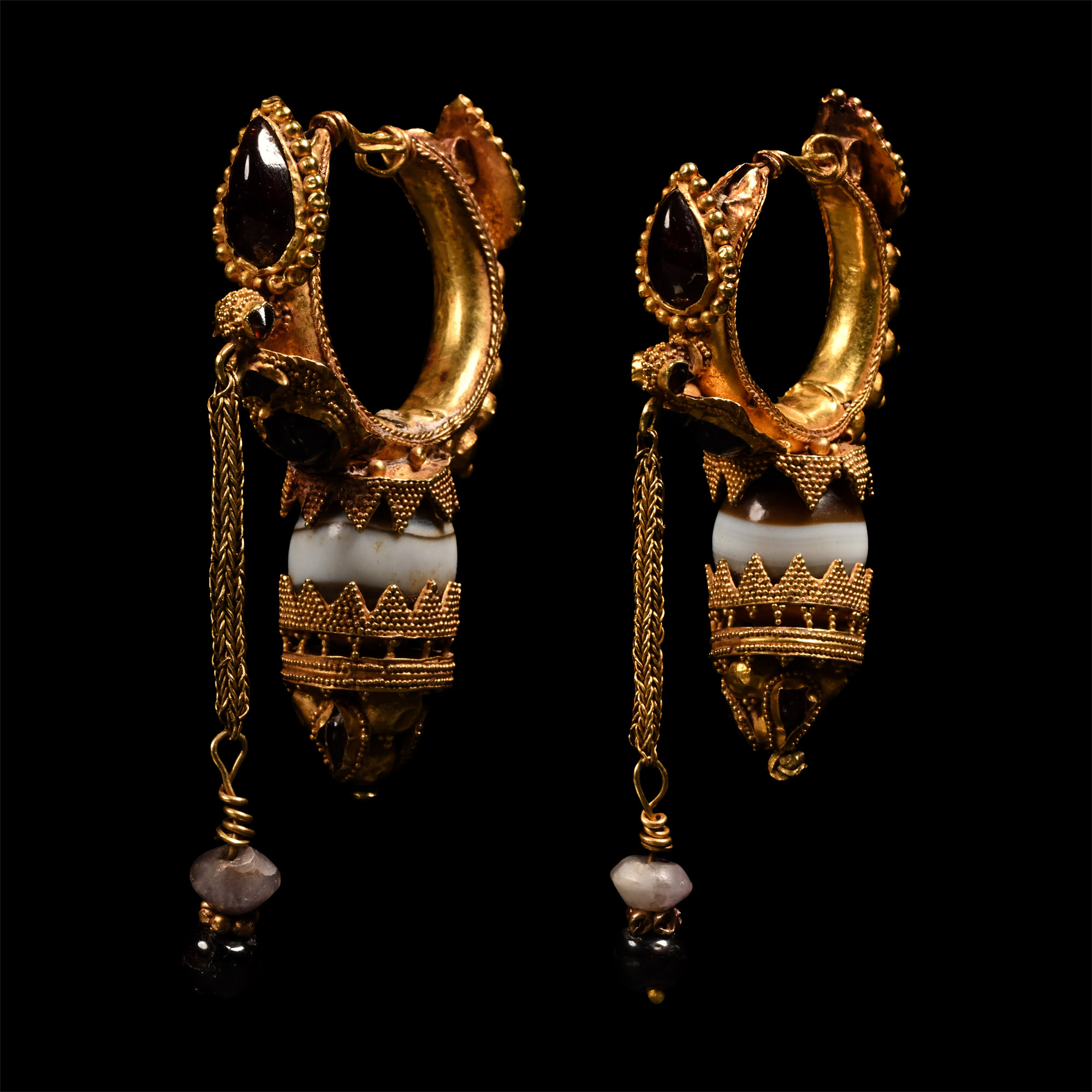
Large Eastern Hellenistic Gold Earring Pair with Garnets
3RD-1ST CENTURY B.C.
2 1/4 - 2 3/8 in. (34.2 grams total, 56-60 mm).
Each a hollow-formed crescent with applied filigree borders, band of hollow-formed knops to the outer edge and piriform panel at each end with granulated border and inset garnet cabochon; below, a banded agate sphere with framing dentilled granulated collars, cluster of hollow bulbs with flanking cabochon garnets. [2]
ProvenanceProperty of a London, UK, gentleman, pre-1990.
Ex London, UK, gallery.
Accompanied by an academic report by Dr Raffaele D'Amato.
This lot has been checked against the Interpol Database of stolen works of art and is accompanied by search certificate no.11185-186691.
This lot has been cleared against the Art Loss Register database, and is accompanied by an illustrated lot declaration signed by the Head of the Antiquities Department, Dr Raffaele D'Amato.
Cf. MET accession no. 95.15.203.204, for the type of composition and manufacture style, 2nd century B.C.; Ogden, J. and Williams, D., Greek Gold Jewelry of The Classical World, New York, 1994; Contestabile, H., ‘Hellenistic Jewelry & the Commoditization of Elite Greek Women’ in Berkeley Undergraduate Journal of Classics, 2(2), Berkeley, 2013, pp. 1-13, for discussion on the style; Quast, D., ‘Parthian and early Sassanian Earrings with garnet inlay’ in Le Archeologie di Marilli, miscellanea di studi in ricordo di Maria Maddalena Negro Ponzi Mancini, Alessandria, 2018, pp.123-128, figs.3,5, for other examples with garnet insert.
FootnotesThe boat-shaped central body is typical of old style Greek earrings connected with clusters of globe and is visible in the early Hellenistic jewellery from Taranto (Williams & Ogden, 1994, p.213), but the abundant use of filigree fits with examples from the Eastern Mediterranean area (Williams & Ogden, 1994, p.243).
CONDITIONTimeLine Auctions follows a vetting process to ensure the authenticity and legality of all items, reinforcing our commitment to integrity and responsible trading. Each antiquity, antique, and coin lot undergoes thorough examination by a vetting committee of at least ten external specialists, professional trade association members, scientists, and archaeologists: Our Vetting Process
AUCTIONS:
TimeLine is a leading auction house specialising in antiquities, ancient art, collectables, natural history, coins, medals, and books. Our auctions offer museums, collectors, historians, and enthusiasts the opportunity to acquire unique and historically significant pieces.
LOT 0508
Large Eastern Hellenistic Gold Earring Pair with Garnets
Estimate £4,000 - 6,000€4,640 - 6,960 (for guidance only)$5,400 - 8,100 (for guidance only)
-
.jpg)
Greek Gold Floral Diadem
2nd century B.C.Sold for (Inc. bp): £1,040
A triangular sheet-gold panel with repoussé flowers and tendrils; mounted on perspex backing. 45.56 grams total, 15 cm wide (18 cm wide including stand)
From the estate of Dr Jacob Hirsch. Acquired by Galerie Rhéa, Zurich, from the above in 1999. This lot is accompanied by an illustrated lot declaration signed by the Head of the Antiquities Department, Dr Raffaele D'Amato. -
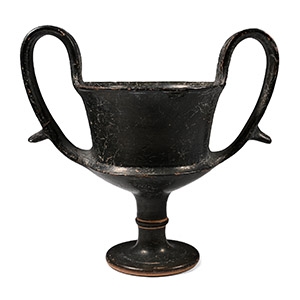
Boeotian Black-Glazed Terracotta Kantharos
Circa 5th century B.C.Estimate: £1,000 - 1,400 (‡+bp*)
Opening Bid: £500
The high-handled drinking cup with carinated lower body and a tall offset foot with a collar. 310 grams, 19 cm wide
Ex Galleria Serodine, Arte Antichità, Fritz Huchelmann-Tieche, Ascona 13 November 1987. Private collection, Bern, Switzerland. This lot is accompanied by an illustrated lot declaration signed by the Head of the Antiquities Department, Dr Raffaele D'Amato. -
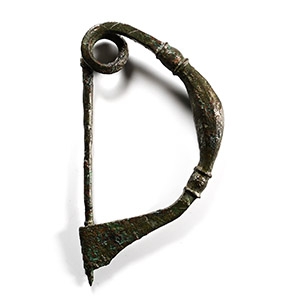
Large Greek Bronze Bow Brooch
6th-5th century B.C.Sold for (Inc. bp): £59
Comprising a tapering bow with median cluster of an elongated bulb with collar either side, one arm extending to a single-loop spring and pin, the other widening to a flat catchplate. 47 grams, 96 mm
Acquired on the UK art market before 2000. Property of an Essex, UK, gentleman. This lot is accompanied by an illustrated lot declaration signed by the Head of the Antiquities Department, Dr Raffaele D'Amato.
