
Loading, please wait...
_900x900.jpg "Large Ceramic Vase with Representation of the Months")
_200x200.jpg "Large Ceramic Vase with Representation of the Months")
.jpg "Large Ceramic Vase with Representation of the Months")
LOT 2162
Large Ceramic Vase with Representation of the Months
20TH CENTURY A.D.
21 1/4 in. (4.2 kg, 54 cm high).
With flared mouth and bulbous body, low-relief frieze of workers and labourers undertaking appropriate agricultural tasks, horizontal bands with the corresponding names of the months. [No Reserve]
ProvenanceAcquired London, UK.
Property of a Harwich gentleman.
TimeLine Auctions follows a vetting process to ensure the authenticity and legality of all items, reinforcing our commitment to integrity and responsible trading. Each antiquity, antique, and coin lot undergoes thorough examination by a vetting committee of at least ten external specialists, professional trade association members, scientists, and archaeologists: Our Vetting Process
AUCTIONS:
TimeLine is a leading auction house specialising in antiquities, ancient art, collectables, natural history, coins, medals, and books. Our auctions offer museums, collectors, historians, and enthusiasts the opportunity to acquire unique and historically significant pieces.
-
.jpg)
Tudor Period Bronze Signet Ring with Flower
Circa 16th century A.D.Sold for (Inc. bp): £78
With D-section hoop, keeled shoulders supporting an ellipsoid bezel with a flower motif. 5.79 grams, 23.77 mm overall, 20.54 mm internal diameter (approximate size British V, USA 10 1/2, Europe 23.77, Japan 22)
Private collection formed since the 1940s. UK art market. Property of an Essex gentleman. -
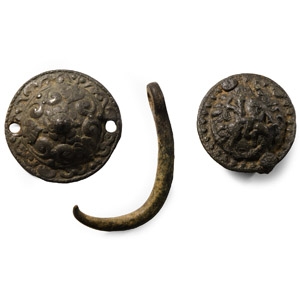
Tudor Bronze Mount Collection
16th century A.D.Sold for (Inc. bp): £13
Comprising a disc mount with domed centre and high-relief scrolled foliage, and a substantial pin with ring finial. 171 grams total, 54-80 mm
Found on various UK sites since 1974. Property of an Essex collector. -
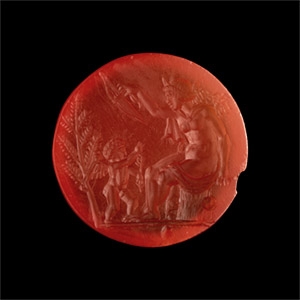
Carnelian Gemstone with Venus Playing with Cupid
20th century A.D.Sold for (Inc. bp): £130
Discoid plaque with intaglio scene of Venus seated on a tree-stump holding a bow in its quiver above the head of Cupid playing at her feet; supplied with a museum-quality impression. 2.8 grams, 20 mm
with Bertolami, Auction 56, London, 11 March 2018, no.88. Private collection, England.
