
Loading, please wait...
LOT 2193
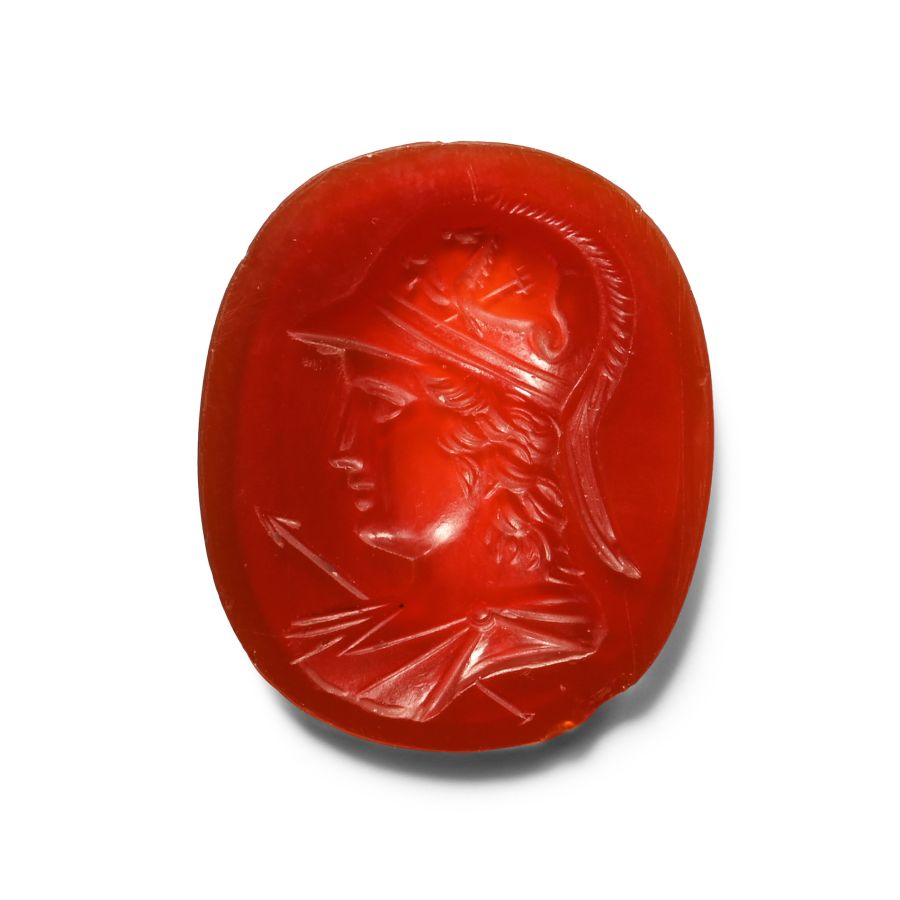
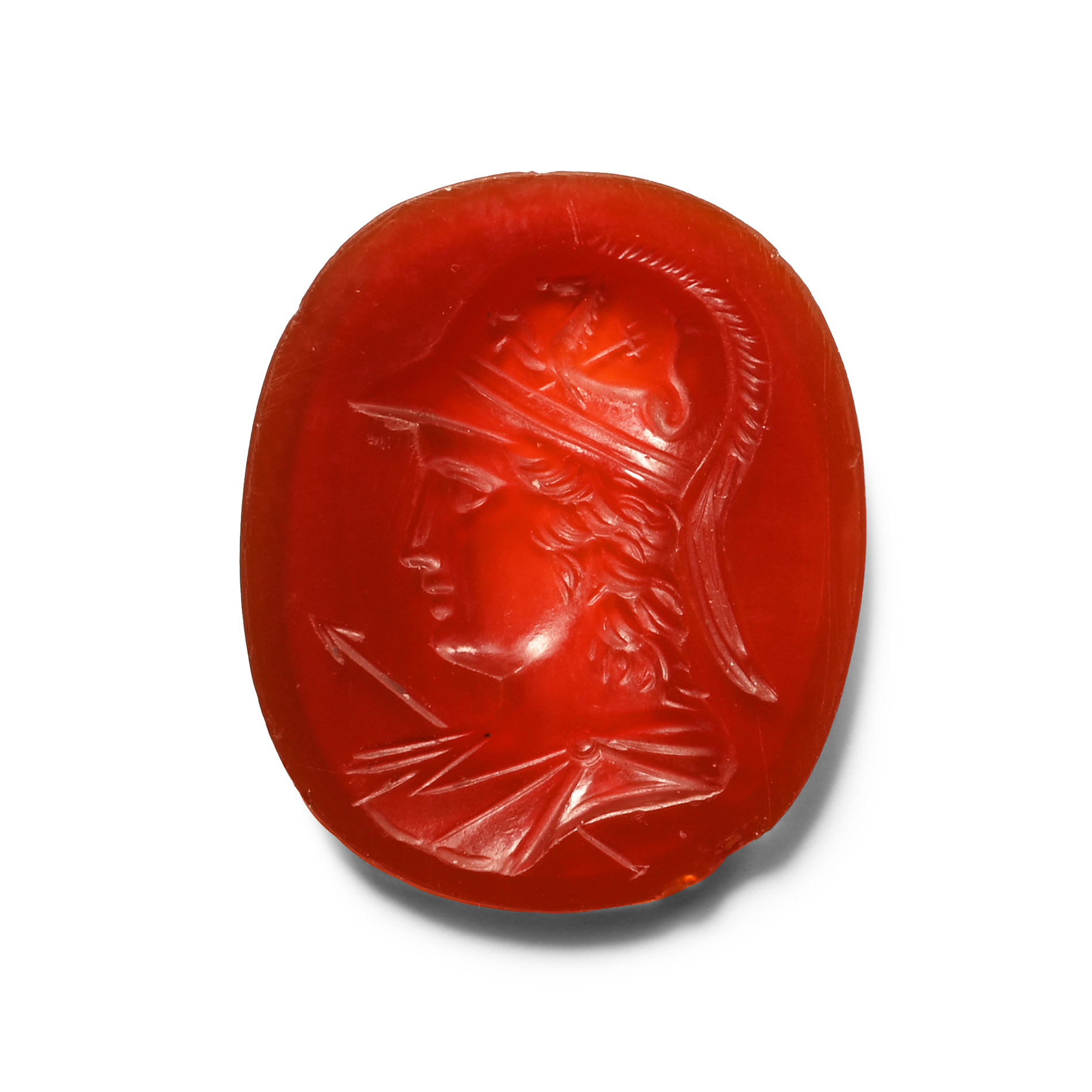
Large Carnelian Intaglio with Bust of Minerva
19TH CENTURY A.D.
1 1/8 in. (3.03 grams, 28 mm).
Ellipsoid plaque with chamfered edge; intaglio profile bust of Minerva in Corinthian-style helmet with hippocamp motif to the bowl; small arrow placed at her shoulder. [No Reserve]
ProvenanceUK private collection before 2000.
Acquired on the UK art market.
Property of a London gentleman.
TimeLine Auctions follows a vetting process to ensure the authenticity and legality of all items, reinforcing our commitment to integrity and responsible trading. Each antiquity, antique, and coin lot undergoes thorough examination by a vetting committee of at least ten external specialists, professional trade association members, scientists, and archaeologists: Our Vetting Process
AUCTIONS:
TimeLine is a leading auction house specialising in antiquities, ancient art, collectables, natural history, coins, medals, and books. Our auctions offer museums, collectors, historians, and enthusiasts the opportunity to acquire unique and historically significant pieces.
-

Tudor Period Tinned Bronze Betrothal Ring with Arrow
Circa 16th century A.D.Sold for (Inc. bp): £39
With octagonal plaque and chamfered edges, incuse design including an arrow and enigmatic pseudo-text. 12.11 grams, 23.32 mm overall, 19.10 mm internal diameter (approximate size British R 1/2, USA 8 3/4, Europe 19.38, Japan 18)
Private collection formed since the 1940s. UK art market. Property of an Essex gentleman. -

Post Medieval Brass Cup Weight Collection
16th-19th century A.D.Sold for (Inc. bp): £13
Including 'shallow' type with rings beneath, deep 'bucket' type and others. 641 grams total, 27-52 mm
Ex Simmons Gallery, 1990s. -

Post Medieval Iron Artefact Display
16th-18th century A.D.Sold for (Inc. bp): £20
Comprising: a medieval stone mason's chisel; two post medieval foot pattens (17th-18th century A.D.) for an adult and a child, composed of a ring with extended tongue fitted with iron rivets used to secure the ring to a wooden platform; a 16th-17th century two prong fork with handle replacement; mounted on a backing board. 563 grams total, 15-18.5 cm
From the collection of the famous author, writer and speaker, Gordon Bailey, Essex, UK; formed since 1968.
Iron pattens first came into use probably in 17th century A.D., and gained popularity by the first half of this century. The original design of the patten was that of one piece of shaped wood, but this evolved into to a wooden platform attached to the underside of an iron ring. The foot pattens were forerunners of the Wellington boot which came into use in 19th century A.D.
