
Loading, please wait...
_900x900.jpg "Large Byzantine Silver Archer's Ring")
_200x200.jpg "Large Byzantine Silver Archer's Ring")
.jpg "Large Byzantine Silver Archer's Ring")
LOT 1071
Large Byzantine Silver Archer's Ring
14TH-15TH CENTURY A.D.
1 3/8 in. (22.61 grams, 34.77 mm overall, 25.16 mm internal diameter).
Comprising a hoop with reserved triangular ornament on the edges and triangular plaque with foliage motifs, raised central panel with frond motif.
ProvenanceAcquired in the 1990s.
Ex Cambridgeshire, UK, collection.
Cf. Bikic, V., ‘Beyond the Jewellery: Archer’s Rings in the Medieval Balkans (14th-15th centuries)’ in Bosselmann-Ruickbie, A. (ed.), New Research on Late Byzantine Goldsmiths’ Works (13th-15th Centuries), Mainz, 2019, figs.5, 6, 7.
FootnotesArcher rings in Late Byzantium and the medieval Balkans were connected with the employment of the powerful composite bow, but very often, in the 14th century they served as insignia of rank for aristocratic noblemen. Archaeological findings of archers’ rings originate mainly from fortified towns, including mining centres. Many were made in bone, simple in design and undecorated. In contrast, the ones made in bronze and silver were usually decorated in rather uniform style, consisting of floral motifs on the head, mostly tulip and foliage, and linear motifs around the edges. This decoration combined Turkish, Central European and Eastern Roman traditional patterns.
CONDITIONTimeLine Auctions follows a vetting process to ensure the authenticity and legality of all items, reinforcing our commitment to integrity and responsible trading. Each antiquity, antique, and coin lot undergoes thorough examination by a vetting committee of at least ten external specialists, professional trade association members, scientists, and archaeologists: Our Vetting Process
AUCTIONS:
TimeLine is a leading auction house specialising in antiquities, ancient art, collectables, natural history, coins, medals, and books. Our auctions offer museums, collectors, historians, and enthusiasts the opportunity to acquire unique and historically significant pieces.
LOT 1071
Large Byzantine Silver Archer's Ring
Estimate £600 - 800€700 - 930 (for guidance only)$810 - 1,080 (for guidance only)
-
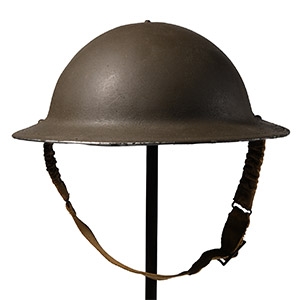
British WWII 'Tommy's' Helmet
1939-1945 A.D.Sold for (Inc. bp): £130
Standard issue steel helmet with leather liner and fabric chin-strap, finished green. 1.14 kg, 31 wide
The Kusmirek Collection, UK. -
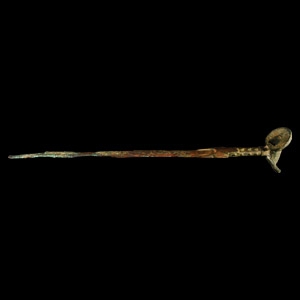
Luristan Bronze Sword with 'Ear' Pommel
10th-9th century B.C.Sold for (Inc. bp): £585
Comprising a long tapering blade, rectangular-section hilt with raised circular bosses, horned crescent-shaped guard curved to accept the blade and a large bifurcated pommel formed as two ear-lobes with ribbed joining shank. 1.17 kg, 66 cm
Acquired in the early-1990s. Ex Guernsey collection. The Kusmirek Collection, UK.
This kind of sword was entirely made of cast bronze. They were characterised by an 'ear' pommel and raised mid-rib on the blade, square shoulders and rectangular, open guard. The handle was cast on the blade. The square and solid sectioned handle has bossed with reinforcements which allow a better grip. -
.jpg)
Roman Bronze Armour Double Fastening Hook
1st century A.D.Sold for (Inc. bp): £176
Each a scrolled and angled bar tapering to a gently carinated zoomorphic terminal, formed as a serpent or other animal with stylised geometric detailing; attachment perforations to both terminals. 33 grams total, 70 mm each
Acquired on the London art market, 1980s-1990s.
In the 1st century B.C.-1st century A.D., the Celtic fastening system of the ring mail armour (gallica, lorica ferro aspera) became the standard in the Imperial Roman army, with a pivot attached to the breast and hinged to the edges of the humeralia (shoulder guards). The chest fastener had various different designs. The double hooks, S-shaped and usually with snake-head terminals, were secured by a central rivet on the chest. The system allowed excellent freedom of movement, giving greater protection to the shoulders and the arms. Similar fasteners for infantry mail have been found on the Kalkriese battlefield, some of them also decorated with niello and inscribed with the name of the soldier.
