
Loading, please wait...
LOT 0962
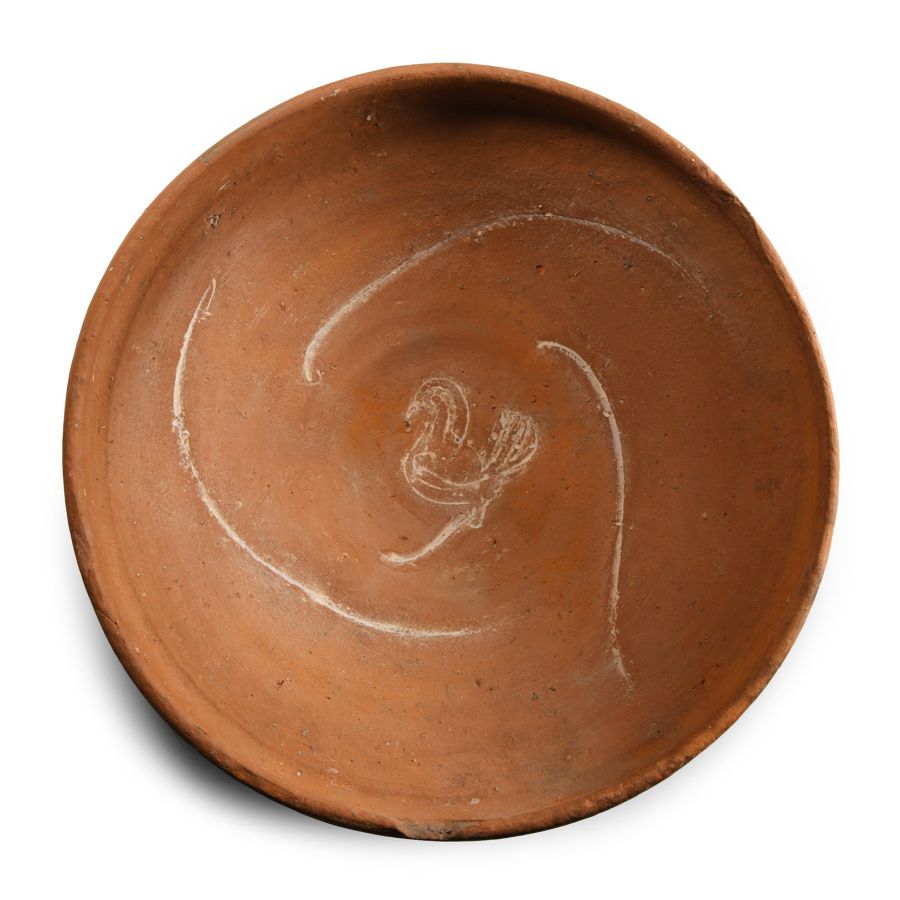
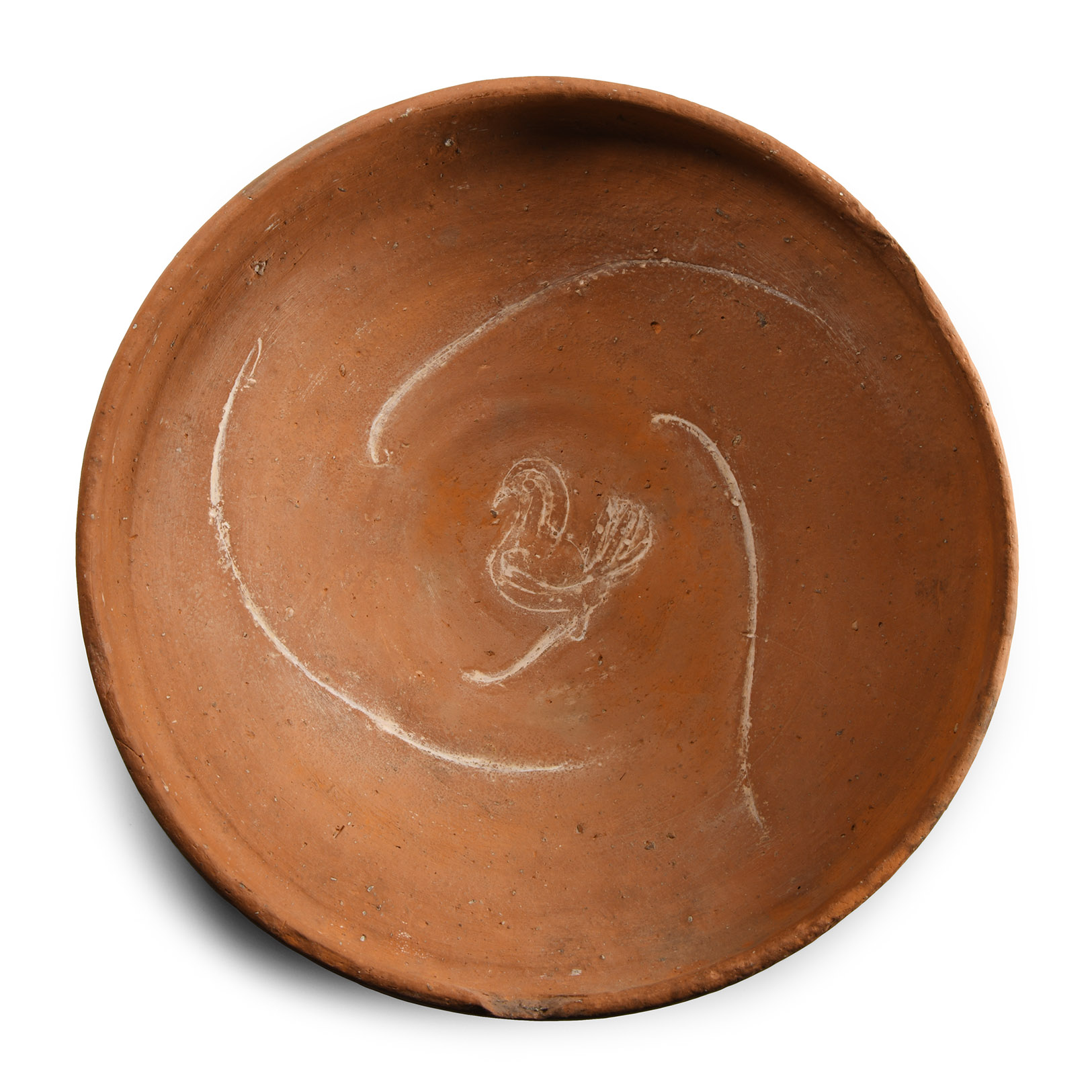
Large Byzantine Sgraffito Terracotta Bowl with Bird
CIRCA 8TH CENTURY A.D.
10 5/8 in. (1.2 kg, 27 cm wide).
With low basal ring and inverted rim; to the inner surface's centre a possibly later incised image of a standing bird amid three radiating curved lines. [No Reserve]
ProvenanceEx Atticart Ltd, London, SW5, UK.
Acquired from Proto Cultures Art, Manchester, UK, circa 2011.
From the private collection of Mr A Hills, Kent, UK.
Cf. similar design on an item in the Metropolitan Museum of Art, New York, under accession no.L.2000.77.2.
CONDITIONTimeLine Auctions follows a vetting process to ensure the authenticity and legality of all items, reinforcing our commitment to integrity and responsible trading. Each antiquity, antique, and coin lot undergoes thorough examination by a vetting committee of at least ten external specialists, professional trade association members, scientists, and archaeologists: Our Vetting Process
AUCTIONS:
TimeLine is a leading auction house specialising in antiquities, ancient art, collectables, natural history, coins, medals, and books. Our auctions offer museums, collectors, historians, and enthusiasts the opportunity to acquire unique and historically significant pieces.
-
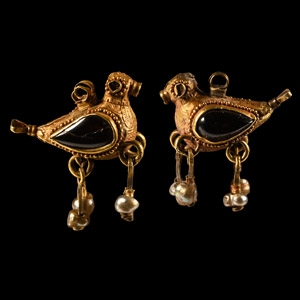
Byzantine Gold and Garnet Earring Pair
4th-5th century A.D.Sold for (Inc. bp): £2,600
Each formed as a dove with garnet set wings and eyes (one eye absent), beaded border framing the raised settings; triangular tail with garnet insert; body with incised feather detailing; four loops to the underside with pearl drops (one absent) and a double loop on the back. 12.8 grams total, 32 mm
Art market before 2000. Private collection, London, UK. This lot has been checked against the Interpol Database of stolen works of art and is accompanied by search certificate no.12104214176.
There are good points of comparison between the earring from the Piazza della Consolazione treasure in Rome and the Cluj (Pietroasa) with our earring to suggest that these should all be dated from the second quarter to the second half of the 5th century A.D. The earring set of Piazza della Consolazione treasure is decorated with radiating pearls on wires, in the fashion of the Cluj medallion and our earring. -
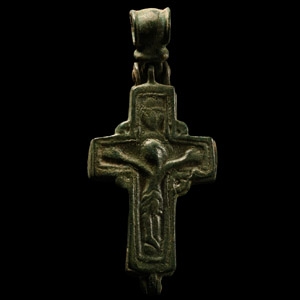
Byzantine Bronze Reliquary Cross Pendant
Circa 12th century A.D.Sold for (Inc. bp): £312
Two-piece enkolpion with hinged suspension loop, to each face a low-relief Corpus Christi with facing mask above. 29.7 grams, 62 mm
Acquired on the London art market in the late 1980s-1990s. From the family collection of an East London, UK, gentleman. -
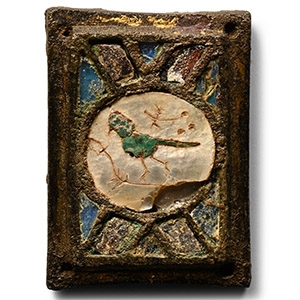
Byzantine Bronze Plaque with Bird Inlay
Circa 10th-11th century A.D.Estimate: £4,000 - 6,000 (‡+bp*)
Opening Bid: £1,111
Sub-rectangular in form with raised rectangular panel to centre, cells forming X-motif inlaid with red glass(?) against a blue field, central nacre(?) roundel engraved with a perched bird with polychrome enamelled detailing; trace remains of gilding to upper and side edges; piercing to each corner. 20.6 grams, 38 mm
Acquired in London, early 1980s. Purchased in Europe before 1992. Private collection, Europe. This lot has been checked against the Interpol Database of stolen works of art and is accompanied by search certificate number no.11811-206495.
The small square plaque was possibly part of the decoration of an Evangeliary, such as the enamels covering the binding of Henry II's Perikopenbuch, or the Siena Evangeliary (11th-13th century). Byzantium brought the enamel and cloisonné technique to its most perfect, refined and skilful expression. Between the 10th and 11th centuries it spreads its forms in the East and West and after some infiltration in the Romanesque-Lombard sphere, precious Eastern Roman cloisonnes were found in Russian art, reaching their apex in the Roman Empire during the 10th-12th centuries, in the decoration of icons and other artworks.
