
Loading, please wait...
LOT 1423
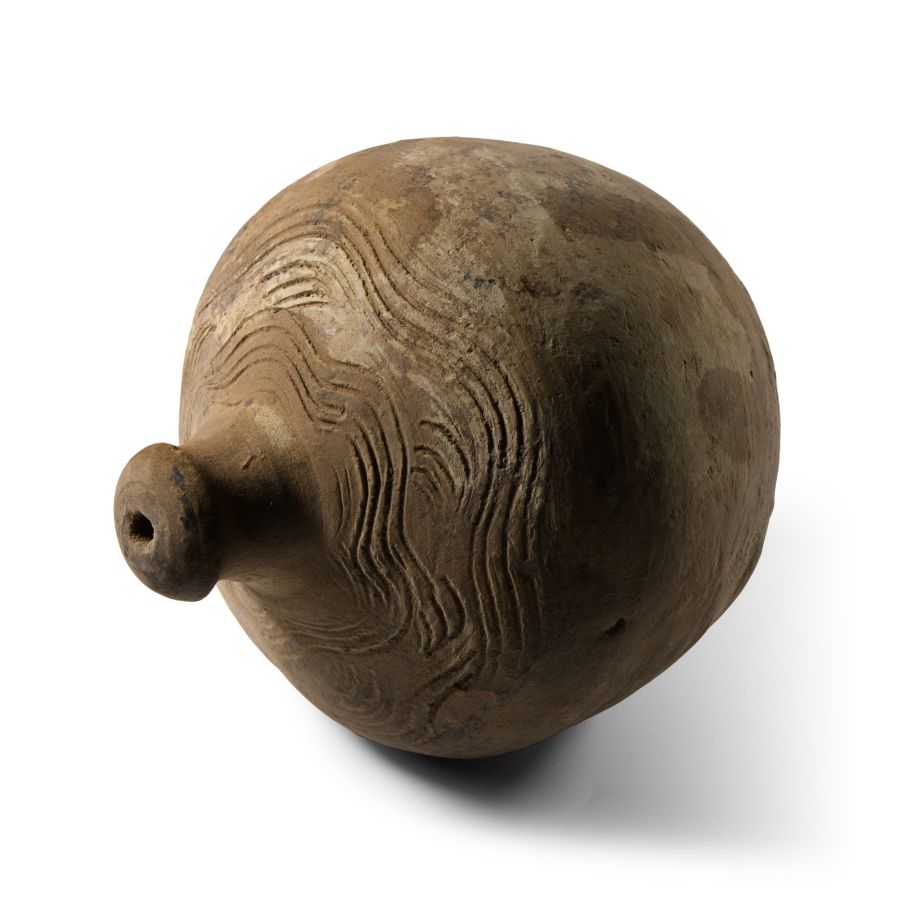
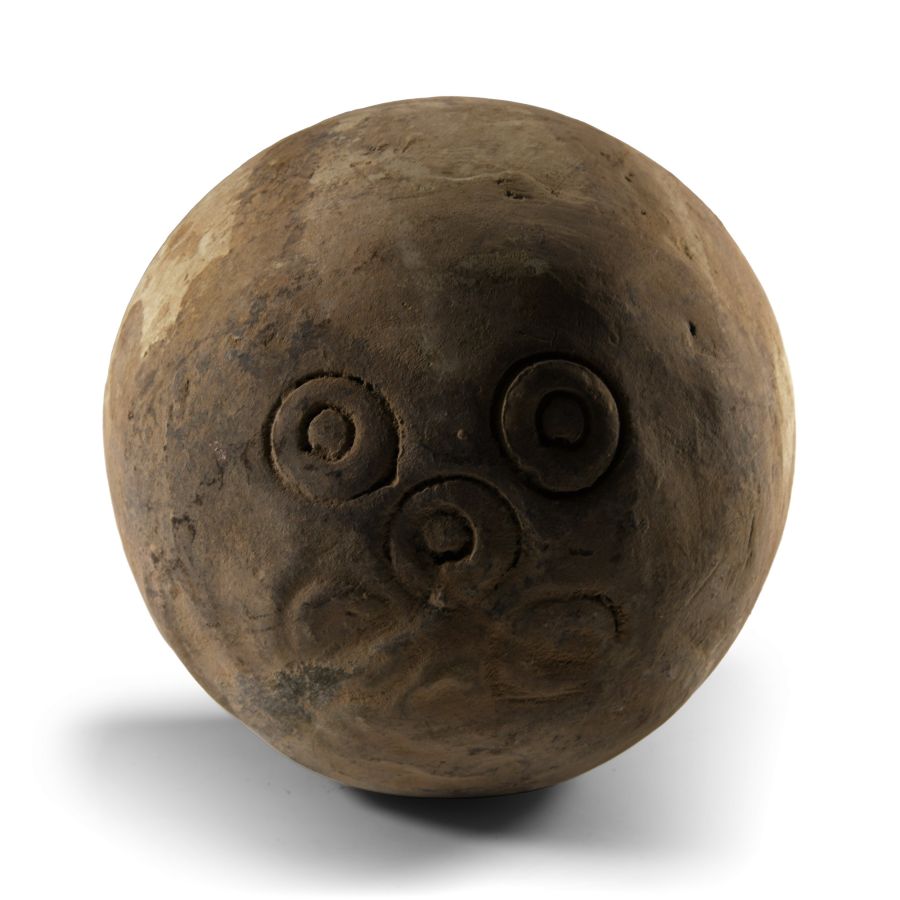
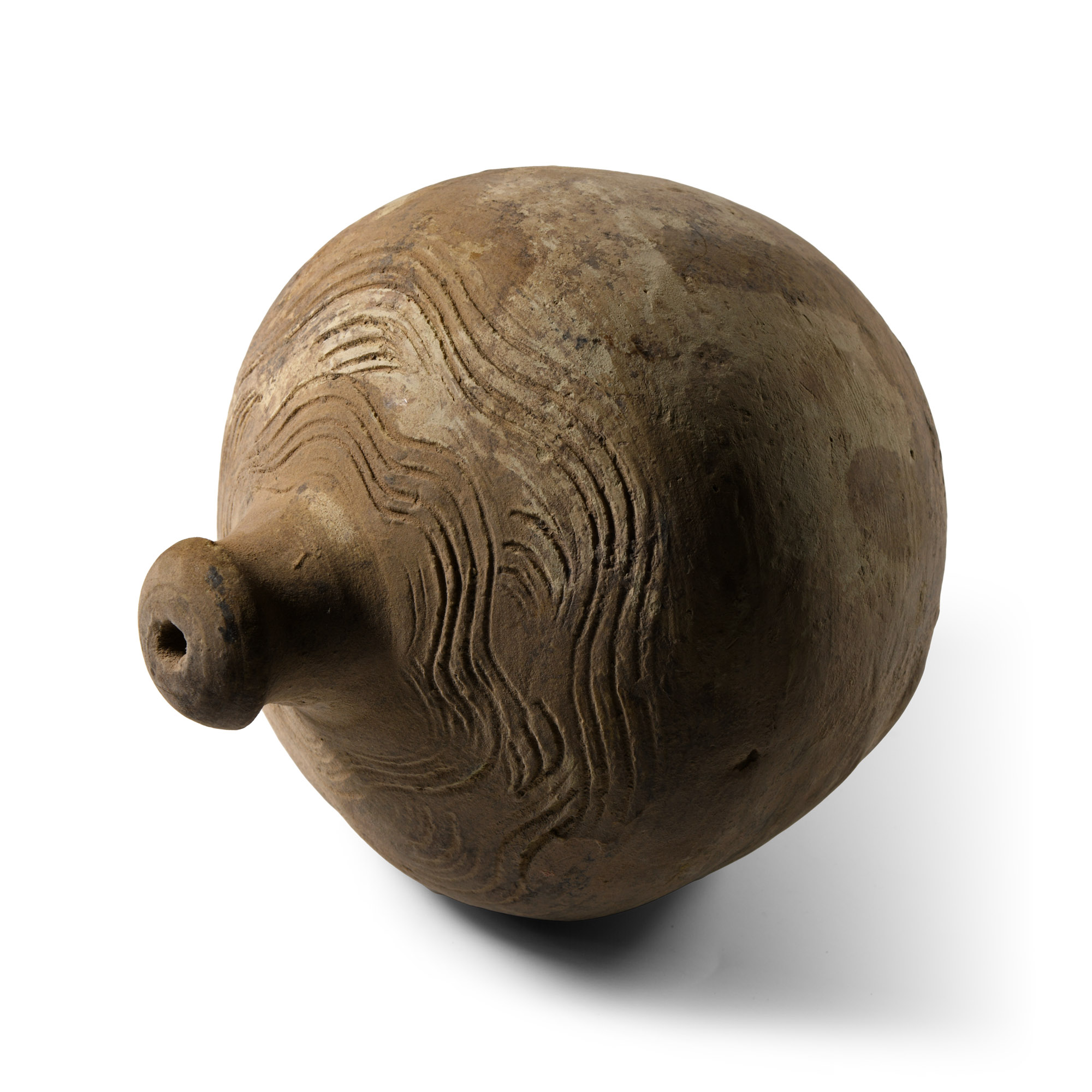
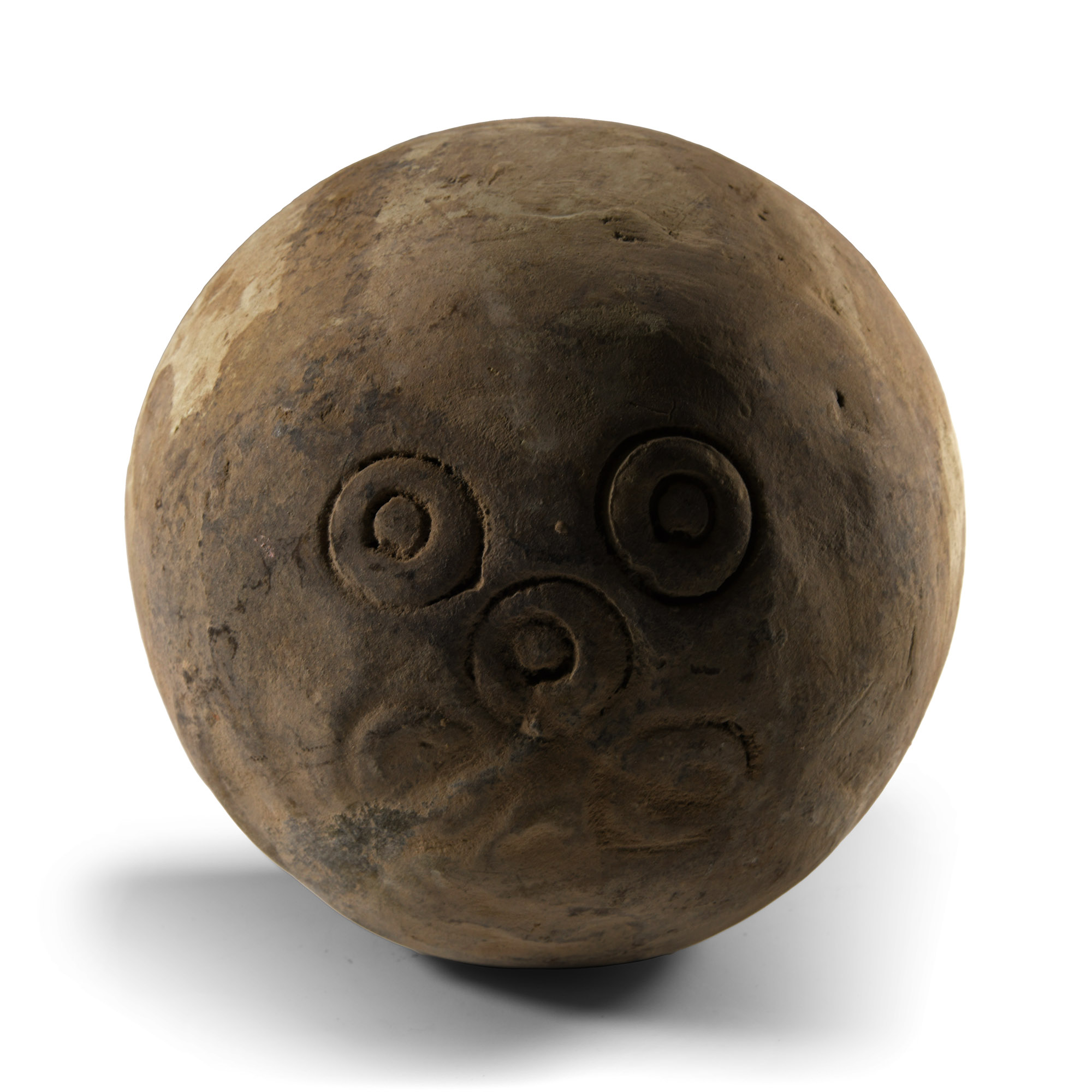
Large Byzantine 'Greek Fire' Ceramic Fire Bomb or Hand Grenade
9TH-11TH CENTURY A.D.
5 1/2 in. (947 grams, 14.1 cm).
A spherical ceramic missile with incised swirls to the shoulder, domed filler-hole, intended to be filled with explosive liquid and wick, used as a hand grenade. [No Reserve]
ProvenanceFrom a military inspired collection formed from the 1990s.
Accompanied by an academic paper by military specialist Dr Raffaele D'Amato, dated 15 July 2019 and titled 'Eastern Roman Empire - Greek Fire Bomb or Hand Grenade (μεσαίον kακάβιον) 9th-11th century AD'.
Cf. Arendt, W. I., Granaten des 13-14. Jahrhunderts, die an der Wolga gefunden sind, Zeitschrift fur Historische Waffen-und Kostumkunde, 11 (1926-8), p.42; cf. Arendt, W., Die Spharisch-konischen Gefäße aus Gebranntem Ton, ibid; cf. Ayalon, D., Gunpowder and Firearms in the Mamluk Kingdom, London, 1956, p.16.
FootnotesApart from the use of siphons or manual flame-throwers called cheirosiphona, special corps of Roman soldiers employed terracotta grenades, in the form of small jars, abundantly evidenced in archaeological excavations. They were called μεσαία kακαβιά or κυτροκακάβια where the former had a bulbous shape and the latter a more cylindrical form.
CONDITIONTimeLine Auctions follows a vetting process to ensure the authenticity and legality of all items, reinforcing our commitment to integrity and responsible trading. Each antiquity, antique, and coin lot undergoes thorough examination by a vetting committee of at least ten external specialists, professional trade association members, scientists, and archaeologists: Our Vetting Process
AUCTIONS:
TimeLine is a leading auction house specialising in antiquities, ancient art, collectables, natural history, coins, medals, and books. Our auctions offer museums, collectors, historians, and enthusiasts the opportunity to acquire unique and historically significant pieces.
LOT 1423
Large Byzantine 'Greek Fire' Ceramic Fire Bomb or Hand Grenade
Sold for (Inc. bp): £91
-
Luristan Bronze Arrowhead Collection
Circa 13th-9th century B.C.Sold for (Inc. bp): £312
Including triangular, leaf-shaped, barbed and other types. 446 grams total, 10-16.5 cm
Ex London, UK, collection, 1990s.
One series of arrowheads seem to belong to the category of lanceolate head and rounded shoulders from the category Type V, i.e. triangular arrowheads with rounded or angular midrib. Some other arrowheads seem to be a subcategory of subtype A of Khorasani but longer. -
Scythian Bronze Zoomorphic Openwork Horse Chamfron
4th century B.C.Sold for (Inc. bp): £8,450
The edges formed of opposed curving serpent heads, each pair flanking a central zoomorphic head, possibly representing a horse or a beast; the animals with incised detailing to their bodies and heads; a large horse(?) head to the lower edge with its muzzle forming the point of the chamfron; two loops to the reverse. 283 grams, 39.5 cm
From the Gorovits family collection, since at least the 1940s. Private collection, London. Accompanied by an academic report by Dr Raffaele D’Amato. This lot has been checked against the Interpol Database of stolen works of art and is accompanied by search certificate number no. 17178-221462.
Bronze open-worked frontlets like this one were found with horses in the Barrow-mound no.5 of the Ulyap burial-ground in the Kuban basin, and their secure dating to the 4th century B.C. was established by the Thasian amphoras found in the respective graves (nn. 14-15-21, see Leskov, 1990, figs.180,183). The incised decoration of the chamfron finds various parallels both on frontlets from Barrow-Mounds nos. 4/1913 and 4/1917 near Elizavetinskaya Kossack-Village, in Kuban Basin, and from Gyuenos in Abkhazia (Galanina, 2010, pl.7,12). The piece belongs to a rare type of chamfron, known only from finds in the Scythian and Meotian burials of 5th-4th centuries B.C. -
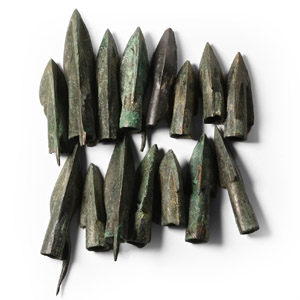
Greek Bronze Tri-Finned Arrowhead Collection
Circa 7th-3rd century B.C.Sold for (Inc. bp): £195
Comprising: seven arrowheads with a slender, lozenge-shaped blade and a socket extending near the tip, base of the socket with a side lug; eight socketted bronze arrowheads, mainly triangular or foliate in section, trilobate and with short socket. 77 grams total, 23-46 mm
UK private collection before 2000. Acquired on the UK art market. Property of a London gentleman.
The Scythians were famous for their archery abilities, and were often employed as mercenaries. The Athenian tyrant Pisistratus hired them and they participated in battles beside the Athenian phalanx as well as serving as a police corps keeping order within the city of Athens. This explains the great range of Scythian arrowheads found on the Greek sites.
