
Loading, please wait...
LOT 0223
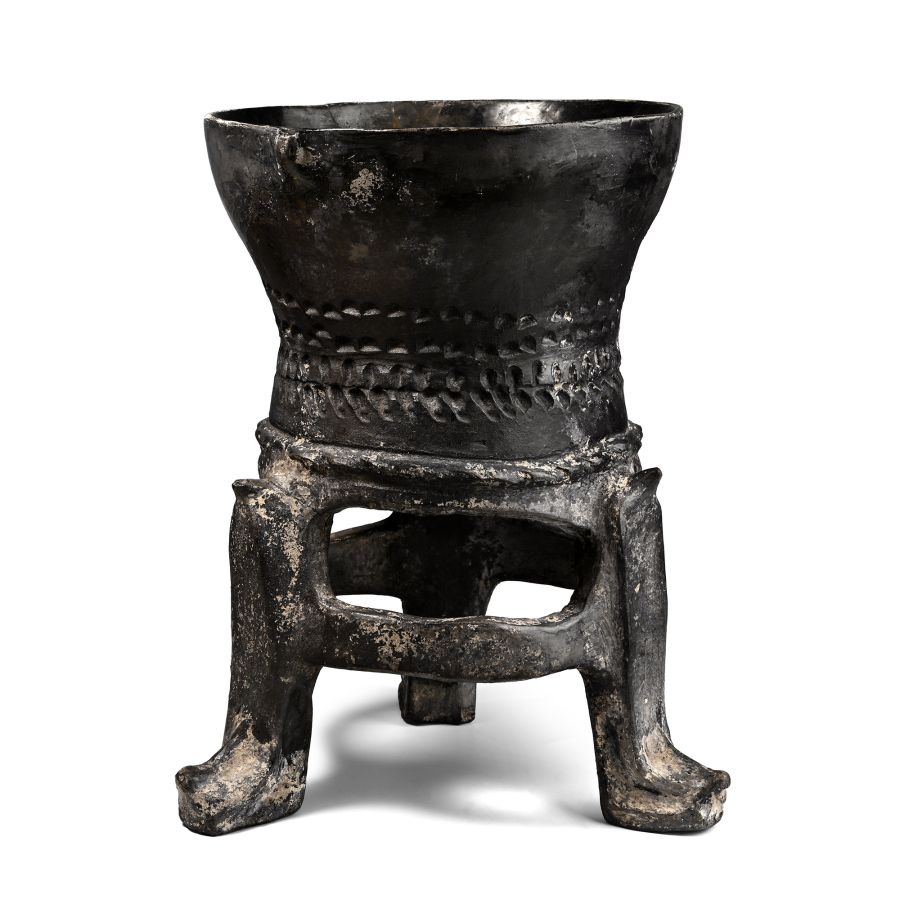
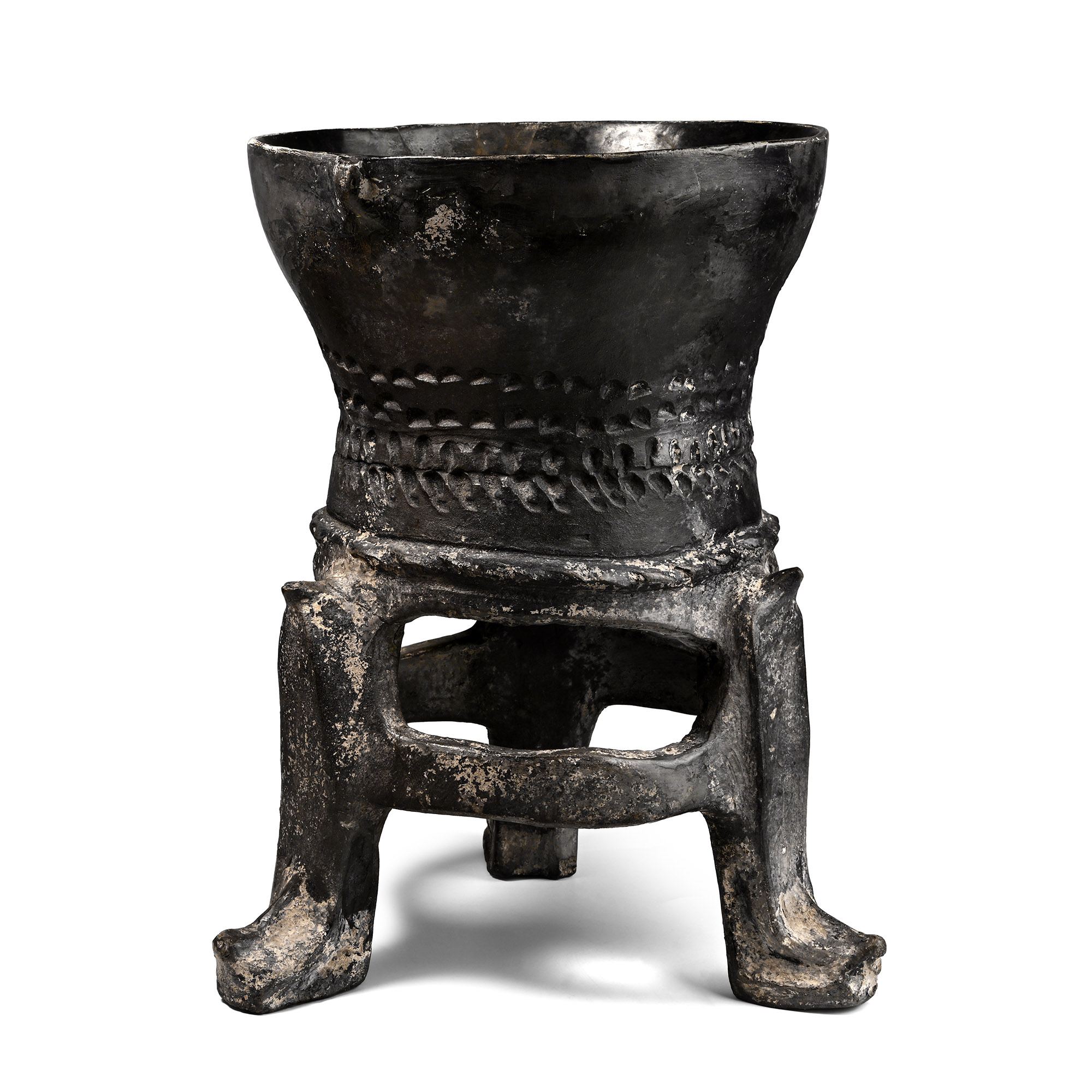
Large Azerbaijan Hasanlu Tepe Pottery Vessel
1ST MILLENNIUM B.C.
14 in. (5.28 kg, 35.5 cm).
Comprising a broad bell-shaped bowl with flat rim attached by a thick trunk with four rows of angled impressions to a tripod base with sturdy curved legs with inner supporting ring and keeled finials.
Provenancewith Mahboubian Gallery, London, UK, 1974.
Private collection, London, UK.
TimeLine Auctions follows a vetting process to ensure the authenticity and legality of all items, reinforcing our commitment to integrity and responsible trading. Each antiquity, antique, and coin lot undergoes thorough examination by a vetting committee of at least ten external specialists, professional trade association members, scientists, and archaeologists: Our Vetting Process
AUCTIONS:
TimeLine is a leading auction house specialising in antiquities, ancient art, collectables, natural history, coins, medals, and books. Our auctions offer museums, collectors, historians, and enthusiasts the opportunity to acquire unique and historically significant pieces.
LOT 0223
Large Azerbaijan Hasanlu Tepe Pottery Vessel
Estimate £1,500 - 2,000€1,740 - 2,320 (for guidance only)$2,030 - 2,700 (for guidance only)
-
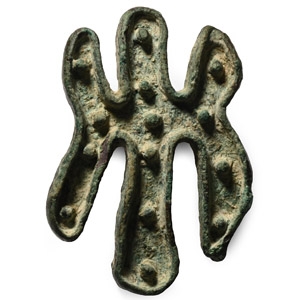
Central Asian Bronze Stamp Seal with Stylised Four-Winged God
Circa 2300-2000 B.C.Estimate: £200 - 300 (+bp*)
Opening Bid: £100
Formed as three vertical bars joined near the base; accompanied by an old scholarly note, typed and signed by W.G. Lambert, late Professor of Assyriology, University of Birmingham, 1970-1993, which states: 'Stamp Seal of Bronze 54 x 48 x 26mm This bears the shape of the design, with flat face and flat back, on which is mounted a handle of angular shape with rounded top. The piece has roughly three parallel vertical segments, which join in the middle, the whole being surrounded by a rim. Each segment has a row of dots in it: four in the two outer segments, six in the middle one, which is longer. This comes from western central Asia and dates to c. 2300-2000 B.C. It is extremely rare for its design, which may be understood as a stylized depiction of a standing four-winged god, but this is not completely certain.The piece is generally in good condition, but is a little bent.' 25 grams, 53 mm
Ex S collection, deceased, London, UK, 1990s. Accompanied by an original scholarly note, typed and signed by Professor Wilfrid George Lambert. -
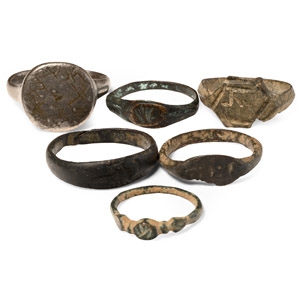
Western Asiatic and Other Bronze Ring Group
2nd-8th century AD.Sold for (Inc. bp): £91
Including disc bezel with hatched field, hexagonal bezel with incised legend and other types. 16.11 grams total, 19-22 mm
From the collection of a gentleman, acquired on the London art market in the 1990s. -
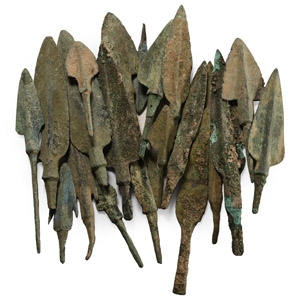
Luristan Bronze Arrowhead Collection
12th-10th century B.C.Sold for (Inc. bp): £156
Including triangular, barbed-and-tanged, leaf-shaped, and other types. 266 grams total, 49-108 mm
Ex London art market, 1980-1990s. This lot has been cleared against the Art Loss Register database, and is accompanied by an illustrated lot declaration signed by the Head of the Antiquities Department, Dr Raffaele D'Amato.
Some of these arrowheads seem to belong to the type V, subcategory types A, C and D according to the classification of Khorasani and Negahban. In the four categories of triangular bronze arrowheads from Luristan, Marlik and Northern Iran individuated by Negahban, subtypes C and D of type V are larger arrow or javelin heads, C with barbed shoulders and D with round shoulders. Subtype A is substantially similar to C, but smaller.
