
Loading, please wait...
_900x900.jpg "Lapis Lazuli Bead Necklace")
_200x200.jpg "Lapis Lazuli Bead Necklace")
.jpg "Lapis Lazuli Bead Necklace")
LOT 2081
Lapis Lazuli Bead Necklace
20TH CENTURY A.D.
17 3/8 in. (104 grams, 44 cm long).
Composed of coin-shaped beads with a hook-and-eye clasp. [No Reserve]
ProvenanceUK gallery, early 2000s.
CONDITIONTimeLine Auctions follows a vetting process to ensure the authenticity and legality of all items, reinforcing our commitment to integrity and responsible trading. Each antiquity, antique, and coin lot undergoes thorough examination by a vetting committee of at least ten external specialists, professional trade association members, scientists, and archaeologists: Our Vetting Process
AUCTIONS:
TimeLine is a leading auction house specialising in antiquities, ancient art, collectables, natural history, coins, medals, and books. Our auctions offer museums, collectors, historians, and enthusiasts the opportunity to acquire unique and historically significant pieces.
-
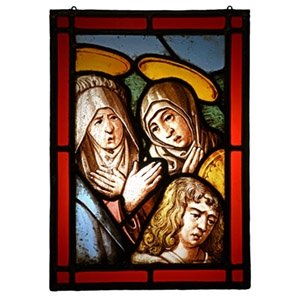
Stained Glass Panel with Three Figures at the Base of the Crucifixion
Northern France, Champagne, circa 1520s A.D.Sold for (Inc. bp): £2,210
A composite panel comprising: central figural sections with nimbate Virgin Mary, Saint Mary Magdalene and Saint John below, with deep blue surround; outer frame of deep red square and rectangular panes in lead cames with loops to the upper edge. 1.16 kg, 38 x 26.7 cm
Estate of Dr Woody Cobbs and Mrs Honor Cobbs, Atlanta, Georgia, USA. with Ahlers & Ogletree 1 May 2016, no.394. From a Suffolk, UK, collection. This lot has been checked against the Interpol Database of stolen works of art and is accompanied by a search certificate number no.12301-221724. -
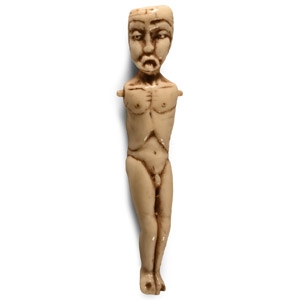
Post Medieval Bone Figure of Christ
18th century A.D.Sold for (Inc. bp): £91
Corpus Christi carved in the round with exaggerated head, spigots for posable arms, holes to the feet. 18 grams, 93 mm
From a collection acquired on the UK art market from various auction houses and collections mostly before 2000. From an important Cambridgeshire estate; thence by descent. -
.jpg)
Bronze Astrolabe
20th century A.D.Sold for (Inc. bp): £390
Composed of three circular quadrants, the body surmounted with an openwork panel incised with a floral motif and set with small blue glass cabochons; suspension loop. 1.25 kg, 24 cm
UK gallery, early 2000s.
