
Loading, please wait...
LOT 1926
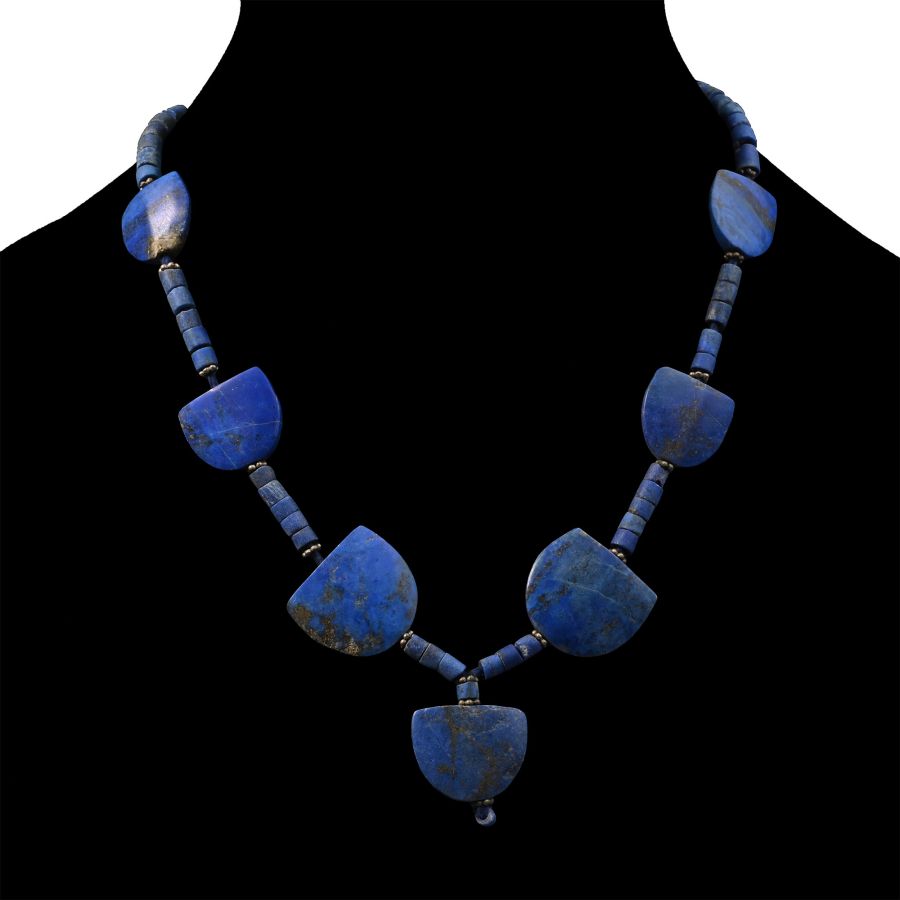
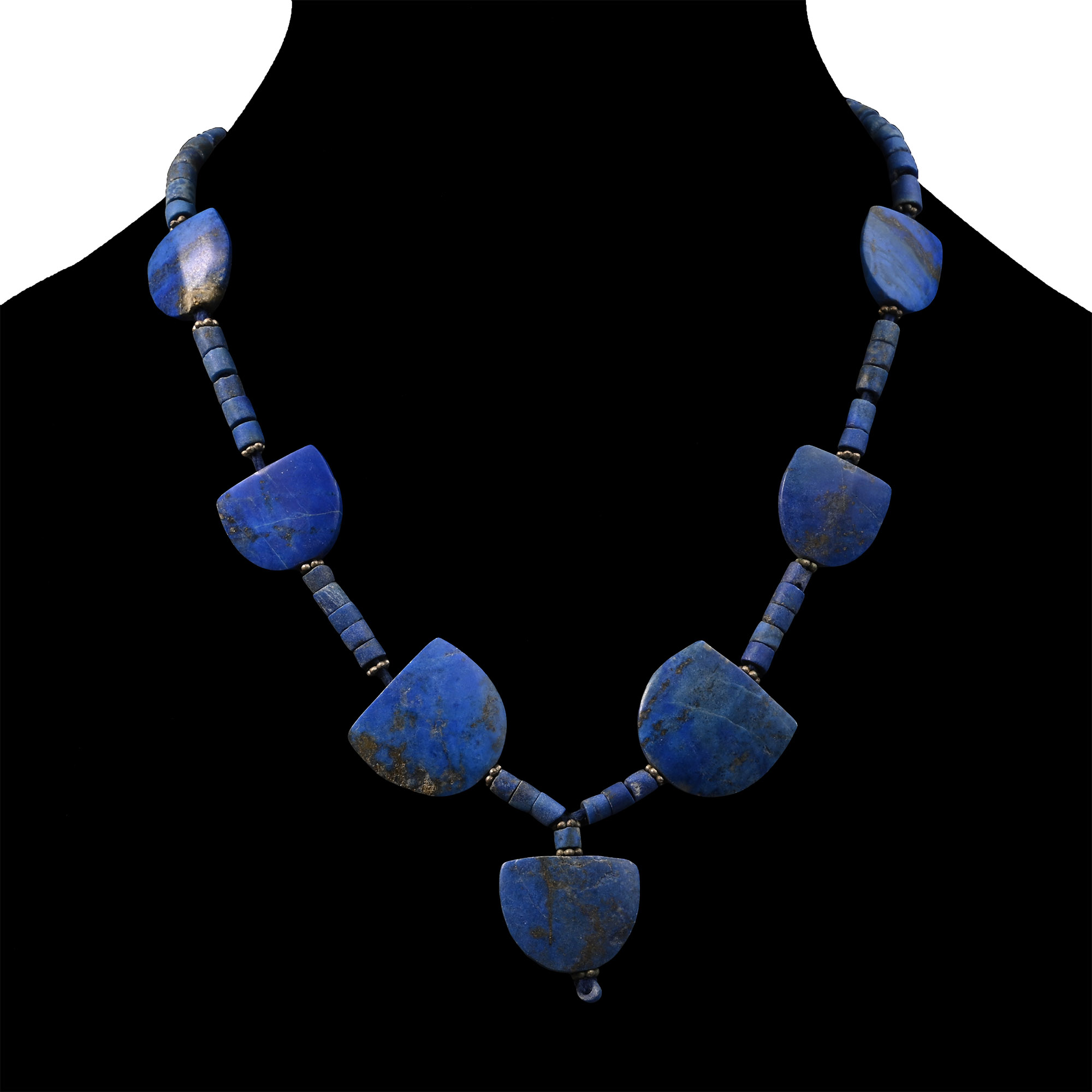
Lapis Lazuli Bead Necklace String
20TH CENTURY A.D.
13 3/4 in. (44.2 grams, 35 cm).
Restrung group of tabular, annular and other types with D-shaped pendant centrepiece. [No Reserve]
ProvenanceLondon, UK, collection, 2000s.
CONDITIONTimeLine Auctions follows a vetting process to ensure the authenticity and legality of all items, reinforcing our commitment to integrity and responsible trading. Each antiquity, antique, and coin lot undergoes thorough examination by a vetting committee of at least ten external specialists, professional trade association members, scientists, and archaeologists: Our Vetting Process
AUCTIONS:
TimeLine is a leading auction house specialising in antiquities, ancient art, collectables, natural history, coins, medals, and books. Our auctions offer museums, collectors, historians, and enthusiasts the opportunity to acquire unique and historically significant pieces.
-
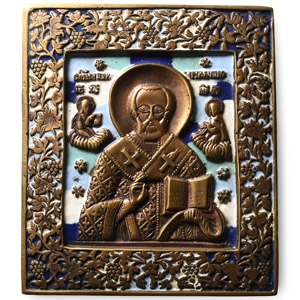
Russian Orthodox Enamelled Bronze Travel Icon with Saint Nicholas
19th century A.D.Estimate: £250 - 350 (+bp*)
Opening Bid: £125
Representing Saint Nicholas of Myra with a book in his left hand and making the gesture of blessing with his right, dressed as a bishop with sticharion, covered by omophorion, and surmounted by an epitrachelion embroidered with crosses; the saint flanked by Jesus and Virgin Mary, Christ holding the gospel, Mary the bishop’s epitrachelion; Cyrillic inscriptions 'Saint Nikolaos the Wonderworker (СВЯТЫЙ НИКОЛА ЧУДОТВОРЕЦ), Iesus Christos (ΙΣ ΧC) and Mother of God (ΜΡ ΘΥ)' on the enamelled background. 348 grams, 10.7 cm
Acquired from Chris Martin-Zakheim, Iconastas, 5 Piccadilly Arcade, London SW1. From the private collection of a West London, UK, gentleman, formed since the early 2000s.
The icon features meticulous craftsmanship typical of Orthodox iconography. The enamel colors, despite the passage of time, retain their vibrant intensity, highlighting the key elements of the depicted images. The refined details and use of enamel give depth and luminosity to the icon, making it a precious example of the Russian Orthodox tradition. -
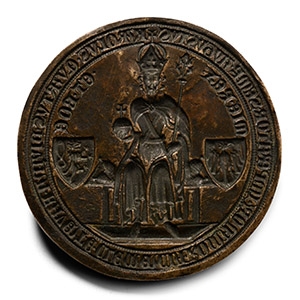
Bronze Seal Matrix with Emperor Charles IV
18th century A.D.Estimate: £200 - 300 (+bp*)
Opening Bid: £100
Discoid in plan with pierced flange handle to reverse; incuse image of a facing enthroned monarch with orb and sceptre in his hands, crown topped by a cross, two heater shields to the sides, on with a lion rampant and the other with a spread eagle; legend 'MIE.REZ', 'ET. BOE'; outer band with Lombardic legend 'AVGVSTVS. KAROLVS . QVARTVS . DIVINAE.FAVENTE . MEME[...]' referring to Holy Roman Emperor Charles IV. 143 grams, 62 mm
Private collection, UK. -
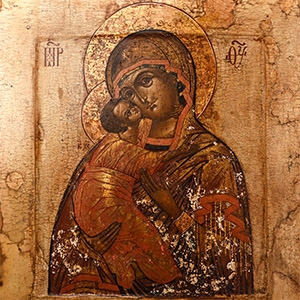
Painted Wooden Icon with the Virgin of Vladimir
Russia, 18th century A.D.Estimate: £1,200 - 1,700 (+bp*)
Opening Bid: £600
With veiled head and wearing a fringed golden maphorion mantle over a dark blue robe with gold cuffs, inclined towards the infant Jesus supported by her right hand; monograms and titling, on each side of her head 'ΜΡ ΘΥ' (Μήτηρ (τοῦ) Θεοῦ = Mother of God), over the child inscription in Greek letters 'ΙϹ ΧϹ' (ΙΗϹΟΥϹ ΧΡΙϹΤΟϹ = Jesus Christ), three letters (only two visible) inside the nimbus of Christ representing the continuous divine self-existence of Christ as God ('O ѾN' = The Only One who always exists); rectangular wooden board with mounting bar to reverse; Moscow School; old label on the back with inscription in Dutch 'A209 Moeder Gods van Wladimir'. 1.3 kg, 35.7 x 31 cm
Acquired on the UK art market. Private collection, London, UK.
The original icon prototype of these smaller icons was the icon of the Virgin Mother of Vladimir with the infant Jesus (the original preserved in the Tretyakov Gallery, Moscow), probably the most famous icon of Russia, which was thought to have been created in Constantinople in the early part of 1100s. This image is sometimes referred to as the ‘tenderness icon’, with artists attempting to show the close relationship of mother and son with their cheeks touching as they embrace.
