
Loading, please wait...
_900x900.jpg "Langobardic Gold Bishop's Ring with Amethyst")
_200x200.jpg "Langobardic Gold Bishop's Ring with Amethyst")
_900x900.jpg "Langobardic Gold Bishop's Ring with Amethyst")
_200x200.jpg "Langobardic Gold Bishop's Ring with Amethyst")
.jpg "Langobardic Gold Bishop's Ring with Amethyst")
.jpg "Langobardic Gold Bishop's Ring with Amethyst")
LOT 0303
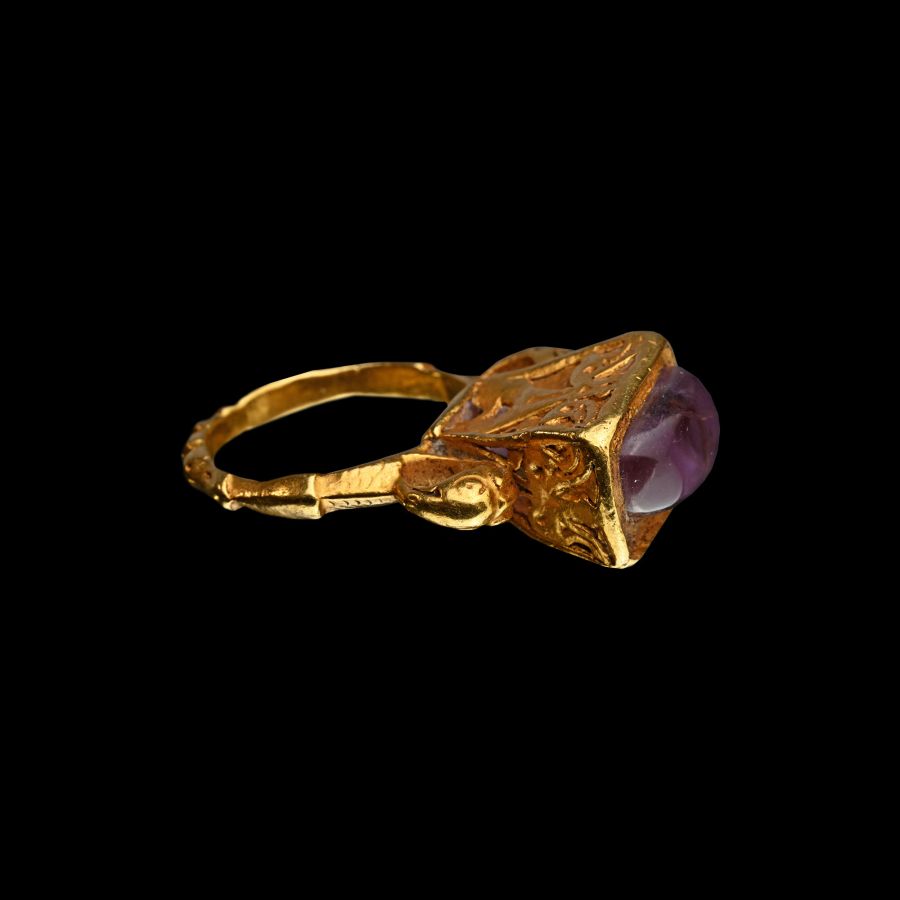
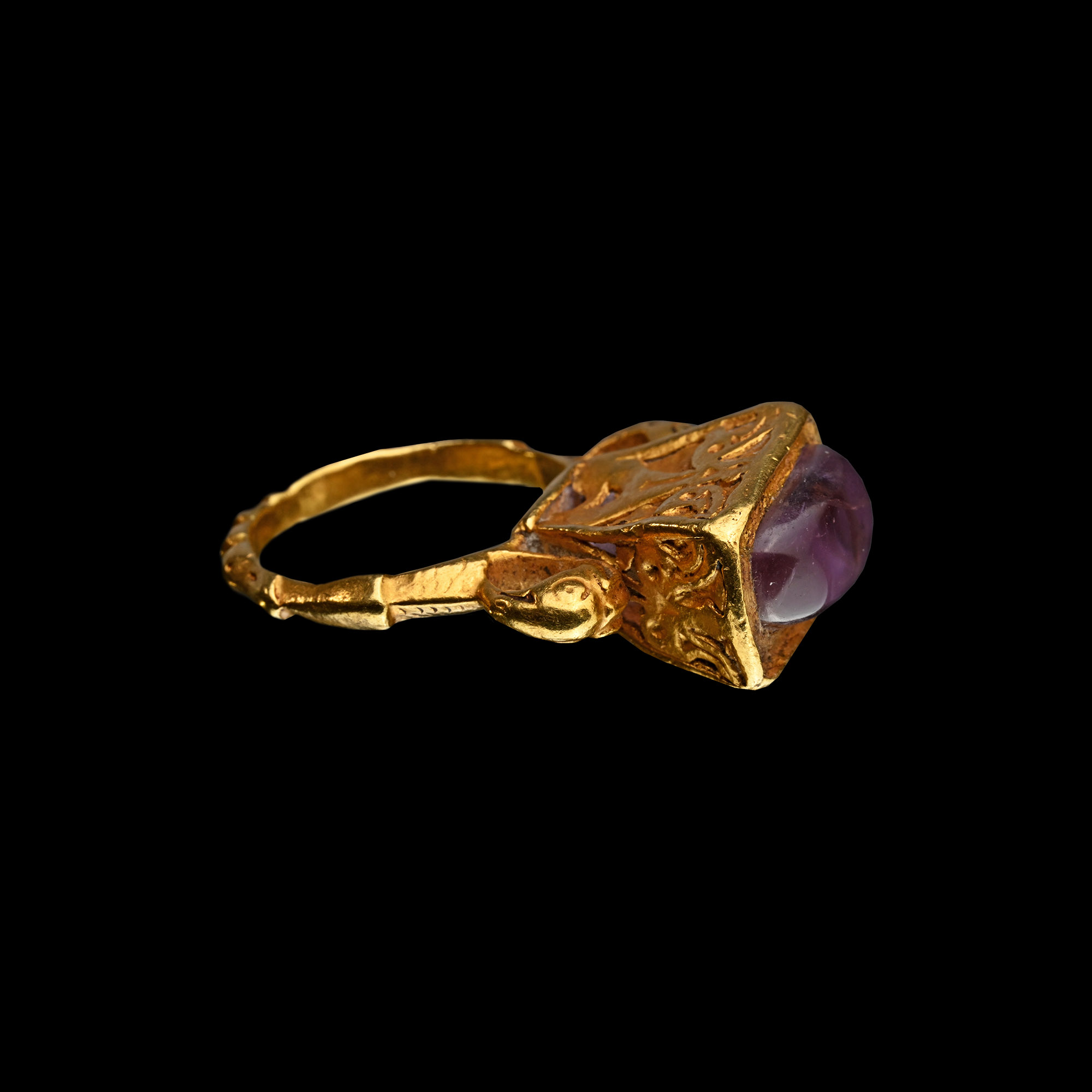
Langobardic Gold Bishop's Ring with Amethyst
7TH-8TH CENTURY AD.
1 3/8 in. (11.38 grams, 34.70 mm overall, 17.74 mm internal diameter (approximate size British M 1/2, USA 6 1/4, Europe 13.09, Japan 12)).
A finely crafted ring featuring a prominent square bezel adorned with stylised crucifixes, flanked by outward-facing birds with hooked beaks and large ring-and-dot eyes, the bezel set with a polished amethyst pebble; keeled decorative hoop with three integral collars at the base.
ProvenancePrivate English collection, formed between the late 1970s and early 1990s.
Private collection, UK.
This lot has been checked against the Interpol Database of stolen works of art and is accompanied by search certificate number no.12983-245992.
See a closely related ring in the Griffin Collection, currently on loan to the Metropolitan Museum of Art, New York, object no. L.2015.72.36; see also a gold ring with similar bird motifs in the Victoria and Albert Museum, London, accession no. 615-1871; see Musée d’Archéologie nationale, Château de Saint-Germain-en-Laye, inventory no.MAN87191, for a ring featuring a tall, square bezel set with a chrysoprase and having a similar shank, excavated from a 7th-century burial beneath the Basilica of Saint-Denis.
FootnotesThe Langobards (or Lombards) were a Germanic people who invaded and ruled much of the Italian Peninsula from 568 to 774 AD. Their kingdom, known for its fusion of Germanic and Byzantine artistic traditions, persisted until the Carolingian conquest under Charlemagne.
A Bishop’s ring is a large, often ornate ring worn by bishops as a symbol of their office and spiritual authority. Traditionally, it signifies the bishop’s commitment to the Church and is considered a mark of his episcopal dignity.
TimeLine Auctions follows a vetting process to ensure the authenticity and legality of all items, reinforcing our commitment to integrity and responsible trading. Each antiquity, antique, and coin lot undergoes thorough examination by a vetting committee of at least ten external specialists, professional trade association members, scientists, and archaeologists: Our Vetting Process
AUCTIONS:
TimeLine is a leading auction house specialising in antiquities, ancient art, collectables, natural history, coins, medals, and books. Our auctions offer museums, collectors, historians, and enthusiasts the opportunity to acquire unique and historically significant pieces.
LOT 0303
Langobardic Gold Bishop's Ring with Amethyst
Estimate £15,000 - 20,000€17,400 - 23,200 (for guidance only)$20,250 - 27,000 (for guidance only)
-
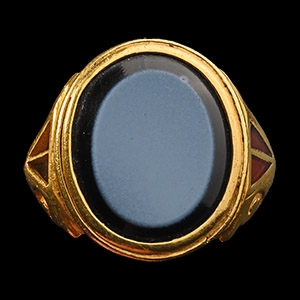
Large Migration Period Gold Ring with Gemstones
Eastern Europe, 4th-5th century A.D.Sold for (Inc. bp): £10,530
Wide hoop with volute decoration on the shoulders, two triangular settings on both shoulders, one side with garnet cloisonnés separated by a narrow bar, an applied strip of sheet-gold to the inside of the ring behind the setting; large oval bezel set with nicolo. 22.03 grams, 29.00 mm overall, 21.65 mm internal diameter (approximate size British U, USA 10, Europe 22.52, Japan 21)
with Fran Sternberg AG, Zurich, Sale XXVI, 16 November 1992, no.689. Private collection, UK. This lot has been checked against the Interpol Database of stolen works of art and is accompanied by search certificate number no.12984-245991. -
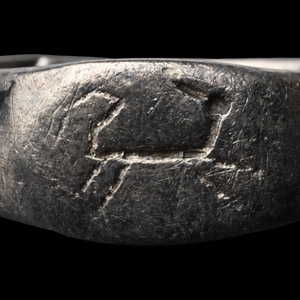
Dark Age Silver Ring with Animal
Circa 6th-8th century A.D.Sold for (Inc. bp): £117
D-section annular hoop with overlapping rounded terminals at the base, bezel with a stylised quadruped. 6.01 grams, 22.32 mm overall, 18.54 mm internal diameter (approximate size British P 1/2, USA 7 3/4, Europe 16.86, Japan 16)
Ex German art market, 2000s. Acquired from an EU collector living in London. From the collection of a Surrey, UK, gentleman. -
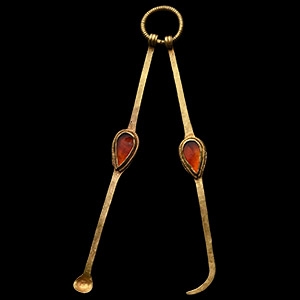
Migration Period Gold Cosmetic Set with Garnets
Early 5th century A.D.Estimate: £4,000 - 6,000 (+bp*)
Opening Bid: £2,000
Comprising a beaded wire suspension loop with two attachments: long-handled spoon with small bowl; rectangular-section pick with hooked end; each with a teardrop-shaped panel with beaded wire rim to each face, the outer ones each with an inset garnet cloison, the rear ones set with a glass cabochon. 23.11 grams, 11.4 cm
Acquired on the UK art market. Private collection, London, UK. This lot has been checked against the Interpol Database of stolen works of art and is accompanied by search certificate number no.12913-244535.
A similar implement, silver and gold-plated, was found in the grave of a small child in Untersiebenbrunn, in Lower Austria. These are precious items that belong to the polychrome style of the 5th century Roman jewellery adopted by so-called ‘barbarians’.
