
Loading, please wait...
_900x900.jpg "Kushan Turquoise-Glazed Bowl")
_200x200.jpg "Kushan Turquoise-Glazed Bowl")
_900x900.jpg "Kushan Turquoise-Glazed Bowl")
_200x200.jpg "Kushan Turquoise-Glazed Bowl")
.jpg "Kushan Turquoise-Glazed Bowl")
.jpg "Kushan Turquoise-Glazed Bowl")
LOT 0319
Kushan Turquoise-Glazed Bowl
12TH-13TH CENTURY A.D.
7 7/8 in. (473 grams, 20 cm wide).
Footed bowl with painted black rim and vertical strokes to the outer face, eight painted internal segments with lattice, scrolls and other ornament.
ProvenanceEx London, UK, gallery, 1971-early 2000s.
London, UK, collection.
This lot has been checked against the Interpol Database of stolen works of art and is accompanied by a search certificate number no.12722-235581.
This lot has been cleared against the Art Loss Register database, and is accompanied by an illustrated lot declaration signed by the Head of the Antiquities Department, Dr Raffaele D'Amato.
TimeLine Auctions follows a vetting process to ensure the authenticity and legality of all items, reinforcing our commitment to integrity and responsible trading. Each antiquity, antique, and coin lot undergoes thorough examination by a vetting committee of at least ten external specialists, professional trade association members, scientists, and archaeologists: Our Vetting Process
AUCTIONS:
TimeLine is a leading auction house specialising in antiquities, ancient art, collectables, natural history, coins, medals, and books. Our auctions offer museums, collectors, historians, and enthusiasts the opportunity to acquire unique and historically significant pieces.
LOT 0319
Kushan Turquoise-Glazed Bowl
Estimate £1,800 - 2,400€2,090 - 2,780 (for guidance only)$2,430 - 3,240 (for guidance only)
-
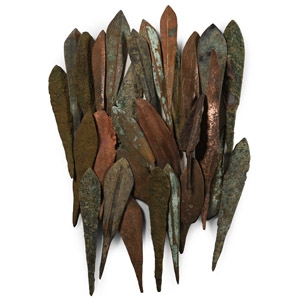
Western Asiatic Bronze Arrowhead Collection
19th - 2nd century B.C.Sold for (Inc. bp): £130
Including triangular, leaf-shaped, barbed, paddle-shaped arrowheads with a flat, comparatively wide mid-rib, and others. 271 grams total, 5.8-10.7 cm
Ex London art market, 1980-1990s. This lot has been cleared against the Art Loss Register database, and is accompanied by an illustrated lot declaration signed by the Head of the Antiquities Department, Dr Raffaele D'Amato.
Some of the represented arrowheads (paddle-shaped) were typical of the Old Babylonian Empire. The shoulders were pronounced and the arrowhead had a rectangular-section tapering tang. This simple form was popular throughout and are comparatively common finds in the Holy Land. -
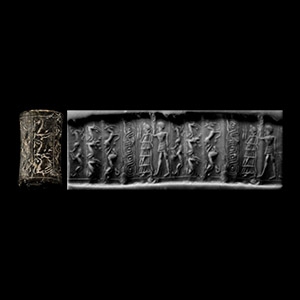
Syrian Stone Cylinder Seal with Figure Wearing Kilt
Circa 1800-1700 B.C.Sold for (Inc. bp): £416
Cylinder with cord and bead handles; accompanied by a copy of an old scholarly note, typed and signed by W.G. Lambert, late Professor of Assyriology, University of Birmingham, 1970-1993, which states: 'Cylinder seal of dark-brown stone with white inclusions, 14 x 8.5 mm. Slight chipping on top, otherwise condition fine. Male figure wearing short kilt and raising one hand, in front of him female figure wearing long, flounced garment and raising both hands; both facing four bands containing (i) guilloche, (ii) backwards-facing rampant horned quadruped above sideways recumbent lion, (iii) recumbent stage between two other recumbent horned quadrupeds, (iv) slender dog (?) chasing quadruped with horns or long ears. From Syria, c. 1800-1700 B.C. For similar seals, see D. Collon, "The Green Jasper Cylinder Seal Workshop" in M.K. Buccellati et al. (eds.), Papers in Honor of Edith Porada.'; supplied with a museum-quality impression. 2.88 grams, 14 mm
UK private collection, acquired 1980-1983. Accompanied by a copy of a scholarly note, typed and signed by Professor Wilfrid George Lambert in January 1989. This lot has been cleared against the Art Loss Register database, and is accompanied by an illustrated lot declaration signed by the Head of the Antiquities Department, Dr Raffaele D'Amato. -
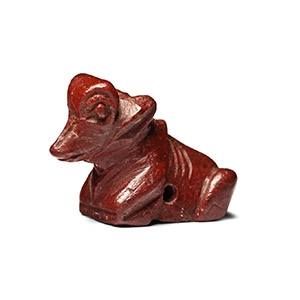
Urartian Jasper Bovine Seal Amulet
8th-7th century B.C.Estimate: £500 - 700 (‡+bp*)
Opening Bid: £250
Carved as a reclining bull with erect head, underside engraved with a winged quadruped. 2.67 grams, 21 mm
From the collection of Dr U.O., Zurich, acquired in the 1950s. with Rhea Galerie, Zurich, Switzerland. This lot has been cleared against the Art Loss Register database, and is accompanied by an illustrated lot declaration signed by the Head of the Antiquities Department, Dr Raffaele D'Amato.
