
Loading, please wait...
LOT 1384
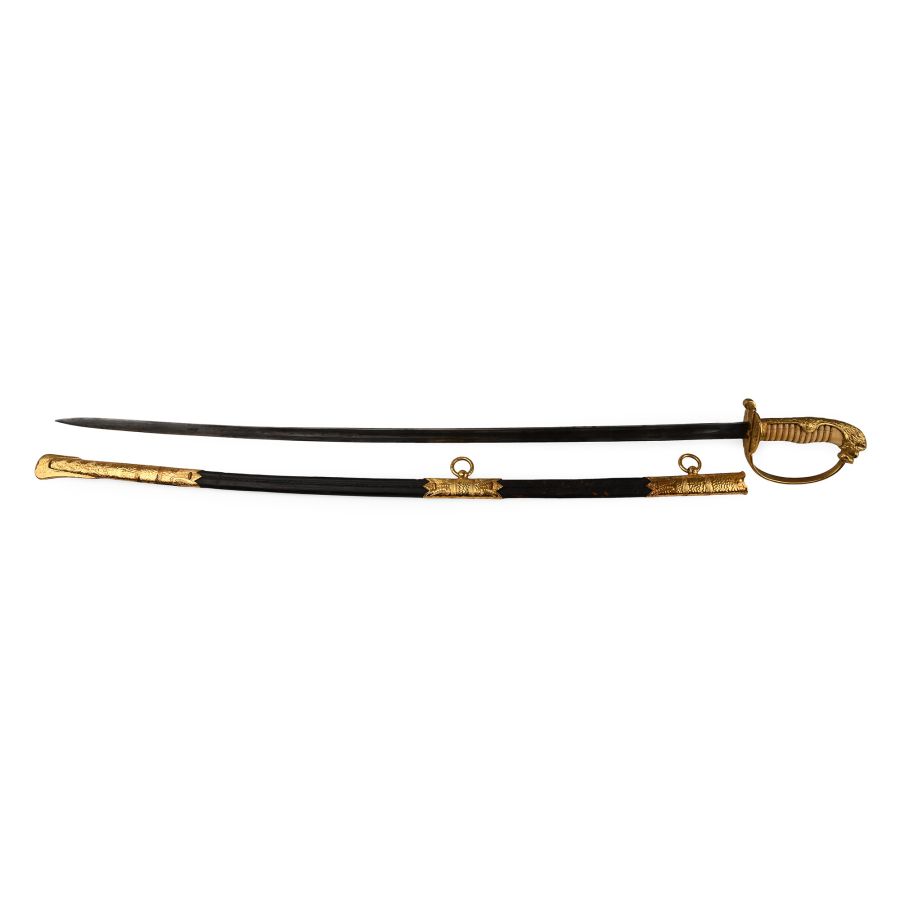
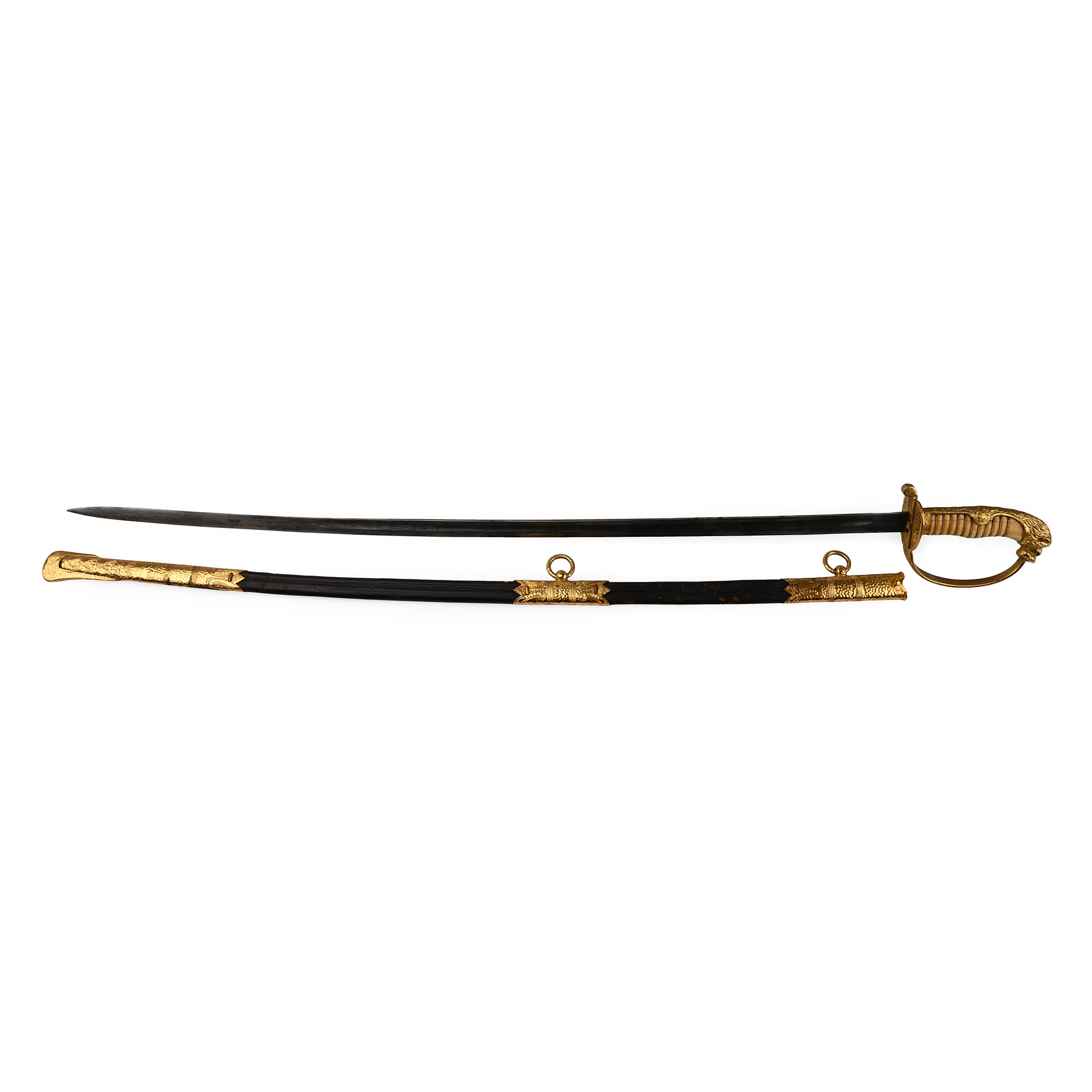
Kriegsmarine WWI German Naval Officer's Sword and Scabbard
EARLY 20TH CENTURY A.D.
35 7/8 in. (778 grams total, 91 cm).
Comprising a slender single-edged blade with etched designs; the hilt composed of a wire-bound ribbed bone handle, a lion-head pommel with inset eyes, and an ornate guard with folding edges, one side with a socket for securing the scabbard; accompanied a leather scabbard with ornate metal fittings. [No Reserve]
ProvenanceFrom the private collection of author and historian Dr DeWitt Bailey, one of the global authorities on the confederate army in the US civil war; thence by descent to his grandson.
CONDITIONTimeLine Auctions follows a vetting process to ensure the authenticity and legality of all items, reinforcing our commitment to integrity and responsible trading. Each antiquity, antique, and coin lot undergoes thorough examination by a vetting committee of at least ten external specialists, professional trade association members, scientists, and archaeologists: Our Vetting Process
AUCTIONS:
TimeLine is a leading auction house specialising in antiquities, ancient art, collectables, natural history, coins, medals, and books. Our auctions offer museums, collectors, historians, and enthusiasts the opportunity to acquire unique and historically significant pieces.
LOT 1384
Kriegsmarine WWI German Naval Officer's Sword and Scabbard
Sold for (Inc. bp): £286
-
.jpg)
Viking Age Iron Pattern-Welded Sword with Decorated Hilt and Chape
11th-13th century A.D.Sold for (Inc. bp): £9,750
Of Couronian type with straight blade tapering towards the point, shallow, tapering fullers, narrow tang, and boat-shaped lower guard with Jellinge Style decoration with wheel-type decoration to both sides, five-lobed pommel rivetted at the top; accompanied by a scabbard with Jellinge Style interlace decoration. 705 grams, 87.3 cm
From the private collection of a London gentleman, from his grandfather's collection formed before the early 1970s. Accompanied by an academic report by Dr Raffaele D’Amato. This lot has been checked against the Interpol Database of stolen works of art and is accompanied by search certificate number no.12915-245172.
One of the most characteristic and numerous sword types in the early medieval period from the Baltic territory is a special type of a double-edged sword, characteristic of the entire Eastern Baltic region, which is known as the ‘Couronian’ sword, the name given by Latvian archaeologist E. Šturms in his article in 1936, based on the finds from his country. -
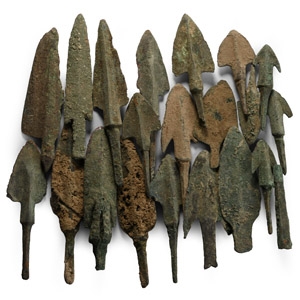
Greek and Luristan Bronze Arrowhead Collection
2nd-1st millennium B.C.Sold for (Inc. bp): £117
Mainly small triangular-headed tanged types. 182 grams total, 39-82 mm
Ex London, UK, collection, 1990s. -
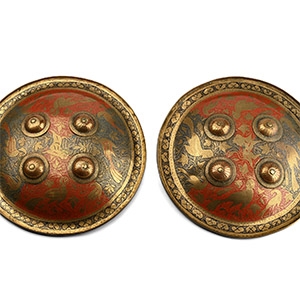
Indo-Persian Enamelled Brass Shield Pair
20th century A.D.Sold for (Inc. bp): £156
Each with flange rim and four applied bosses to the face for attachment of the rear straps, design of reserved foliage, birds and harpies on an enamelled field. 996 grams total, 27.3 cm
Property of a Berkshire, UK, gentleman collector.
