
Loading, please wait...
_900x900.jpg "Khazar Iron Sabre with Gilt Bronze Cross Guard")
_200x200.jpg "Khazar Iron Sabre with Gilt Bronze Cross Guard")
_900x900.jpg "Khazar Iron Sabre with Gilt Bronze Cross Guard")
_200x200.jpg "Khazar Iron Sabre with Gilt Bronze Cross Guard")
.jpg "Khazar Iron Sabre with Gilt Bronze Cross Guard")
.jpg "Khazar Iron Sabre with Gilt Bronze Cross Guard")
LOT 0310
Khazar Iron Sabre with Gilt Bronze Cross Guard
9TH CENTURY A.D.
31 5/8 in. (610 grams, 80.5 cm).
A single-edged hand-forged sabre with a gently curving blade, an iron band welded beneath the cross guard, together with a tongue along the side of the blade; the separate gilt cross guard with spherical ornamented finials to the quillons, the central panel with a stylised face flanked by a pair of leaping lions biting the top of the head, the other side with a lozenge within a ropework frame. [No Reserve]
ProvenanceAcquired 1971-1972.
From the collection of the vendor's father.
Property of a London, UK, collector.
Accompanied by an academic report by military specialist Dr Raffaele D'Amato.
This lot has been checked against the Interpol Database of stolen works of art and is accompanied by search certificate no.114437-196034.
Cf. similar specimens in Zakharow, A., Arendt, W., Studia Levedica, Archaeologischer Beitrag zur Geschichte der Altungarn im IX JH., Budapest, 1935, fig.21, p.54, fig.22, p.56 (guards), pls. III,VI nos. 3,5; Lebedinsky, I., De l’epée scythe au sabre mongol, Paris, 2008, pp.172ff.; Gorelik, M., ‘The image of the men-warrior in Kabaria-Ugria-Russia (in Russian)’ in Archaeology of the Eurasian Steppes, no.5, Kazan, 2017, pp.257-267, fig.1, nos.1,5; Fodor, I., Revesz, L., Wolf, M., Nepper, I.M., Morigi Govi, C., Gli Antichi Ungari, nascita di una nazione, Bologna, 1998, p.132, no.117 (cat.515); Bashir, M., The Arts of the Muslim Knight, The Furusiyya Art Foundation Collection, Milano, 2008, p.34.
FootnotesThis exceptional sabre shows similarity with examples from the Caucasus and Kuban regions. The blade could be Khazar-Magyar, and certainly its best parallels are the specimens from Verchne-Szaltovo area. According to M. Gorelik, some of these sabres were produced by the Kabarians, a breakaway tribe from the Khazar State, who formed an alliance with the Magyars. The extra band welded beneath the quillons, together with the side tongue, not only protected the scabbard from being cut by the blade but, more importantly, defended the warrior’s fingers which were wrapped around the quillons when fighting.
CONDITIONTimeLine Auctions follows a vetting process to ensure the authenticity and legality of all items, reinforcing our commitment to integrity and responsible trading. Each antiquity, antique, and coin lot undergoes thorough examination by a vetting committee of at least ten external specialists, professional trade association members, scientists, and archaeologists: Our Vetting Process
AUCTIONS:
TimeLine is a leading auction house specialising in antiquities, ancient art, collectables, natural history, coins, medals, and books. Our auctions offer museums, collectors, historians, and enthusiasts the opportunity to acquire unique and historically significant pieces.
-
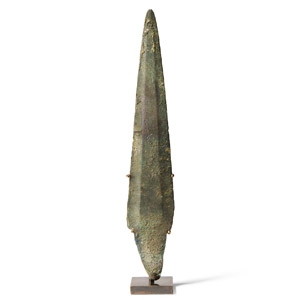
Western Asiatic Bronze Dagger
2nd millennium B.C.Sold for (Inc. bp): £117
With narrow pointed blade and wide raised flange down centre, straight sides, well marked shoulders with wide tang, one upper hole for rivet. 149 grams total, 21 cm high including stand
From the possessions of a member of a German princely family, gathered in the late 19th century, until the 1930s. with Auction House CUSP, Vienna, Auction Antique Art from Asia and from the Eastern Mediterranean, 16 June 2012, lot 75 [Part].
The type was technically more advanced than previous types of blades in the Near East due to its shape and its slightly convex sides widening out near the point, which combined the advantages of the leaf-shaped and straight-sided forms. -
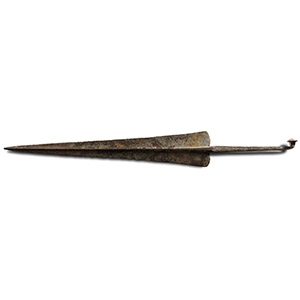
Very Large Tanged Bronze Spear
1900-1650 B.C.Sold for (Inc. bp): £124
Each side rising to a pointed ridge, curved tang for attaching to a shaft. 1.06 kg, 73 cm
From a collection acquired on the UK art market from various auction houses and collections mostly before 2000. From an important Cambridgeshire estate; thence by descent.
The characteristic point is the hooked tang, the end of which was fitted with a button. The spear was inserted into a wooden barrel and then held in place with a series of leather laces (Gernez, 2007, p.312). -
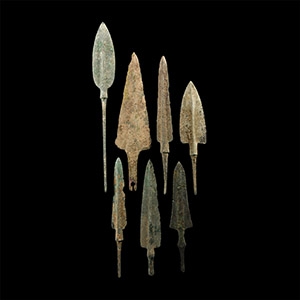
Luristan Bronze Arrowhead Group
13th-7th century B.C.Sold for (Inc. bp): £156
Comprising mainly tanged arrowheads including various types of leaf-shaped heads with midribs. 200 grams total, 12-15.3 cm
Acquired 1990s. From the collection of a late Japanese weaponry collector.
The barbed arrowhead seems to belong to the type V, subcategory type C, according to the classification of Khorasani and Negahban. In the four categories of triangular bronze arrowheads from Luristan, Marlik and Northern Iran individuated by Negahban, subtypes C and D of type V are larger arrow or javelin heads, C large triangular arrowheads with barbed shoulders and D with lanceolate shape and rounded midrib. The straight shoulders recalls a Marlik typology (see Khorasani, 2006, p.307, fig.379).
