
Loading, please wait...
LOT 1424
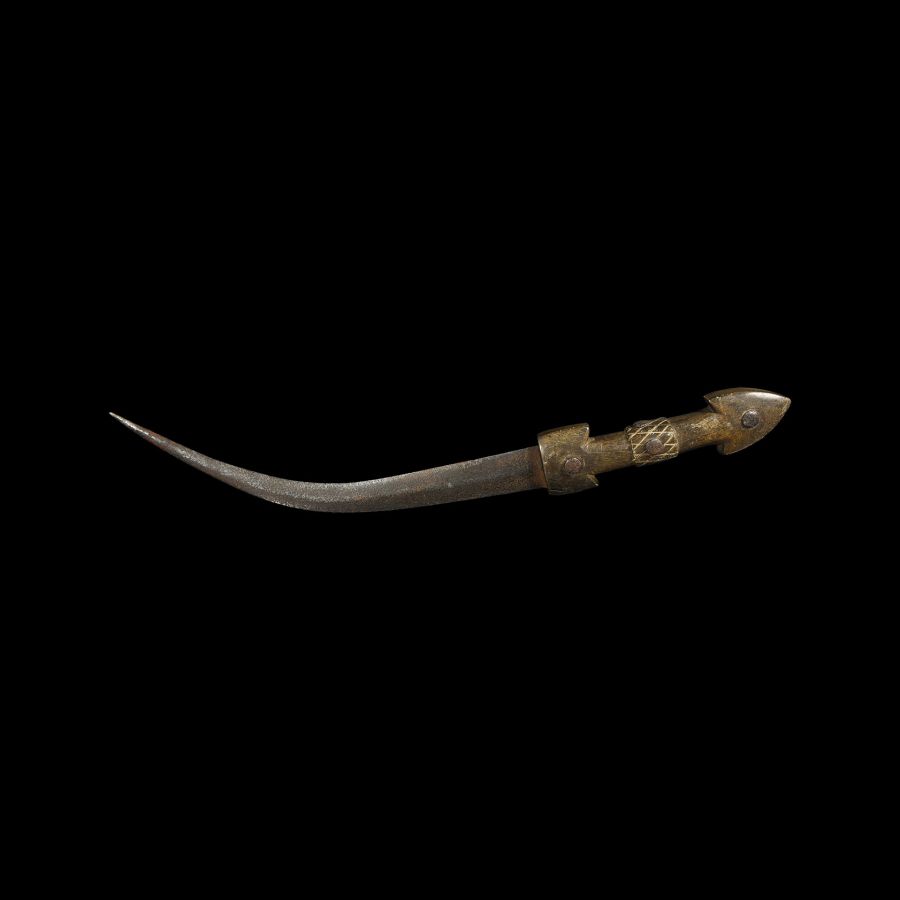
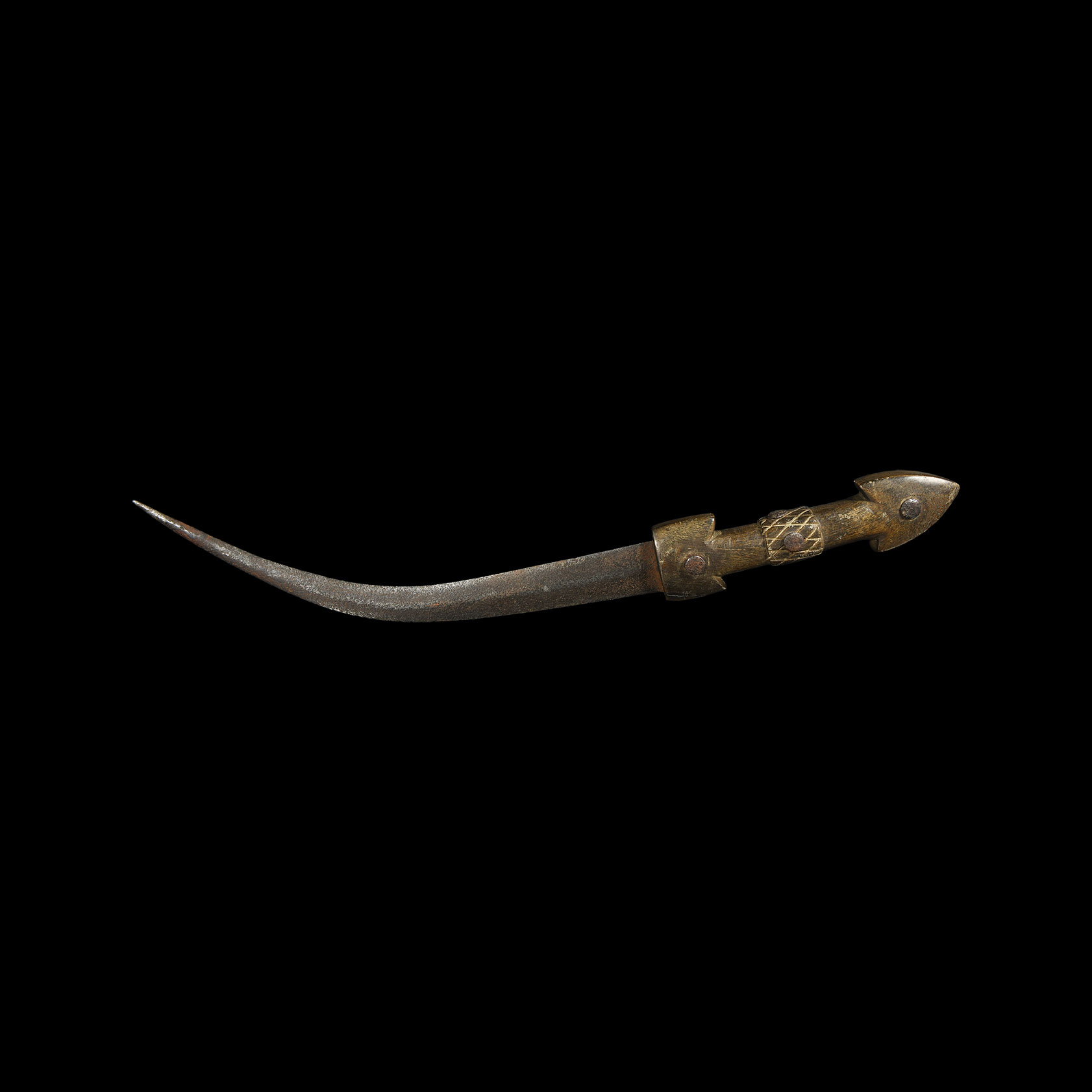
Khandjar Type Iron Dagger
19TH CENTURY A.D.
12 1/2 in. (118 grams, 32 cm long).
Curved with a thick double edge blade, handle composed of wood and iron, ornately decorated with lozenges, fastened by eight iron flat-headed rivets.
ProvenancePrivate family collection formed in London, mid 1980s to early 1990s.
LiteratureSee similar blades in Lebedynsky, J., Les Armes Orientales, Langres, 1992, pp.107ff.
FootnotesAmong the various Arab dagger groups, the one from North Africa is characterised by rather fine blades made in the Turkish-Persian style. Usually the handles (in wood, ivory and metal) feature a large rounded pommel in the guise of peacock feathers. This type is common in Morocco, Tunisia and all the way to Egypt, and is a type of Khandjar usually called Koummiya or Goummiya (a term later adopted in Spanish as Goumia, to indicate all the short Arab daggers).
CONDITIONTimeLine Auctions follows a vetting process to ensure the authenticity and legality of all items, reinforcing our commitment to integrity and responsible trading. Each antiquity, antique, and coin lot undergoes thorough examination by a vetting committee of at least ten external specialists, professional trade association members, scientists, and archaeologists: Our Vetting Process
AUCTIONS:
TimeLine is a leading auction house specialising in antiquities, ancient art, collectables, natural history, coins, medals, and books. Our auctions offer museums, collectors, historians, and enthusiasts the opportunity to acquire unique and historically significant pieces.
LOT 1424
Khandjar Type Iron Dagger
Estimate £150 - 200€170 - 230 (for guidance only)$200 - 270 (for guidance only)
-
.jpg)
Khazar Iron Sabre with Gilt Bronze Cross Guard
9th century A.D.Sold for (Inc. bp): £975
A single-edged hand-forged sabre with a gently curving blade, an iron band welded beneath the cross guard, together with a tongue along the side of the blade; the separate gilt cross guard with spherical ornamented finials to the quillons, the central panel with a stylised face flanked by a pair of leaping lions biting the top of the head, the other side with a lozenge within a ropework frame. 610 grams, 80.5 cm
Fine condition.
Acquired 1971-1972. From the collection of the vendor's father. Property of a London, UK, collector. Accompanied by an academic report by military specialist Dr Raffaele D'Amato. This lot has been checked against the Interpol Database of stolen works of art and is accompanied by search certificate no.114437-196034.
This exceptional sabre shows similarity with examples from the Caucasus and Kuban regions. The blade could be Khazar-Magyar, and certainly its best parallels are the specimens from Verchne-Szaltovo area. According to M. Gorelik, some of these sabres were produced by the Kabarians, a breakaway tribe from the Khazar State, who formed an alliance with the Magyars. The extra band welded beneath the quillons, together with the side tongue, not only protected the scabbard from being cut by the blade but, more importantly, defended the warrior’s fingers which were wrapped around the quillons when fighting. -
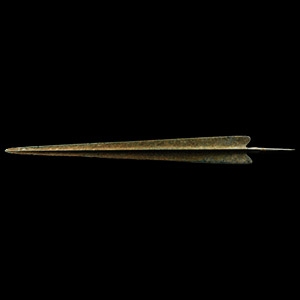
Large North-West Persian Bronze Sword Blade
11th-7th century B.C.Sold for (Inc. bp): £211
With prominently curved guard extending out from the ricasso partly framing the hilt, thick midrib extending slightly above the ricasso. 460 grams, 52 cm
Acquired 1980-2015. Ex Abelita family collection.
The hilt of such swords was made separately and unfortunately is nearly always missing from the archaeological records. Similar daggers have been recorded from the South Caspian area from Tomadjan and Ghalekuti. Their chronology ranges from late 2nd millennium B.C. to 7th century B.C. -
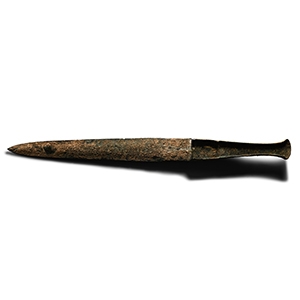
Canaanite Bronze Dirk
13th-12th century B.C.Estimate: £400 - 600 (‡+bp*)
Opening Bid: £200
With lentoid-section blade, tongue-shaped in plan, integral tapering hilt with flared finial, lateral flanges to accept a panel of bone or wood to each face forming the grip. 174 grams, 34 cm
Ex Joseph J. Gancie (1923-2010), Washington, Silver Spring, Maryland. with Alex Cooper Auctioneers Inc., sale 1035, 27 January 2013, lot 162a.
The dirk belongs to the type III in the Medvedskaya classification, used in Near East from the 13th to the 6th century B.C. The type is the 32a of the Maxwell-Hyslop study. The Asiatic daggers of this type are confined to Syria and Persia, but Transcaucasia also provides an interesting analogy from Kalekent on the Baku peninsula, where a pointed straight-sided dagger blade has a flanged hilt with the whole of the side flanges bent over the centre.
