
Loading, please wait...
LOT 0180
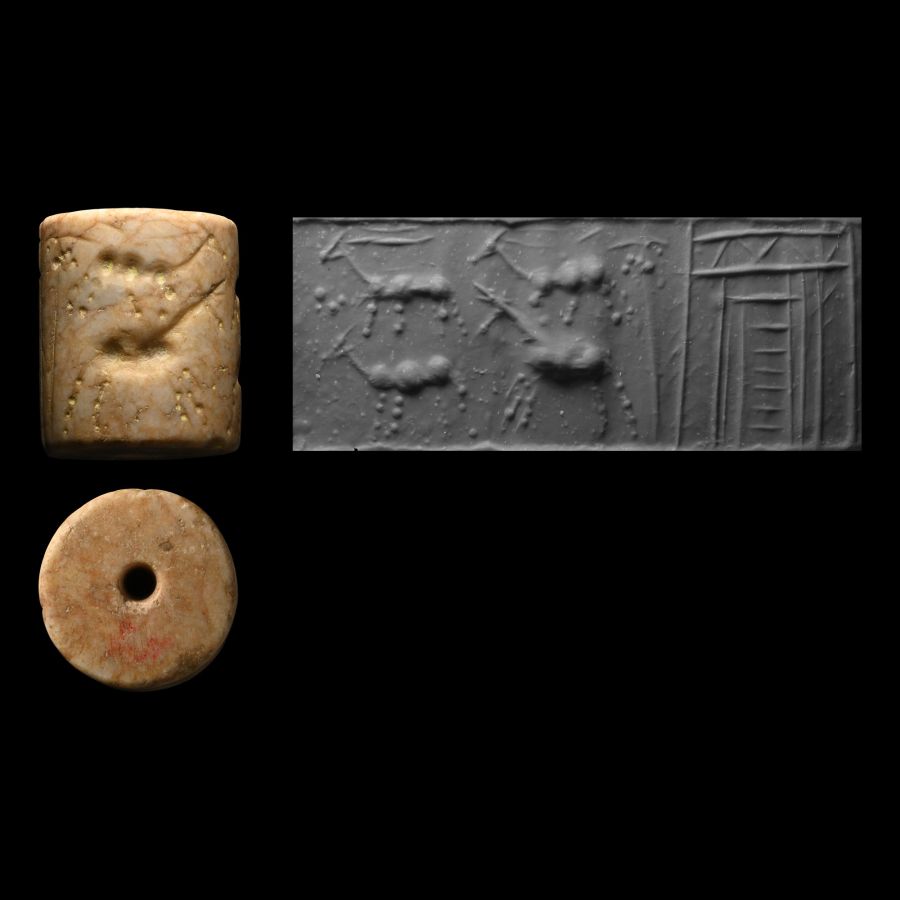
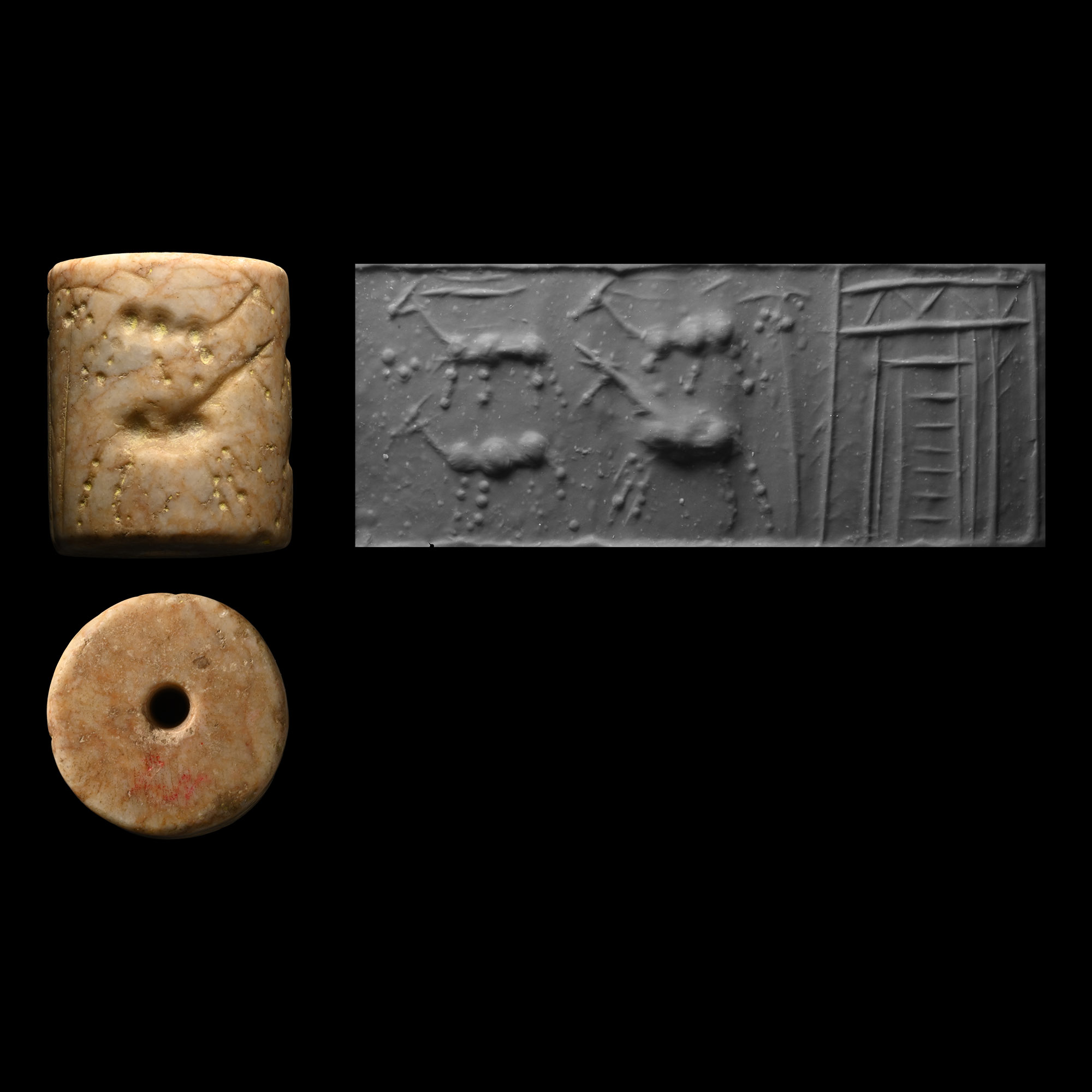
Jemdet Nasr White Marble Cylinder Seal with Temple
3000-2800 B.C.
1 5/8 in. (98.8 grams, 41 mm).
Showing a decorated temple with animals, accompanied by a museum quality impression and a copy of an old scholarly note, typed and signed by W.G. Lambert, late Professor of Assyriology, University of Birmingham, 1970-1993, which states: Cylinder Seal of White Marble, 41 x 35 mm. The engraving shows a decorated temple facade and beside it four horned animals, a standard on a pole and a motif of four dots. This is a Jemdet Nasr seal, c. 3000-2800 B.C., from southern Mesopotamia, and is in very good state of preservation. It illustrates the Sumerian city state of the time. the temple was the largest building, and it owned flocks and herds, being a big economic organization as well as a religious institution. For the climate and terrain sheep and goats were the normal domestic animals, and ordinary people might own these. The larger domestic animals, which included cattle and other horned animals such as gazelles which eventually proved unsuccessful as domestic animals, were owned only by the temple. Seals of this size and quality are rare.' [No Reserve]
Provenancewith Armand Trampitsch, Glyptique Archéologie, Paris, Hôtel Drouot, Sale No.2, 13-14 May 1992, no.216.
Accompanied by a copy of a scholarly note, typed and signed by Professor Wilfrid George Lambert in 1992.
Seals were the working signatures of the ancient Near East. Pressed or rolled into wet clay, they secured jars, bags, doors and tablets, and left a distinct impression that identified the owner, authorised a transaction, and showed whether a container had been opened. Stamp seals (pressed once to leave a single emblem) appear from the 7th–4th millennia BC and continue throughout later periods; cylinder seals (rolled to create a repeating frieze) develop in Mesopotamia in the late 4th millennium BC and are used into the 1st millennium BC. Beyond administration, seals were miniature artworks and amulets. Their images—gods and worshippers, royal hunts, banquets, heroes and mythic beasts—broadcast rank, piety and profession, and were believed to protect the owner. Materials range from soft stones to hard chalcedonies, haematite and lapis, worked with drills and abrasives to achieve crisp intaglio cutting. Many were worn on cords or rings and followed their owners through life, sometimes into the grave. Seals matter because they underpin the earliest systems of record-keeping and trade. Impressions on tablets and bullae are primary documents for ancient law, economy and religion; the seals themselves preserve that imagery in the round. For collectors, well-cut examples with sharp impressions, good polish and honest ancient wear are especially desirable, and pieces with early collection histories are keenly sought.
CONDITIONTimeLine Auctions follows a vetting process to ensure the authenticity and legality of all items, reinforcing our commitment to integrity and responsible trading. Each antiquity, antique, and coin lot undergoes thorough examination by a vetting committee of at least ten external specialists, professional trade association members, scientists, and archaeologists: Our Vetting Process
AUCTIONS:
TimeLine is a leading auction house specialising in antiquities, ancient art, collectables, natural history, coins, medals, and books. Our auctions offer museums, collectors, historians, and enthusiasts the opportunity to acquire unique and historically significant pieces.
-
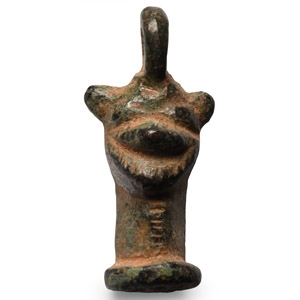
Neo-Assyrian Bronze Pazuzu Head Pendant
Circa 800 B.C.Sold for (Inc. bp): £221
Columnar in form and plano-convex in section with discoid base and grotesque mask. 4.82 grams, 26 mm
From a collection of a late London, UK, collector, 1980s. This lot has been cleared against the Art Loss Register database, and is accompanied by an illustrated lot declaration signed by the Head of the Antiquities Department, Dr Raffaele D'Amato. -
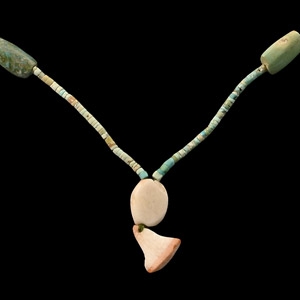
Bactrian Turquoise Bead Necklace
1st millennium B.C.Estimate: £150 - 200 (+bp*)
Opening Bid: £75
Restrung designer group of turquoise-coloured seed beads with fan-shaped, lentoid and other beads. 4.57 grams, 56.5 cm
Ex Jack Ogden and Faustus Gallery, Mayfair, London, UK, 1980s-1990s, and latterly a London gentleman's collection. -
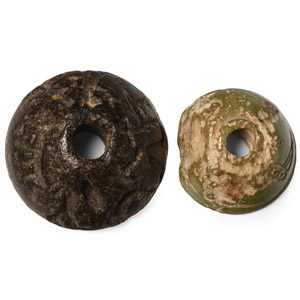
Western Asiatic Stone Decorated Spindle Whorl Group
1st millennium B.C.Sold for (Inc. bp): £26
Comprising two conical spindle whorls, the larger with stylised human figures and quadrupeds, the smaller with ring-and-dot decoration. 9.39 grams total, 18-23 mm
Acquired in the 1980s-2000s. From an important London, UK, collection.
