
Loading, please wait...
LOT 1425
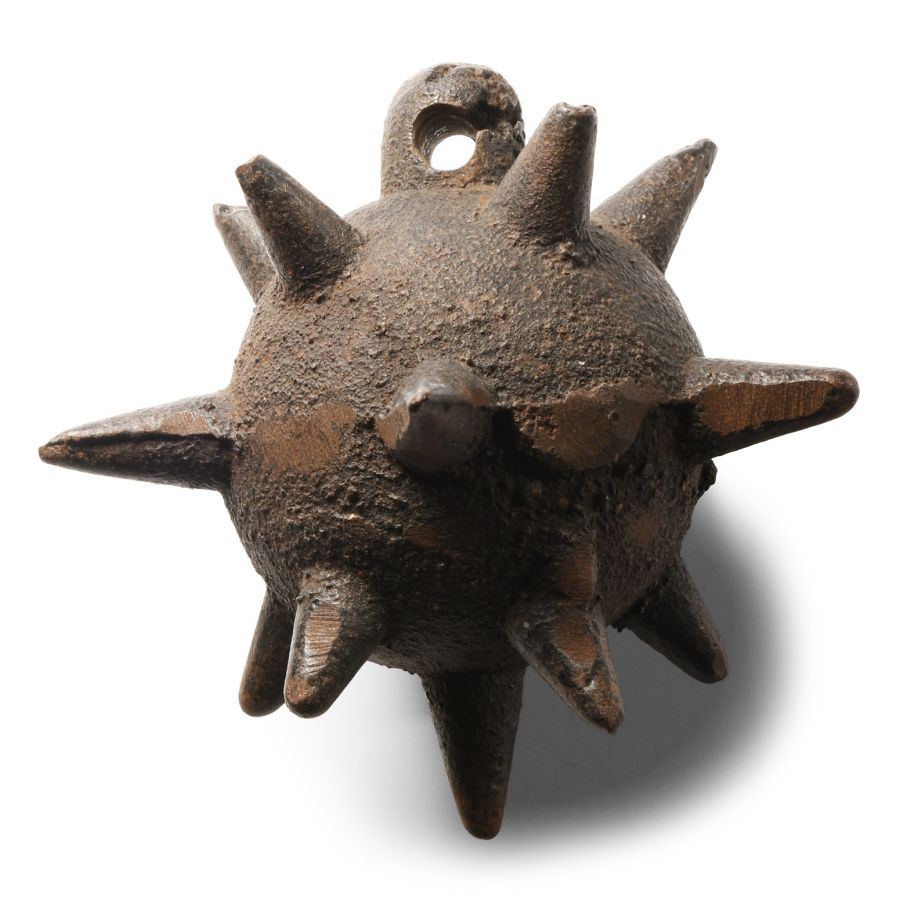
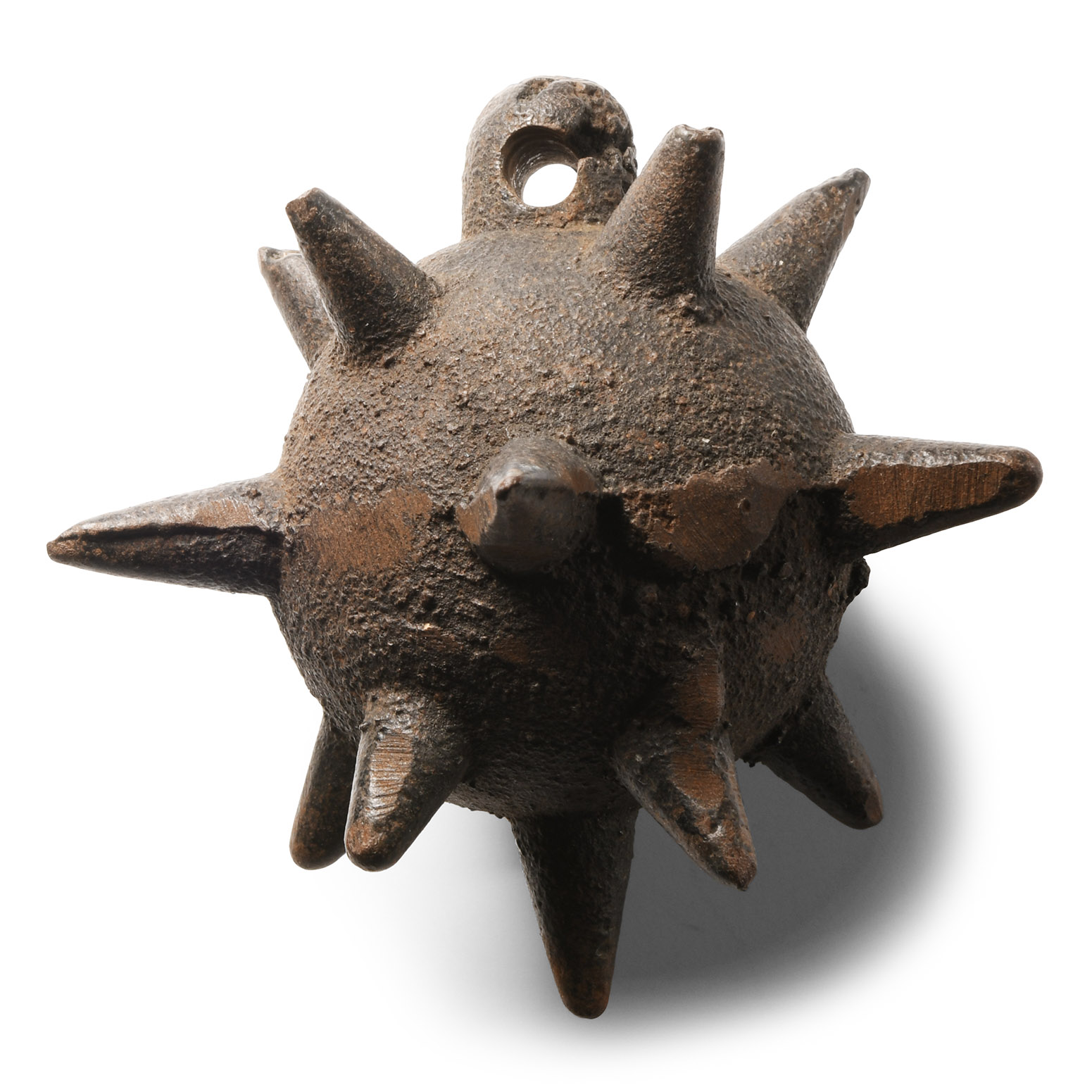
Iron Spiked Macehead
CIRCA 16TH-17TH CENTURY A.D.
3 1/2 in. (829 grams, 89 mm).
Comprising a globular flail head with large suspension loop above and sixteen spiked projections to the sides. [No Reserve]
ProvenanceFrom a collection acquired on the UK art market from various auction houses and collections mostly before 2000.
From an important Cambridgeshire estate; thence by descent.
See Sturtevant, P.B., The military flail, in Medieval Warfare, January/February 2017, Vol.6, No.6, pp.50-53, for discussion.
FootnotesThe medieval flail was a weapon mainly used in Eastern Europe, probably created among the Steppe people and used by the Mongols, adopted by the Slavic people under the name of kisten. Such a weapon probably saw little use in Western Europe, where it is first represented in the 14th century in a fresco depicting the battle of Nineveh painted by Piero della Francesca, as a chain with three maceheads. In the poem Le Chevalier Délibéré written by Olivier de la Marche and published in 1486, there is an engraving representing a knight carrying a rather simple morning star with asymmetrically mounted quills and a single-ball flail of quills. It is thought that in the Middle Ages the nailed mace in general was used to break through and dismantle the armour of enemies who were then 'finished' with swords or daggers.
CONDITIONTimeLine Auctions follows a vetting process to ensure the authenticity and legality of all items, reinforcing our commitment to integrity and responsible trading. Each antiquity, antique, and coin lot undergoes thorough examination by a vetting committee of at least ten external specialists, professional trade association members, scientists, and archaeologists: Our Vetting Process
AUCTIONS:
TimeLine is a leading auction house specialising in antiquities, ancient art, collectables, natural history, coins, medals, and books. Our auctions offer museums, collectors, historians, and enthusiasts the opportunity to acquire unique and historically significant pieces.
-
Large Marlik Type Bronze Socketted Spearhead with Blood Channels
14th-10th century B.C.Sold for (Inc. bp): £211
Comprising a triangular blade with prominent midrib, long split socket with two piercings for attachment and lower part decorated by horizontal circular grooves. 336 grams, 48 cm
Acquired 1980-2015. Ex Abelita family collection.
According to Khorasani, this spearhead belongs to the type VIII of his classification, characterised by a well-projecting midrib and long folded socket. The triangular blade is related to the subtype 2. Similar spearhead was excavated by Dr Negahban in the Royal Cemetery of Marlik (tomb 2, trench III D). -
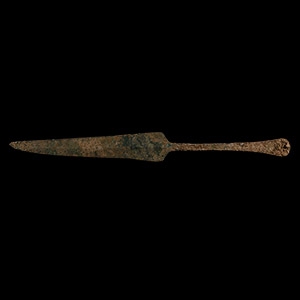
North-Western Persian Type Bronze Blade
Early 1st millennium B.C.Sold for (Inc. bp): £117
With tapering triangular blade, having straight shoulders, flat midrib and tapering square-sectioned tang ending with a rounded pommel. 99 grams, 33 cm
Acquired 1980-2015. Ex Abelita family collection.
Moorey, Gordon and Khorasani created a classification of bladed weapons, according to which daggers are edged weapons not greater than 36cm in length, dirks (short swords) are between 36cm and 50cm in length, and swords are edged weapons greater than 50cm in length. -
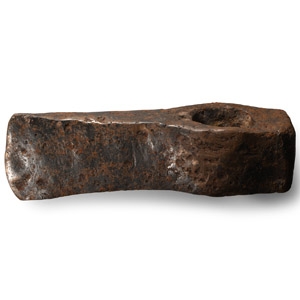
Medieval Iron Axehead
15th-16th century A.D.Sold for (Inc. bp): £46
With square butt, scooped underside and a flared blade. 1.04 kg, 16 cm
Acquired on the UK market before 1992. Ex property of a North London gentleman.
