
Loading, please wait...
_900x900.jpg "Iron Age La Tene Brooch Group")
_200x200.jpg "Iron Age La Tene Brooch Group")
.jpg "Iron Age La Tene Brooch Group")
LOT 1550
Iron Age La Tene Brooch Group
3RD CENTURY B.C.
1 3/8 - 2 3/4 in. (19.8 grams total, 34-69 mm).
Comprising three bow brooches with conical finials; a brooch with an arrow-shaped plaque and coiled spring to the pin. [4, No Reserve]
ProvenanceProperty of the vendor's grandfather, thence by family descent, circa 1985.
From the private collection of a New York, USA gentleman.
TimeLine Auctions follows a vetting process to ensure the authenticity and legality of all items, reinforcing our commitment to integrity and responsible trading. Each antiquity, antique, and coin lot undergoes thorough examination by a vetting committee of at least ten external specialists, professional trade association members, scientists, and archaeologists: Our Vetting Process
AUCTIONS:
TimeLine is a leading auction house specialising in antiquities, ancient art, collectables, natural history, coins, medals, and books. Our auctions offer museums, collectors, historians, and enthusiasts the opportunity to acquire unique and historically significant pieces.
-
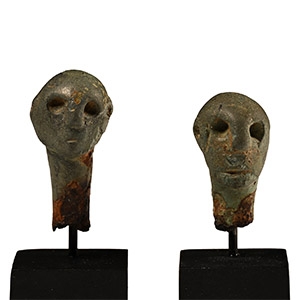
Iron Age Bronze Chariot Lynch Pin Finial Pair
1st century B.C.-1st century A.D.Sold for (Inc. bp): £715
Each a youthful male head with slit mouth and socketed eyes to accept organic inlay; stub neck developing to a sturdy pin; both mounted on a custom-made display stand. 75 grams total, 51-56 mm including stand
Found East Anglia, UK. From a collection acquired on the UK art market from various auction houses and collections mostly before 2000. From an important Cambridgeshire estate; thence by descent. -
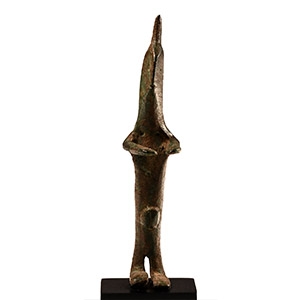
Iron Age Iberian Celtic Bronze Worshipper Statuette
Circa 6th century B.C.Sold for (Inc. bp): £2,210
Modelled in the round as a figure standing nude, the arms stretched out to the front, flat pinched head with conical headdress, impressed eyes and slotted mouth, applied genitals, exaggerated feet; mounted on a custom-made display stand. 82 grams total, 11.5 cm including stand
From the private collection of coll. Ernst Beyeler. Acquired from Cahn Auktionen AG, 3 November 2012, lot 135. From an important Cambridgeshire estate; thence by descent. Accompanied by a copy of the Cahn invoice and relevant catalogue pages. Accompanied by a copy of an Art Loss Register certificate dated 24 September 2012. -
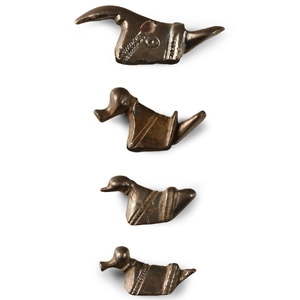
Iron Age Celtic Silver Duck Mount Group
2nd century B.C.-1st century A.D.Sold for (Inc. bp): £221
Each with saddle-shaped body, hatched bands, bulbous head, two with scooped beak and two with pointed beak; all concave to the underside. 11.1 grams total, 17-26 mm
Property of a Suffolk, UK, gentleman; from his private collection acquired in continental Europe. Acquired on the UK art market in 2015. Property of a Kent lady collector.
The duck appears in a number of contexts in Celtic art, mainly on vessels associated with feasting. Ducks are also sacred to the Gallic goddess, Sequana who had a major healing shrine based at the source of the river Seine in Burgundy, France. A bronze figure was found at the temple depicting Sequana standing in a boat which had a duck head at the prow. The duck appears to be an attribute of a celestial deity as well. We know that in the Celtic period the sun and sky gods were complicated figures who were linked not only with the heavens but also with water and the underworld. It is possible that the duck was perceived as a suitable solar emblem because it was both able to fly and swim, thus bringing together the elements of sky and water. To the pagan Celts, the sun and water were both related to healing and so it is possible that small votive images such as these were offered at shrines in the hope of a cure.
