
Loading, please wait...
LOT 0247
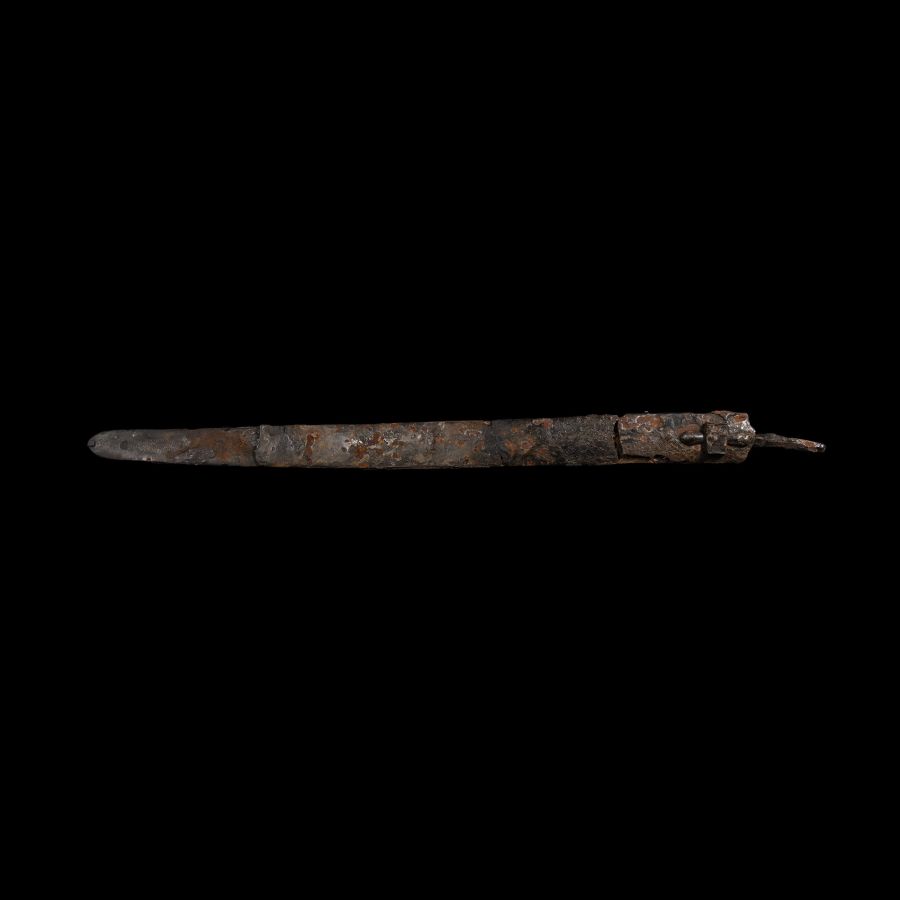
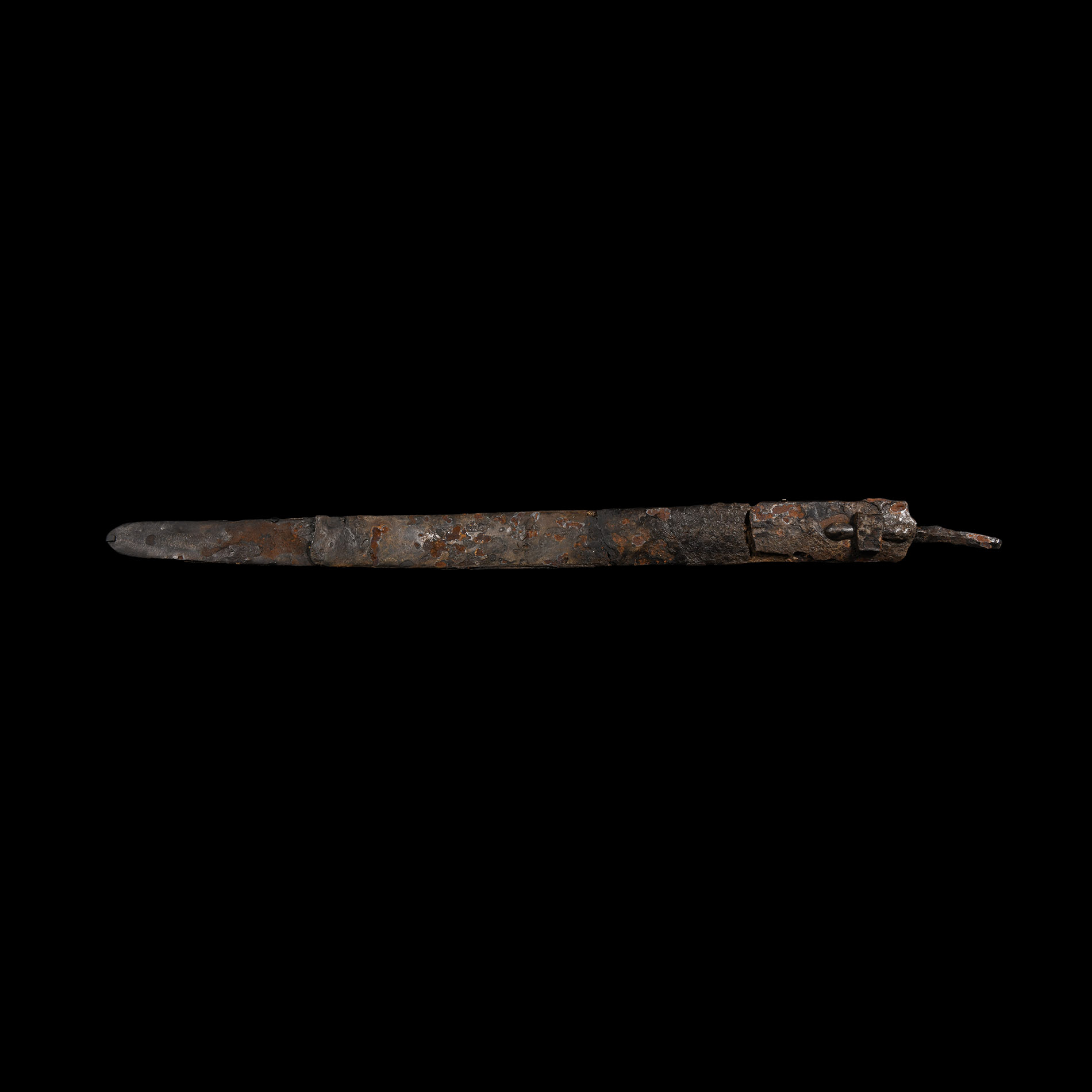
Iron Age Celtic La Tene III Sword
1ST CENTURY B.C.
34 1/4 in. (1.5 kg total, 87 cm).
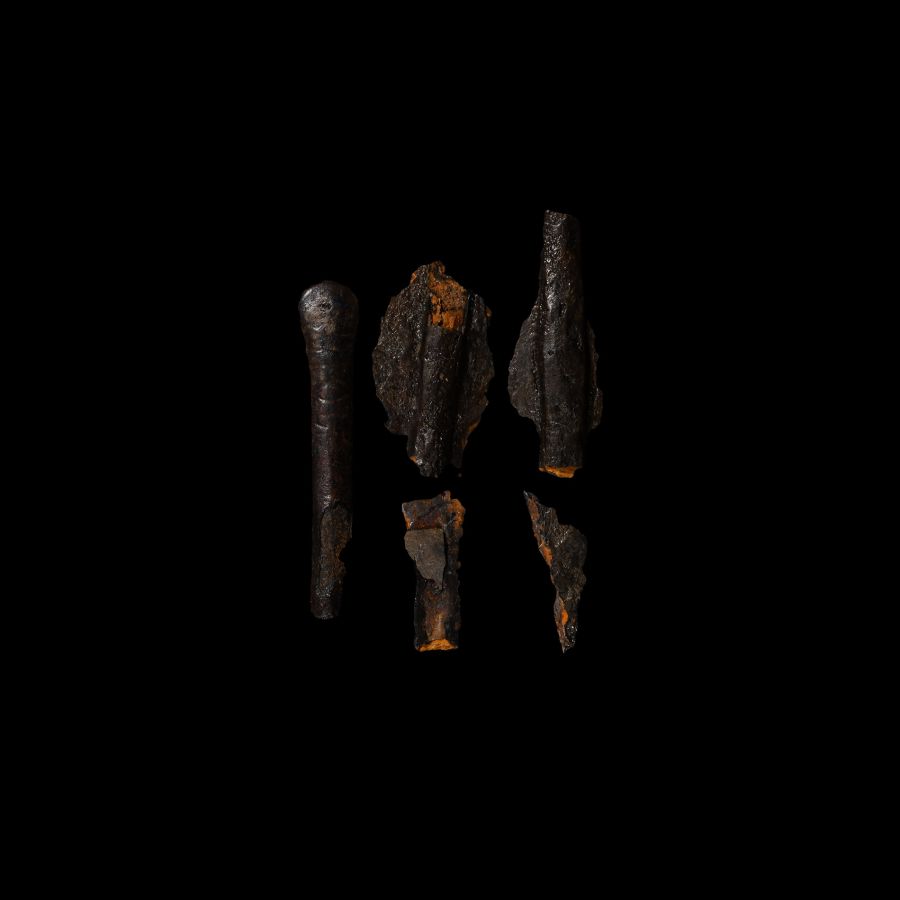
Accompanied by a scabbard with fragments of the slider; the sword with lentoid-section two-edged iron blade, tapering gently to a broad point; slightly bent square-section tang; the fragments of the scabbard show a broad, slender sheath with stepped lower end, the obverse face rolled over the edges to clasp the reverse plate; the suspension elements comprising a fragment of the transverse bars clasping the front and back plates connected to vertical flared straps with a stepped slider-loop to the centre, once framed by two more similar bars with vertical straps forming a hollow square in which the slider-loop sits; mounted on a wall display mount.
ProvenancePrivate collection, Munich, Germany, 1970s.
Private collection, London, UK, 2014, acquired from the above.
Cf. similar specimens in Tasic, N., Scordisci, and the native population in the Middle Danube Region, Belgrade, 1992, nos.56-59, and especially no.59.
FootnotesCeltic swords of this period were longer, reaching one meter in length, with the tip having the tendency to be rounded, while the scabbards were less decorated or more simply ornamented than the swords of the previous period.
CONDITIONTimeLine Auctions follows a vetting process to ensure the authenticity and legality of all items, reinforcing our commitment to integrity and responsible trading. Each antiquity, antique, and coin lot undergoes thorough examination by a vetting committee of at least ten external specialists, professional trade association members, scientists, and archaeologists: Our Vetting Process
AUCTIONS:
TimeLine is a leading auction house specialising in antiquities, ancient art, collectables, natural history, coins, medals, and books. Our auctions offer museums, collectors, historians, and enthusiasts the opportunity to acquire unique and historically significant pieces.
-
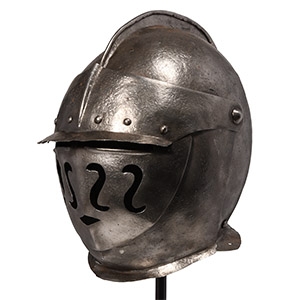
European Savoyard Burgonet
Circa 1620 A.D.Estimate: £3,500 - 4,500 (+bp*)
Opening Bid: £1,389
Comprising a full face shield with broad wavy bars and a small mouth opening, a wide hinged visor; the visor and the front section of the helmet secured by large hook-and-eye closures on the right-hand side; the crown with a tall ridge running from front to back, small collar for protecting the neck. 1.14 kg, 25 cm high
Acquired from Andrew Bennett in 2016. The Kusmirek Collection, UK. Accompanied by a copy of a payment confirmation from Andrew Bennett, dated 1st June 2016. Accompanied by an academic report by Dr Raffaele D'Amato. This lot has been checked against the Interpol Database of stolen works of art and is accompanied by search certificate number no. 11768-203986.
This variation of the burgonet helmet is thought to have originated in the Savoy region of southeast France, and was very popular with heavy cavalry (Reiters) serving with a variety of Continental armies of the period. The term Savoyard is a reference to a large number of these helmets that the Swiss captured from the troops of the Duke of Savoy during an unsuccessful assault on the city of Genoa in 1602. The undulated bars and the small mouth of the visor are all indicative of the Savoyard style. The hinges on the side allowed the front of the helmet as a whole to be lifted away from the rear, aiding the wearer to place it over his head. -
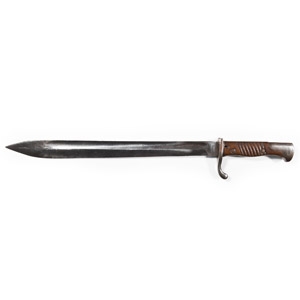
German WWI Erfurt 'Butcher' Bayonet
20th century A.D.Sold for (Inc. bp): £130
Featuring a fullered blade with wood-scale hilt and press-release stud; stamped with a maker's mark and issue date. 557 grams, 50.2 cm
Acquired from The Lanes Armoury, Brighton, UK. The Kusmirek Collection, UK. Accompanied by a Lanes Armoury certificate of authenticity. -
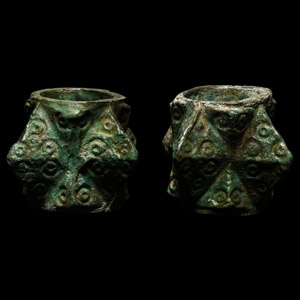
Medieval Decorated Bronze Macehead Group
14th century A.D.Sold for (Inc. bp): £208
Each with four large triangular-shaped projections flanked by smaller projections; decorated with groups of ring-and-dot ornaments. 155 grams total, 46 mm each
Private collection, UK, formed in the 1980s. The Kusmirek Collection, UK.
The polygonal mace evolved into the hexagonal winged mace. Originating in the East, this weapon spread across Eastern Europe during the 13th century A.D., and from there to the West. The winged mace, used by the western Europeans, was almost certainly based upon Eastern Roman or Islamic prototypes. It is relevant to note that the polygonal mace was widely used by the eastern cavalrymen (like Turkish and Mongols), during the 14th century A.D.
