
Loading, please wait...
LOT 0304
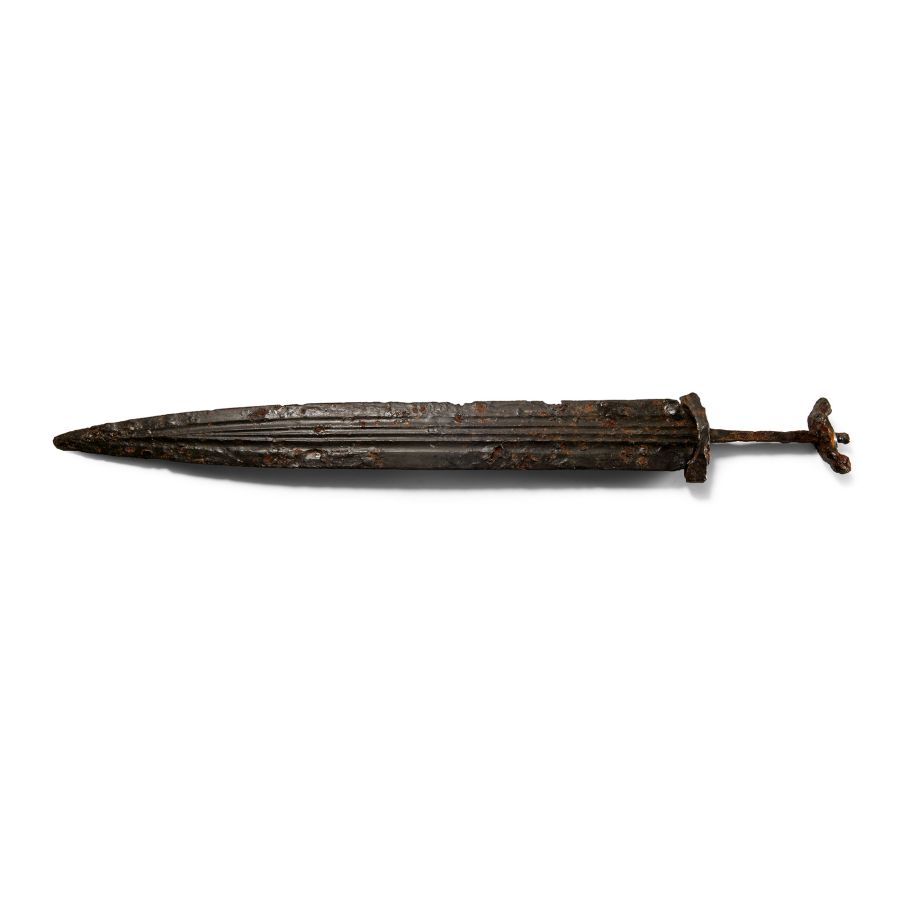
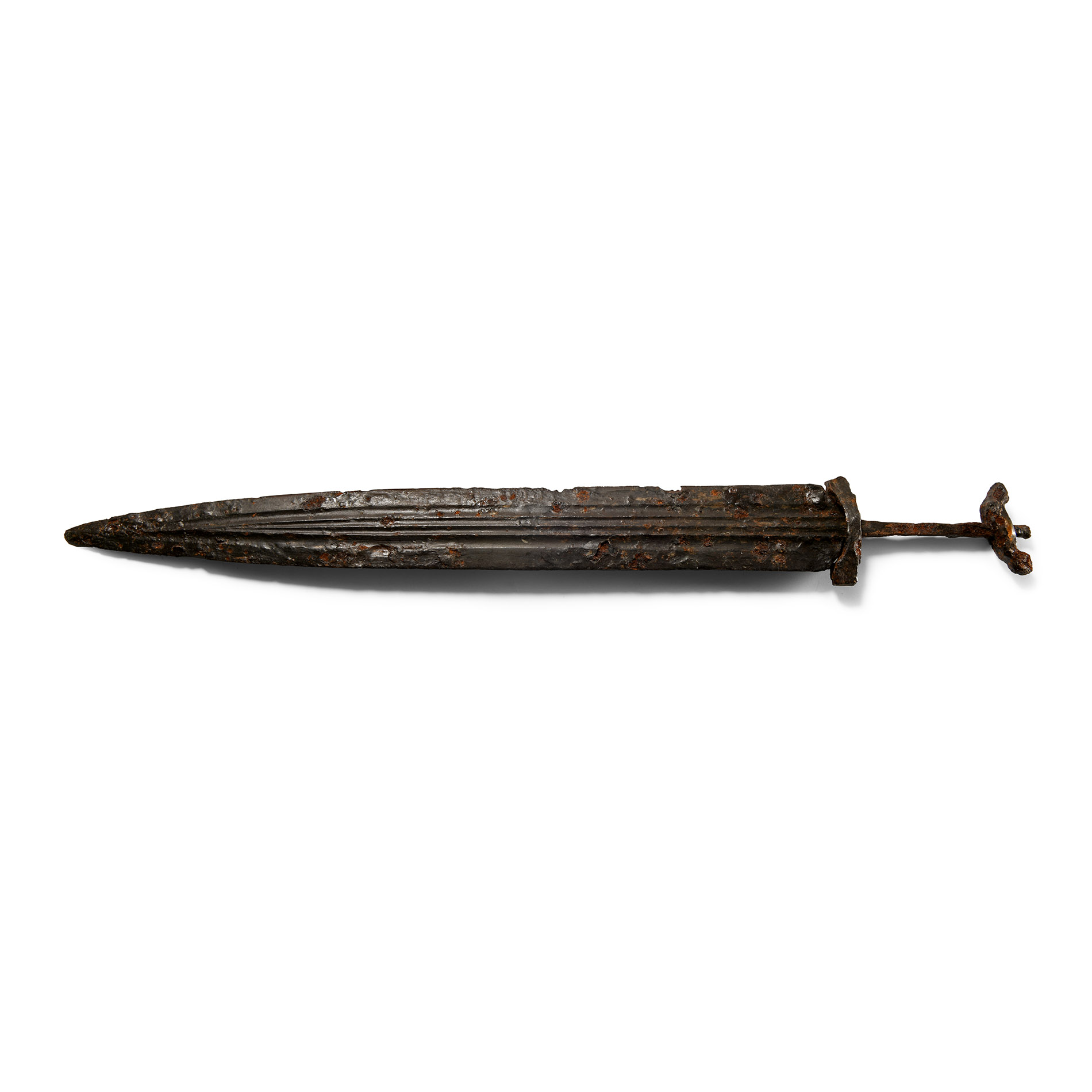
Iron Age Celtiberian Dagger
CIRCA 2ND-1ST CENTURY B.C.
14 3/4 in. (186 grams, 37.5 cm).
Hand-forged with leaf-shaped blade and three pronounced midribs, rounded shoulder, stepped lower guard square-section tang, upper guard with stepped upper face.
ProvenanceEx Mayfair gallery, London, UK, before 1999.
Property of a London, UK, gentleman.
Accompanied by a copy of a previous catalogue information page.
TimeLine Auctions follows a vetting process to ensure the authenticity and legality of all items, reinforcing our commitment to integrity and responsible trading. Each antiquity, antique, and coin lot undergoes thorough examination by a vetting committee of at least ten external specialists, professional trade association members, scientists, and archaeologists: Our Vetting Process
AUCTIONS:
TimeLine is a leading auction house specialising in antiquities, ancient art, collectables, natural history, coins, medals, and books. Our auctions offer museums, collectors, historians, and enthusiasts the opportunity to acquire unique and historically significant pieces.
-
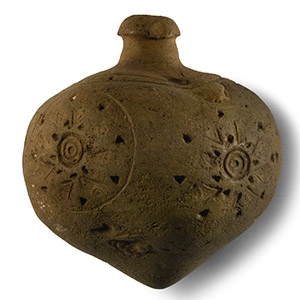
Arab 'Greek Fire' Ceramic Fire Bomb or Hand Grenade
13th century A.D.Sold for (Inc. bp): £143
Piriform body decorated with concentric circles inside a eight rays pointed star pattern, with domed filler-hole, intended to be filled with explosive liquid and wick, used as a hand grenade. 610 grams, 11.5 cm
Acquired 1980-2015. Ex Abelita family collection. Accompanied by an academic paper by military specialist Dr Raffaele D'Amato, dated 15 July 2019 and titled 'Eastern Roman Empire - Greek Fire Bomb or Hand Grenade (μεσαίον kακάβιον) 9th-11th century AD'.
The Arabs, following the Roman examples, made great use of these weapons. The efficiency of the weapon appears, for example, from the account of the siege of Akka in 1189, given by the contemporary historian Ibn al-Athir. He tells how the Christians exercised their engineering skill and built mighty beffroys. The situation was hopeless for the defending Arabs until a man from Damascus showed up, because he knew how to produce Greek Fire: ‘To trick the Christians he first threw some vesseIs with naptha and other things, which were not set on fire, upon one of the beffroy’s, and it was without power. The Christians...climbed the top of the beffroy...the man from Damascus waited until the contents of the vessels were spread all over. When the moment came,he threw a new pot, which was set on fire. In a few moments the fire was spread all over, and the beffroy was eaten up by the flames. The fire was spread in such a hurry that the Christians could not manage to climb down from the beffroy. Men, weapons, everything was eaten up by the flames.’ -
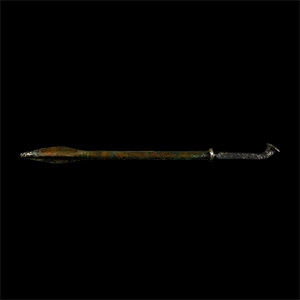
Western Asiatic Bronze Javelin Head
Late 3rd millennium B.C.Estimate: £250 - 350 (+bp*)
Opening Bid: £125
Featuring a tripartite weapon with short, narrow leafy blade, elongated stem decorated by embossed geometric lines and folded tang. 220 grams, 32.3 cm
Acquired 1980-2015. Ex Abelita family collection.
The points within this typology are biconvex or leaf-shaped, not very sharp. These types of spears have been found in the tombs of Palestine from Tell el-'Ajjul (tomb 227) to the sites of the central plains and the banks of Jordan: Yavne, 'Ain Samiya, Jebel Qa'aqir, tombs G 83 and M 13 of Jericho, tombs 2100 and 2111 of Lachish. All are dated to the last two centuries of the 3rd millennium. -
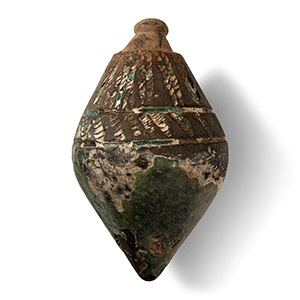
Byzantine 'Greek Fire' Ceramic Fire Bomb or Hand Grenade
9th-11th century A.D.Sold for (Inc. bp): £169
Biconvex body with impressed bands to the shoulder, domed filler-hole, gesso and painted surface, intended to be filled with explosive liquid and wick, used as a hand grenade. 575 grams, 15.5 cm
Acquired 1980-2015. Ex Abelita family collection. Accompanied by an academic paper by military specialist Dr Raffaele D'Amato, dated 15 July 2019 and titled 'Eastern Roman Empire - Greek Fire Bomb or Hand Grenade (μεσαίον kακάβιον) 9th-11th century AD'.
Apart from the use of siphons or manual flame-throwers called cheirosiphona, special corps of Roman soldiers employed terracotta grenades, in the form of small jars, abundantly evidenced in archaeological excavations. They were called μεσαία kακαβιά or κυτροκακάβια where the former had a bulbous shape and the latter a more cylindrical form.
