
Loading, please wait...
LOT 0248
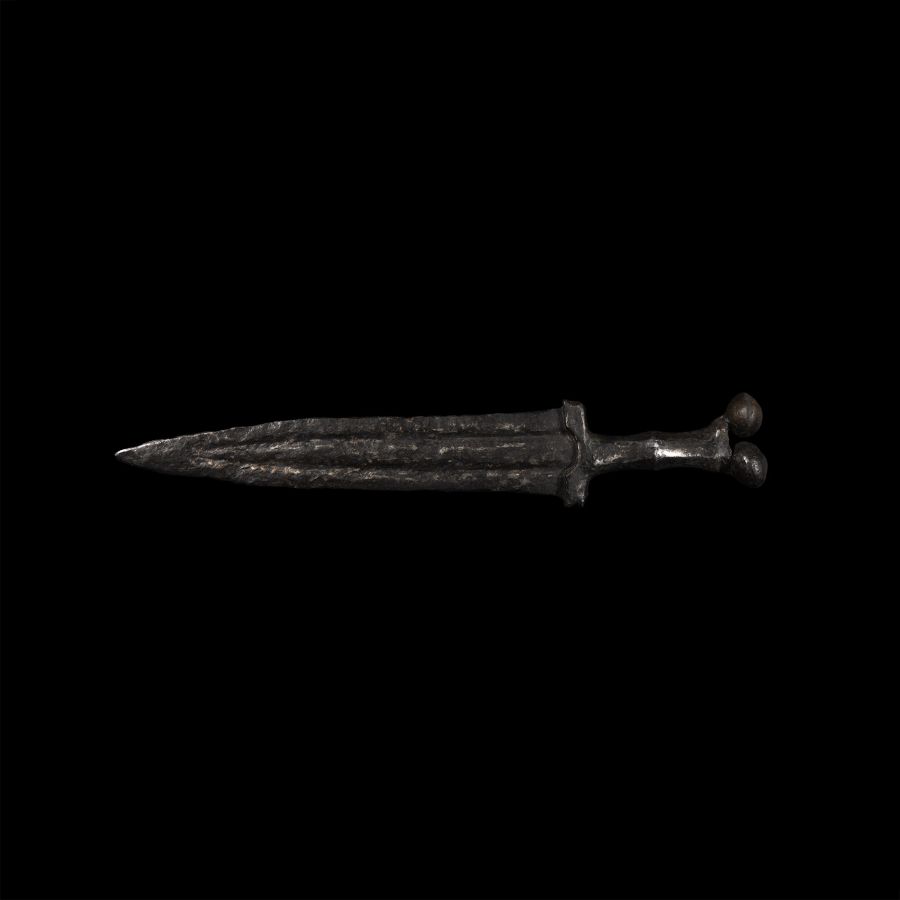
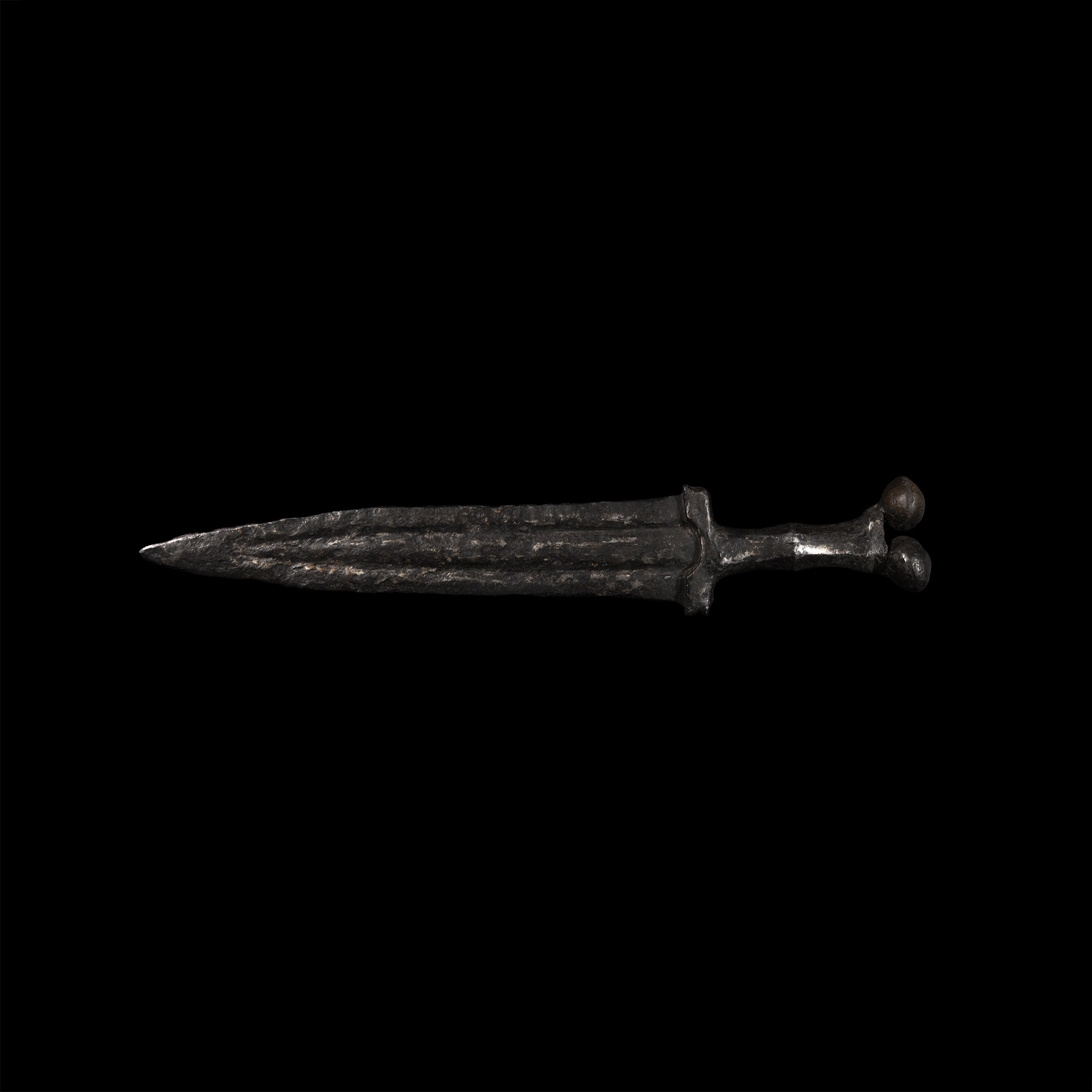
Iron Age Celtiberian Dagger
CIRCA 6TH-5TH CENTURY B.C. OR LATER
12 1/4 in. (255 grams, 31 cm).
Featuring a leaf-shaped double-edged iron blade, shallow fullers tapering to a point, short straight quillons, a soldered two-part grip with ridged middle bulge, the flat pommel surmounted with two spherical finials.
ProvenanceAcquired 1990s-early 2000s.
East Anglian private collection.
Cf. Nieva, I.F., Zubillaga, E.G., 'Las armas de las necropolis Celtibericas de Carasta y La Hoya (Alava, Espana), Tipologia de sus punales y prototipos del Pugio' in Journal of Roman Military Equipment Studies, 8, 1997, pp.137-150, fig.5, 2; Quesada Sanz, F., ‘Gladius Hispaniensis: an archaeological view from Iberia’ in Journal of Roman Military Equipment Studies, JRMES, 8, 1997, pp.251-270.
FootnotesThis type of dagger presents a plate handle system, very similar to that of the Fronton sword and bilobular types, but unlike these, it develops to an antenna terminal on the pommel. It is a type of dagger that is documented in peninsular necropoleis of Hispania from the Iron Age II, such as La Mercadera, Requijana de Gormaz or Uxama. It is type V of short antennae daggers according the classification of F. Quesada Sanz, a possible ancestor of the Roman pugio.
CONDITIONTimeLine Auctions follows a vetting process to ensure the authenticity and legality of all items, reinforcing our commitment to integrity and responsible trading. Each antiquity, antique, and coin lot undergoes thorough examination by a vetting committee of at least ten external specialists, professional trade association members, scientists, and archaeologists: Our Vetting Process
AUCTIONS:
TimeLine is a leading auction house specialising in antiquities, ancient art, collectables, natural history, coins, medals, and books. Our auctions offer museums, collectors, historians, and enthusiasts the opportunity to acquire unique and historically significant pieces.
-
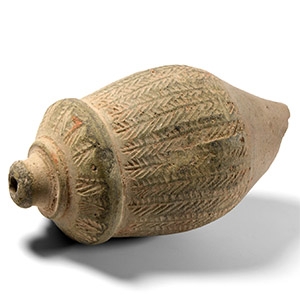
Byzantine Ceramic 'Greek Fire' Fire Bomb or Hand Grenade
9th-11th century A.D.Sold for (Inc. bp): £163
Composed of a piriform body with 'feather' design and eccentrically placed domed mouth; intended to be filled with explosive liquid and wick, and used as a hand grenade; chipped foot. 613 grams, 17 cm
Collected before 1970. Ex gallery of C.M., UK. Accompanied by an academic paper by military specialist Dr Raffaele D'Amato, dated 15 July 2019 and titled 'Eastern Roman Empire - Greek Fire Bomb or Hand Grenade (μεσαίον kακάβιον) 9th-11th century AD'.
Apart from the use of siphons or manual flame-throwers called cheirosiphona, special corps of Roman soldiers employed terracotta grenades, in the form of small jars, abundantly evidenced in archaeological excavations. Such were the γανωτα, vessels (sometimes also of bronze) used for Greek fire. They were called μεσαία kακαβιά or κυτροκακάβια where the former had a bulbous shape and the latter a more cylindrical form. -
.jpg)
Roman Bronze Military Mask Helmet Section
3rd century A.D.Sold for (Inc. bp): £975
From the upper part of the right side of the face mask, the upper edge with a band of embossed curved lines, probably representing stylised hairs, intertwined with laurel crown; embossed image of advancing Mars, the god of war, to the centre, depicted nude with military sagum, a pseudo-Corinthian helmet to the head and carrying a circular shield. 55 grams, 17 cm wide
Acquired 1960s-1990s. Late Alison Barker collection, a retired London barrister.
In the decorative patterns of Roman helmets, Mars was among the most revered deities in the Imperial army. After Jupiter, he was the most aristocratic god of the old Italic religion, master of armament, who governed military service (militiae potens) and oversaw the training ground, for which he was named Campester. The emperor Augustus named him Ultor (‘Avenger’) and dedicated to him a luxurious temple in the centre of the forum in gratitude for his victory over the murderers of Caesar and, in addition, granted to him the privileges of the Capitoline Jupiter. -
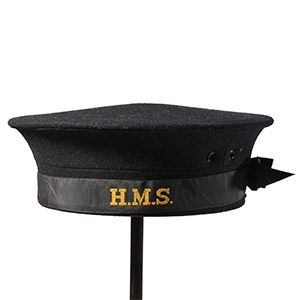
Royal Navy Rating's Cap
Dated 1942 A.D.Sold for (Inc. bp): £20
Standard British naval issue dark blue rating's cap with Toronto maker's ink stamp and date inside, fitted with black fabric 'H.M.S.' ribbon and chin-strap. 196 grams, 25 cm
Acquired from The Historic Flying Clothing Company, 2014. The Kusmirek Collection, UK. Accompanied by a copy of a previous invoice.
