
.jpg "Ionia, Ephesos AR Hekte – Sixth Stater.")
LOT 2936
Ionia, Ephesos AR Hekte – Sixth Stater. Circa 550-500 BC.
Persic standard. Bee / Stellate pattern within incuse square. Karwiese I Series IIIA, 21; SNG Kayhan 1227-30. Extremely Fine. Apparently the finest known example. Rare.(1.72gr, 10mm).
ProvenanceFrom a Swiss private collection, before 2005.
TimeLine Auctions follows a vetting process to ensure the authenticity and legality of all items, reinforcing our commitment to integrity and responsible trading. Each antiquity, antique, and coin lot undergoes thorough examination by a vetting committee of at least ten external specialists, professional trade association members, scientists, and archaeologists: Our Vetting Process
AUCTIONS:
TimeLine is a leading auction house specialising in antiquities, ancient art, collectables, natural history, coins, medals, and books. Our auctions offer museums, collectors, historians, and enthusiasts the opportunity to acquire unique and historically significant pieces.
-
.jpg)
Cilicia, uncertain mint AR Hemiobol. Circa 450-400 BC.
Sold for (Inc. bp): £26
Head of Herakles facing slightly to right, with club over shoulder / Head of lion facing slightly to left, with arrow in mouth. Cf. SNG Levante 204-5 (Herakles to left). 0.27gr, 8mm, 7h
Near Very Fine.
Property of a North London, UK, gentleman. -
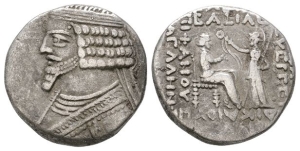
Kings of Parthia, Phraates IV AR Tetradrachm. Circa 38/7-2 BC.
Sold for (Inc. bp): £52
Seleukeia on the Tigris mint. Dated Daisios 288 SE (May 24 BC). Diademed and draped bust to left, with pointed beard / [ΒΑΣΙΛΕΩΣ] ΒΑΣΙΛΕ[ΩΝ] above, [ΑΡΣΑΚΟY] EYEPΓET[OY] to right, ΔΙΚΑΙΟY and [ΗΠC] ΔΑΙΣ[ΙΟΥ] (date) below, [ΕΠΙ]ΦΑΝΟYΣ [ΦΙΛ]ΕΛΛΗΝΟΣ to left, Phraates seated to right on throne, receiving wreath from Athena standing to left, who holds sceptre with left hand. Sellwood 52.3; Sunrise -; Shore -; Callataÿ, Tétradrachmes 326-32. 10.51gr, 26mm, 12h
Very Fine.
Acquired on the UK market before 2000; Property of a London, UK, gentleman. -
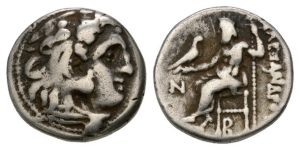
Kingdom of Macedon, Antigonos I Monophthalmos AR Drachm. As strategos of Asia, 320-306/5 BC, or king, 306/5-301 BC.
Sold for (Inc. bp): £39
'Kolophon' mint. In the name and types of Alexander III. Struck circa 310-301 BC. Head of Herakles to right, wearing lion skin headdress, paws tied beneath chin / ΑΛΕΞΑΝΔΡΟ[Υ], Zeus seated to left on backless throne, right leg drawn back, his feet resting on a low foot rest, holding long sceptre in his left hand and, in his right, eagle standing to right with closed wings; N to left, B beneath throne. Price 1800. 4.09gr, 17mm, 12h
Near Very Fine.
Acquired on the UK art market; Property of an Essex, UK, gentleman.
