Loading, please wait...

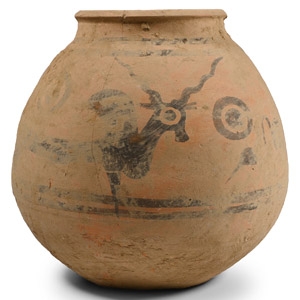
Indus Valley Terracotta Vessel with Geometric Designs Indus Valley Terracotta Vessel with Geometric Designs Indus Valley Terracotta Vessel with Geometric Designs
Use mousewheel to zoom in and out, click to enlarge
Details

LOT 0440

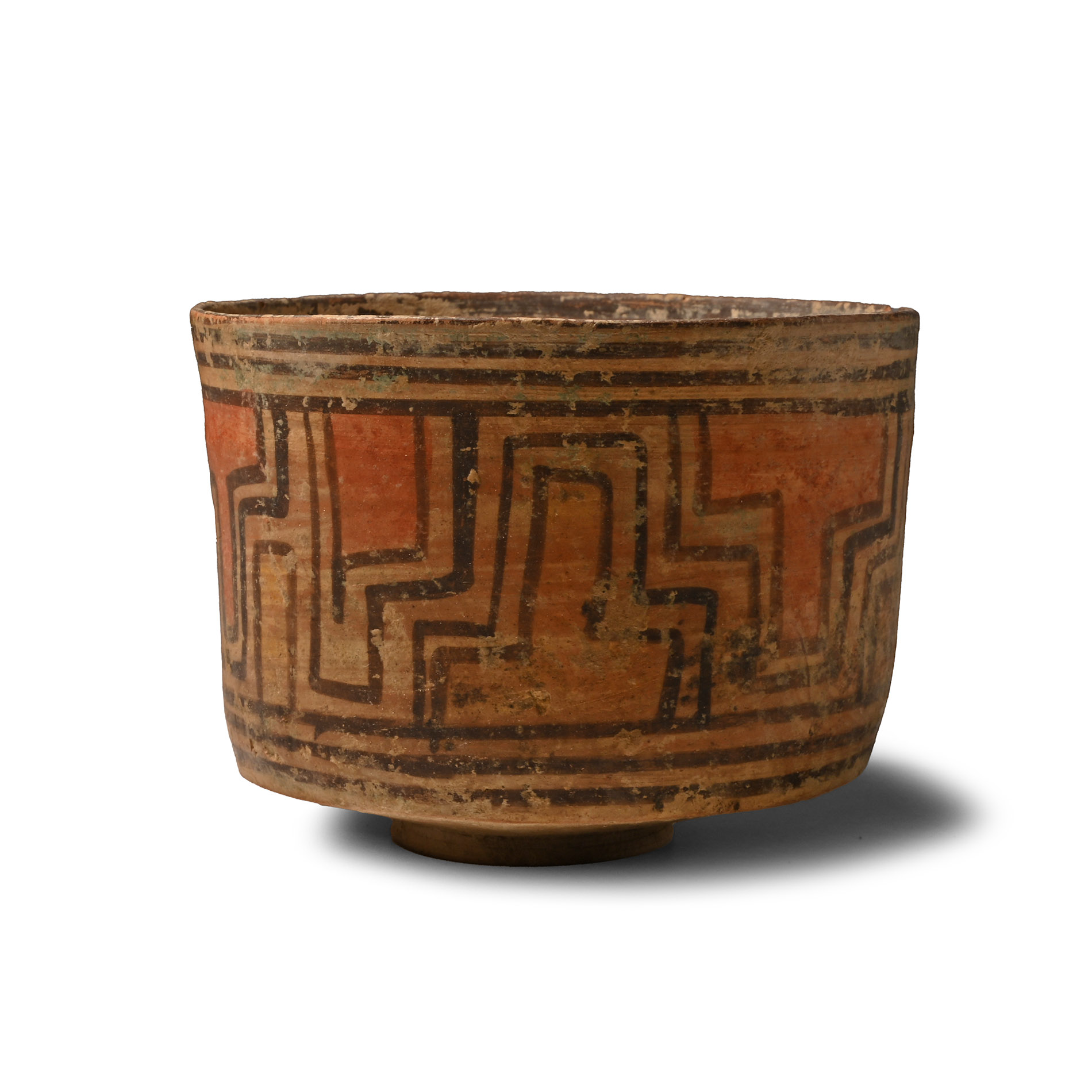
Indus Valley Terracotta Vessel with Geometric Designs

CIRCA 2200 B.C.

3 3/4 in. (117 grams, 95 mm).

Drum-shaped in profile with basal ring, band of interlocking T-shaped and other painted cells; rim chipped.

Provenance

Joseph G Gerena Fine Art, New York, 27 October 2003.
Acquired by the present owner from the above.

Literature

See Satyawadi, S., Proto-Historic Pottery of Indus Valley Civilisation: Study of Painted Motifs, Perspectives in Indian Art and Archaeology, vol.2, New Delhi, 1994.

CONDITION
VETTING:

TimeLine Auctions follows a vetting process to ensure the authenticity and legality of all items, reinforcing our commitment to integrity and responsible trading. Each antiquity, antique, and coin lot undergoes thorough examination by a vetting committee of at least ten external specialists, professional trade association members, scientists, and archaeologists: Our Vetting Process


AUCTIONS:

TimeLine is a leading auction house specialising in antiquities, ancient art, collectables, natural history, coins, medals, and books. Our auctions offer museums, collectors, historians, and enthusiasts the opportunity to acquire unique and historically significant pieces.

LOT 0440

Indus Valley Terracotta Vessel with Geometric Designs

Estimate £500 - 700€580 - 810 (for guidance only)$680 - 950 (for guidance only)

Print page

RELATED LOTS
  • Gandharan Head of Dionysus
    Gandharan Head of Dionysus
    2nd-4th century A.D. or later

    Sold for (Inc. bp): £1,040

    A carved schist head with tightly curled hair, wreath to the brow with a vine-leaf at each temple, curled moustache and beard, ears with long lobes; mounted on a custom-made stand. 3.75 kg, 29.5 cm


    Acquired 1960-1980s. From an important London, W1, collection. Private collection, England.

    With the arrival of Greek colonists into Central Asia and Northern India and the establishment of the Indo-Greek kingdom, came Greek culture and religion which merged with that of the local population. Greek deities, such as Dionysus, were often merged with Buddhist deities, or worshipped in their own right. The image of Dionysus as a mature male with beard and wreath is often referred to as the Indian Dionysus as it depicts the god after his triumphant return from the East with his retinue of Maenads. The adventures of Dionysus in India are recounted in the Greek epic poem, the Dionysiaca. The image of Dionysus returning from India in a chariot pulled by tigers was a favourite for Classical artists and often appeared on sarcophagi as an allegory for the rebirth of the soul. Drinking wine, dancing, and music making were popular subjects for the embellishment of early Buddhist religious centres. The Buddha condemned intoxicants, and music and dance were considered unfit for the monastic community, although they were tolerated in lay contexts. The reason for the depiction of scenes of revelry, along with the Greek god Dionysus, may be the earlier, pre-Buddhist practices celebrating abundance and agricultural prosperity, which involved wine drinking. Dionysus may have been transformed and and understood in the Gandharan context as the South Asian god Indra, whom lay followers would have known as the deity who rules over the paradise known as the Trayastrimsa heaven. As the lay Buddhist community was more concerned with having a positive rebirth (enlightenment being out of reach for all but the most learned of monks) the idea of being reborn in a heaven associated with Indra would no doubt have been attractive. It is thought that the influence of Dionysus on Indian culture may have inspired the development of the Hindu deities Shiva and Krishna, both of whom share similar characteristics to the Greek god.

    Lot Details

  • West Central Asian Stamp Seal with Eagle
    West Central Asian Stamp Seal with Eagle
    23rd-20th century B.C.

    Sold for (Inc. bp): £247

    Zoomorphic seal with V-shaped handle to the reverse; accompanied by an old scholarly note, typed and signed by W.G. Lambert, late Professor of Assyriology, University of Birmingham, 1970-1993, which states: 'Stam Seal of Bronze 45.5x38x19 mm. This has the shape of the items depicted, with flat face and flat back with handle of inverted V-shape mounted on it. The design is compartmented but not open-work and is divided into two compartments, one with three projections, the other with two. This comes from west central Asia and dates to c. 2300-2000 B.C. The ends of the projections have slight denting, but otherwise the object is in very good condition. Interpretation of the design is difficult, but each section appears to have one head of an eagle and one set of an eagle's tail feathers, as if two eagles are crossed, but there is still a difficulty with the third head. The design is extremely rare.' 20 grams, 45 mm


    Ex Signo collection, the property of a West London businessman, formed in the late 1980s-early 1990s; collection number R-495, academically researched and catalogued by the late Professor Lambert in the early 1990s.

    Lot Details

  • Gandharan Terracotta Head
    Gandharan Terracotta Head
    2nd-4th century A.D.

    Estimate: £400 - 600 (+bp*)

    Opening Bid: £180

    Modelled in the round with narrow profile and thick nose, hair drawn up in a top-knot; mounted on a custom-made stand. 556 grams total, 16.2 cm including stand


    Acquired on the London art market. Private collection, 1970s.

    Lot Details

Stay up-to-date with the latest from TimeLine Auctions by joining our mailing list