Loading, please wait...

Use mousewheel to zoom in and out, click to enlarge

Details

LOT 1415

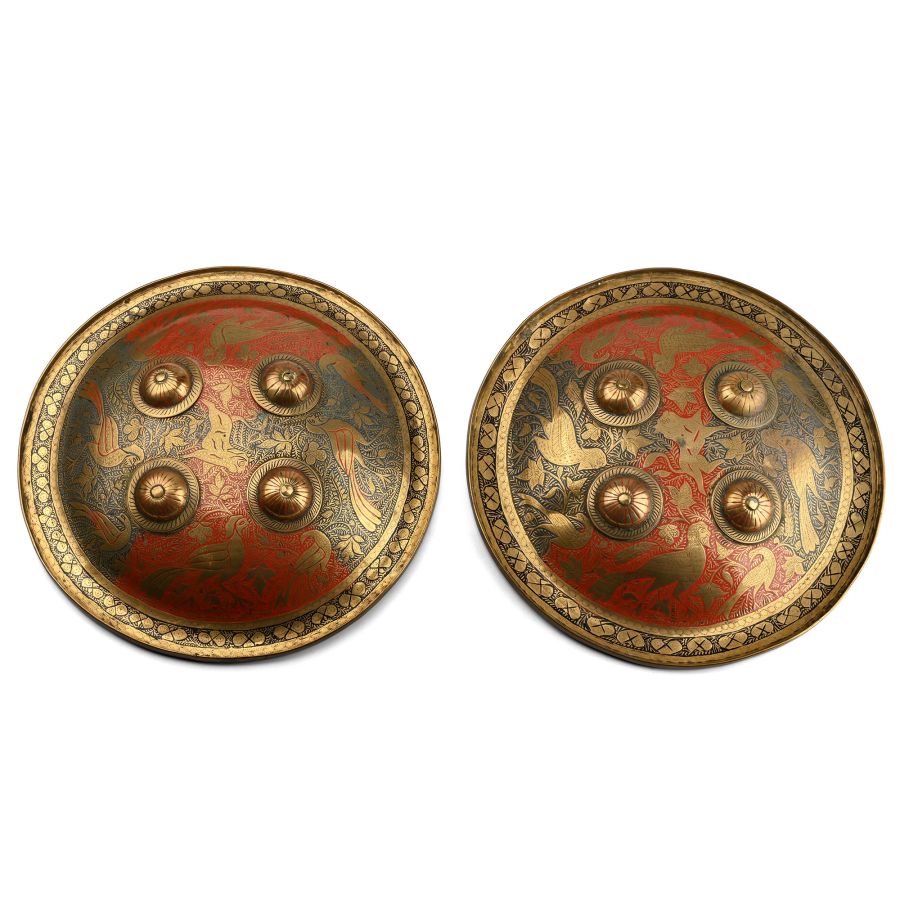
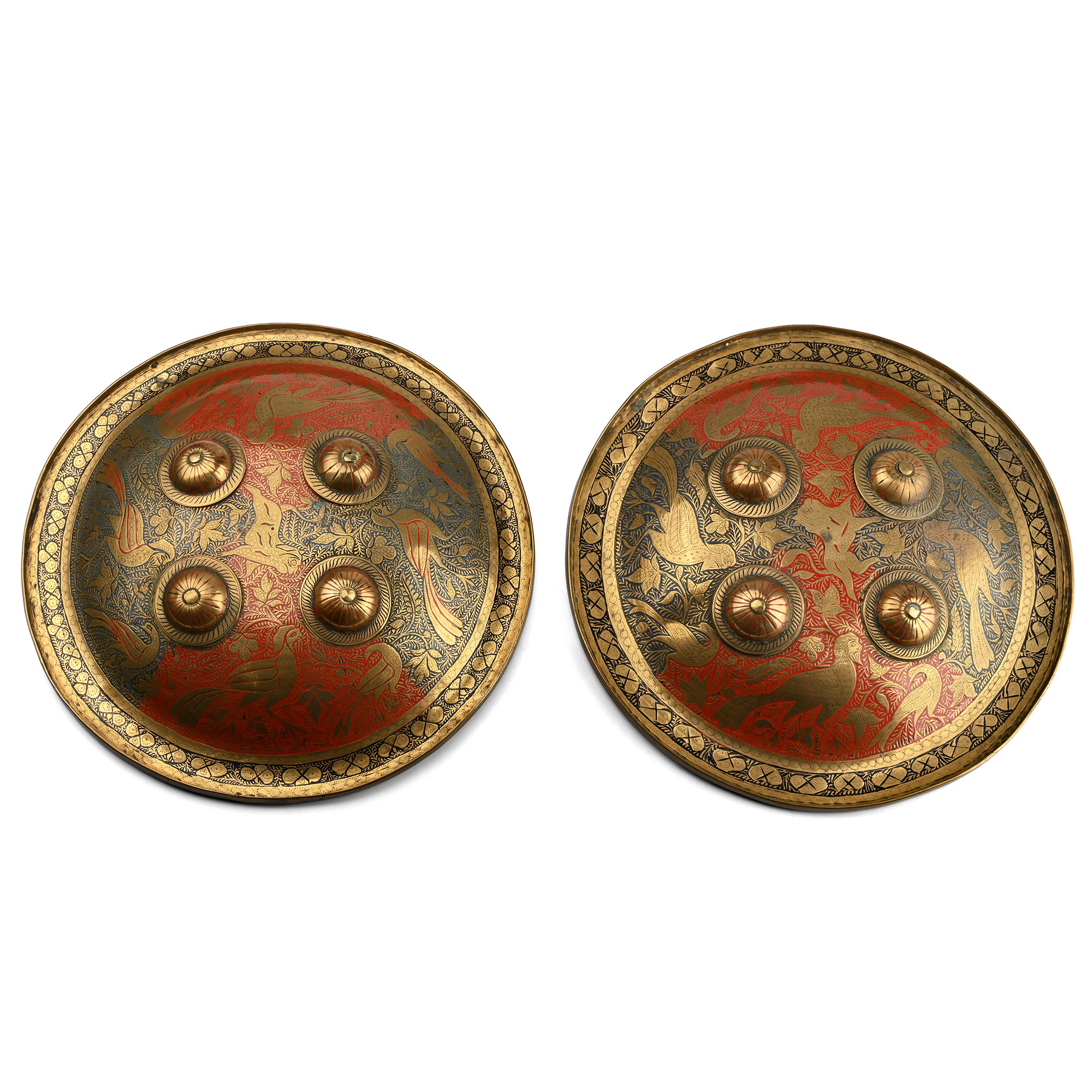
Indo-Persian Enamelled Brass Shield Pair

20TH CENTURY A.D.

10 3/4 in. (996 grams total, 27.3 cm).

Each with flange rim and four applied bosses to the face for attachment of the rear straps, design of reserved foliage, birds and harpies on an enamelled field. [2, No Reserve]

Provenance

Property of a Berkshire, UK, gentleman collector.

CONDITION

VETTING:

TimeLine Auctions follows a vetting process to ensure the authenticity and legality of all items, reinforcing our commitment to integrity and responsible trading. Each antiquity, antique, and coin lot undergoes thorough examination by a vetting committee of at least ten external specialists, professional trade association members, scientists, and archaeologists: Our Vetting Process


AUCTIONS:

TimeLine is a leading auction house specialising in antiquities, ancient art, collectables, natural history, coins, medals, and books. Our auctions offer museums, collectors, historians, and enthusiasts the opportunity to acquire unique and historically significant pieces.

LOT 1415

Indo-Persian Enamelled Brass Shield Pair

Sold for (Inc. bp): £156

Print page

RELATED LOTS

  • Luristan Bronze Short Sword
    Luristan Bronze Short Sword
    2nd-1st millennium B.C. and later

    Sold for (Inc. bp): £468

    With tapering, double-edged triangular blade and central midrib; crescent-shaped, tri-lobed guard at the shoulder; restored decorated cylindrical hilt with domed stone pommel. 878 grams, 54.2 cm


    From a North West London collection; previously acquired in the 1980s.

    Lot Details

  • Greek Bronze Chalcidian-Type Helmet
    Greek Bronze Chalcidian-Type Helmet
    Circa 5th-4th century B.C.

    Estimate: £12,000 - 17,000 (+bp*)

    Opening Bid: £6,000

    Hammered from sheet-bronze, hemispherical dome with a seam at the front and back, the seams secured together with a series of pins, threaded through rivet holes; from the front, a repoussé ridge forming curved brows leading down towards a nasal decorated with four pellets; two small perforations above the right brow and a perforation on either side of the top section; two cheek guards present, a characteristic of the helmet’s type, attached to the helmet with hinges, allowing for easier wear and construction; the cheek-pieces rectangular in shape and curved at the back; a horizontal band of inverted triangles decorating the top of each cheek guard, each pierced towards the bottom, where an inner lining would have been attached, two curved cut-outs behind to accommodate ears; accompanied by a custom-made display stand. 1.46 kg total, 48 cm including stand


    Previously with the Parthenon Gallery, WC1, London, UK; acquired 2010. From the J.L. collection, Surrey, UK. Accompanied by an academic report by Dr Raffaele D'Amato. This lot has been checked against the Interpol Database of stolen works of art and is accompanied by search certificate number no.12909-244364.

    The Chalcidian helmet was a popular type of helmet in the Hellenistic world, particularly in the Greek-occupied region of southern Italy, during the 5th and 4th centuries. However, types have also been found from the mid-6th century BC. It was a lightweight progression from the Corinthian helmet and allowed the wearer better hearing and vision than its older, bulkier Corinthian counterparts. The term ‘Chalcidian’ originates from its frequent depiction on pottery once thought to have come from the Euboean city of Chalcis. This variant of the Chalcidian helmet, featuring hinged cheekplates, is also known as the Lucanian type, as it was used extensively in Lucania. This type of helmet was still in use by the time of Alexander the Great, particularly by the hoplites, heavy infantrymen, and is thought to have developed into the Attic helmet, used well into the Imperial Roman era.

    Lot Details

  • Byzantine Greek Fire Ceramic Fire Bomb or Hand Grenade
    Byzantine 'Greek Fire' Ceramic Fire Bomb or Hand Grenade
    9th-11th century A.D.

    Sold for (Inc. bp): £234

    Ovoid in profile with scrolled linear decoration and impressed pellets; intended to be filled with explosive liquid and a wick, and used as a hand grenade. 400 grams, 10.7 cm


    From an important specialist collection, London, UK, 1990s onwards. Accompanied by an academic paper by military specialist Dr Raffaele D'Amato, dated 15 July 2019 and titled 'Eastern Roman Empire - Greek Fire Bomb or Hand Grenade (μεσαίον kακάβιον) 9th-11th century AD'.

    Apart from the use of siphons or manual flame-throwers called cheirosiphona, special corps of Roman soldiers employed terracotta grenades, in the form of small jars, abundantly evidenced in archaeological excavations. They were called μεσαία kακαβιά or κυτροκακάβια where the former had a bulbous shape and the latter a more cylindrical form.

    Lot Details

Stay up-to-date with the latest from TimeLine Auctions by joining our mailing list