
Loading, please wait...
LOT 0702
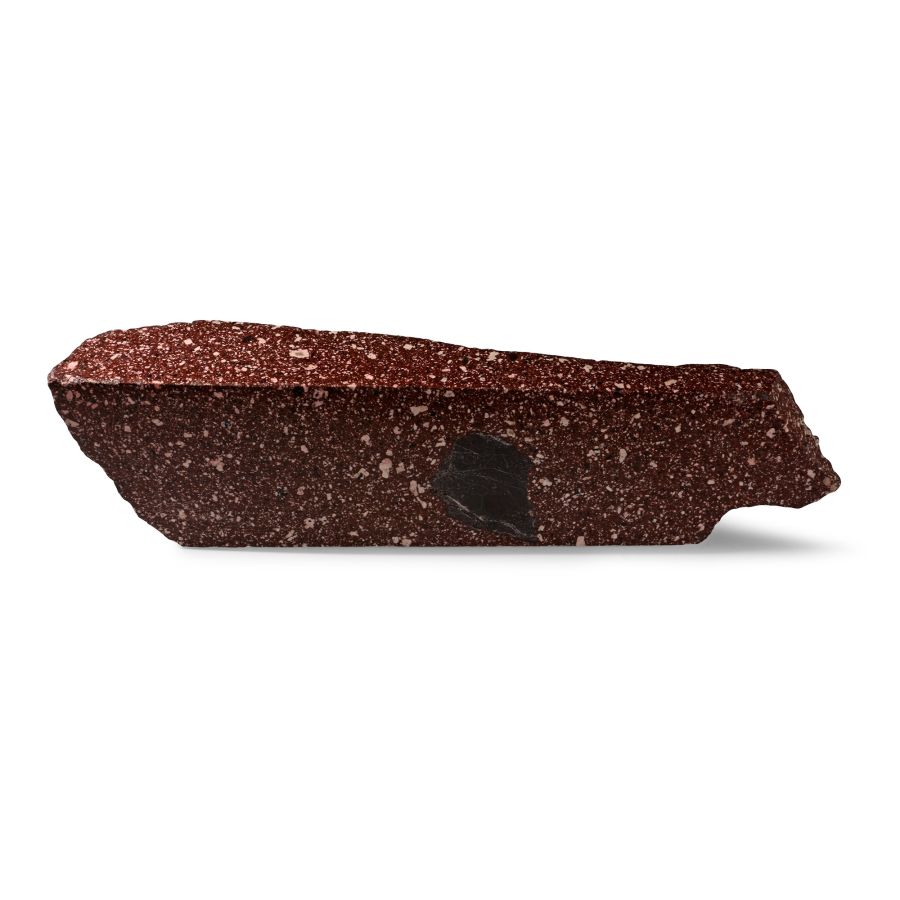
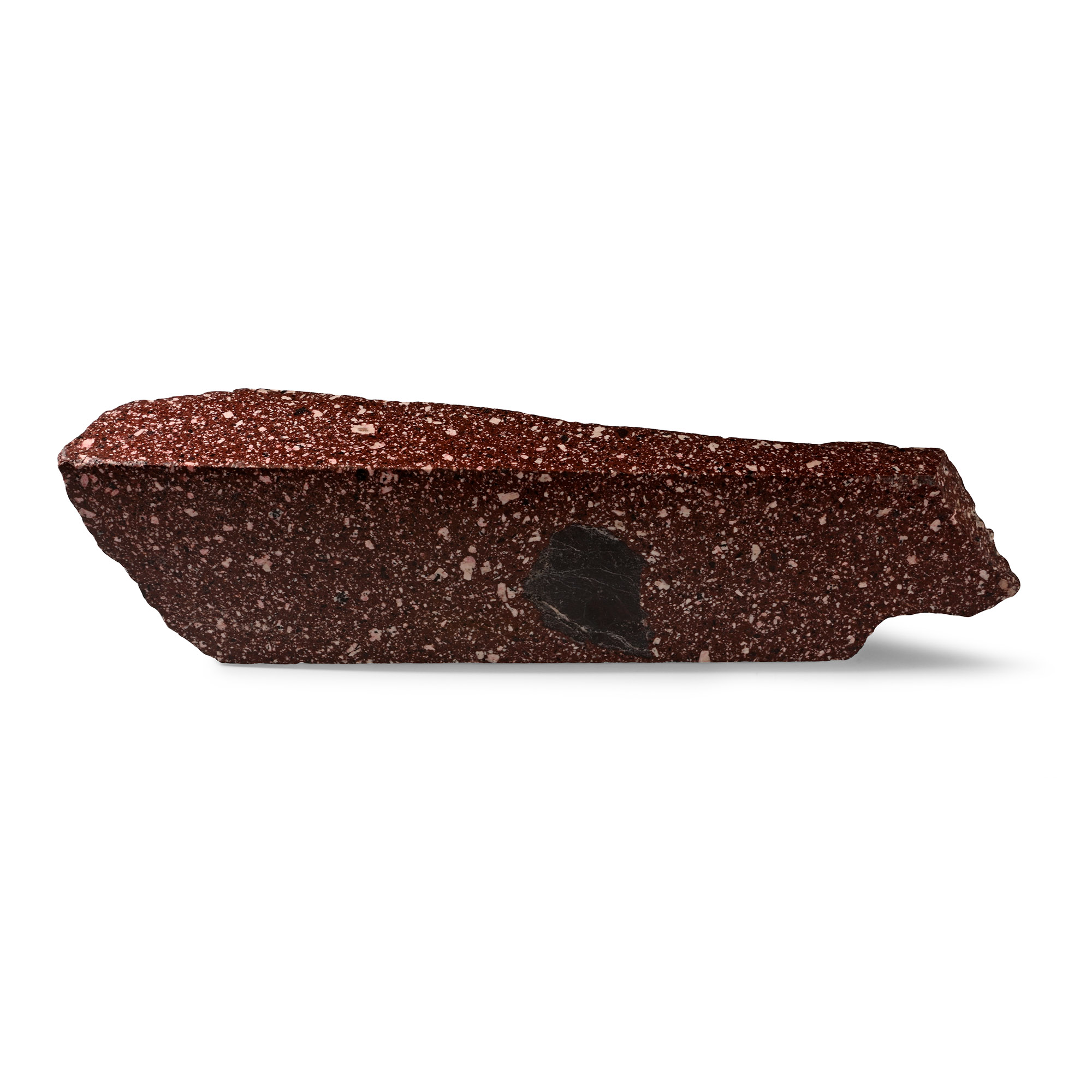
Imperial Porphyry Slab Section with a Black Xenolith
1ST-5TH CENTURY A.D. AND LATER
10 5/8 in. (1 kg, 27 cm).
Comprising irregular part of a polished porphyry block of rectangular shape, polished on three sides, with a black xenolith in the main face; probably from recarved material mined in ancient Roman times between the 1st and 5th century A.D.
ProvenanceFrom the private collection of a UK gentleman since the early 1980s.
This lot is accompanied by an illustrated lot declaration signed by the Head of the Antiquities Department, Dr Raffaele D'Amato.
Mons Porphyrites (today Jabal Abu Dukhkhan) is the mountainous site of a group of ancient quarries in the Red Sea Hills of the inhospitable eastern desert in Egypt, a five day trip from the Nile during Roman times. They were discovered by Caius Cominus Leugas in 18 A.D., and during the Roman Empire, the mines officially belonged to the emperor and were the only known source of the Imperial Porphyry, Mons Porphyrites. This dark purple stone was associated with royalty and used for prestigious sculpture and architecture. The location of the mines was lost some time in the 5th century, and rediscovered in the early 19th century. Excavations in the area have revealed the well-preserved quarries and the dwelling places of the quarrymen, and also thousands of ostraca have been discovered containing messages that provide details of how the quarrying took place, and of how the highly skilled quarrymen ordered their food.
CONDITIONTimeLine Auctions follows a vetting process to ensure the authenticity and legality of all items, reinforcing our commitment to integrity and responsible trading. Each antiquity, antique, and coin lot undergoes thorough examination by a vetting committee of at least ten external specialists, professional trade association members, scientists, and archaeologists: Our Vetting Process
AUCTIONS:
TimeLine is a leading auction house specialising in antiquities, ancient art, collectables, natural history, coins, medals, and books. Our auctions offer museums, collectors, historians, and enthusiasts the opportunity to acquire unique and historically significant pieces.
-
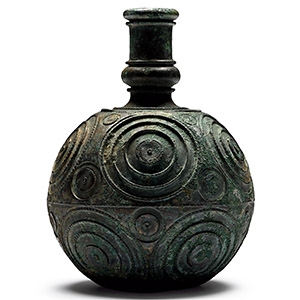
Roman Bronze Bottle with Circular Design
3rd-4th century A.D.Sold for (Inc. bp): £5,200
Spherical in profile with flat base, large raised concentric circles in two bands with smaller similar motifs between; separate balustered neck. 310 grams total, 40-66 mm
Acquired in London in 2002. European private collection. This lot has been checked against the Interpol Database of stolen works of art and is accompanied by a search certificate number no.12686-234678. This lot has been cleared against the Art Loss Register database, and is accompanied by an illustrated lot declaration signed by the Head of the Antiquities Department, Dr Raffaele D'Amato.
This is a rare type of Roman vessel, dated to the late Imperial period, between the late 3rd and 4th century A.D. The closest known parallel is a near-identical example in the Metropolitan Museum of Art, New York, which retains its original chain attachment and suspension holes at the shoulder. Such vessels were likely sealed with a perishable stopper and intended for storing or transporting perfumes or cosmetic oils. -
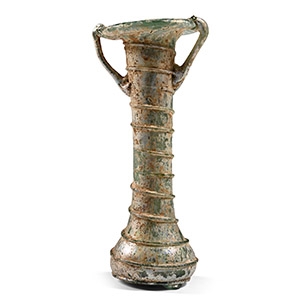
Roman Iridescent Glass Vessel with Spiral Trail
2nd-3rd century A.D.Estimate: £250 - 350 (+bp*)
Opening Bid: £139
Bulbous body with long funicular neck and everted rim, applied strap handles to the top, applied spiral decoration to the body. 14.6 grams, 76 mm
Ex London gallery, UK, 1986. Ex private UK collection. This lot is accompanied by an illustrated lot declaration signed by the Head of the Antiquities Department, Dr Raffaele D'Amato. -
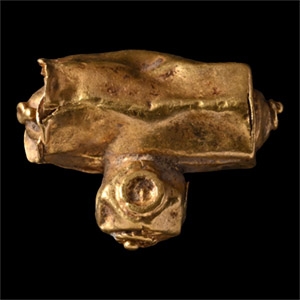
Roman Gold Amulet Case
5th-6th century A.D.Estimate: £120 - 170 (+bp*)
Opening Bid: £60
Cylindrical body with domed finials with applied pellets, cornerless cube-shaped suspension loop with applied pellet and filigree annulets. 0.78 grams, 14 mm
Ex property of a late Japanese collector, 1970-2000s. This lot is accompanied by an illustrated lot declaration signed by the Head of the Antiquities Department, Dr Raffaele D'Amato.
