
Loading, please wait...
LOT 2068
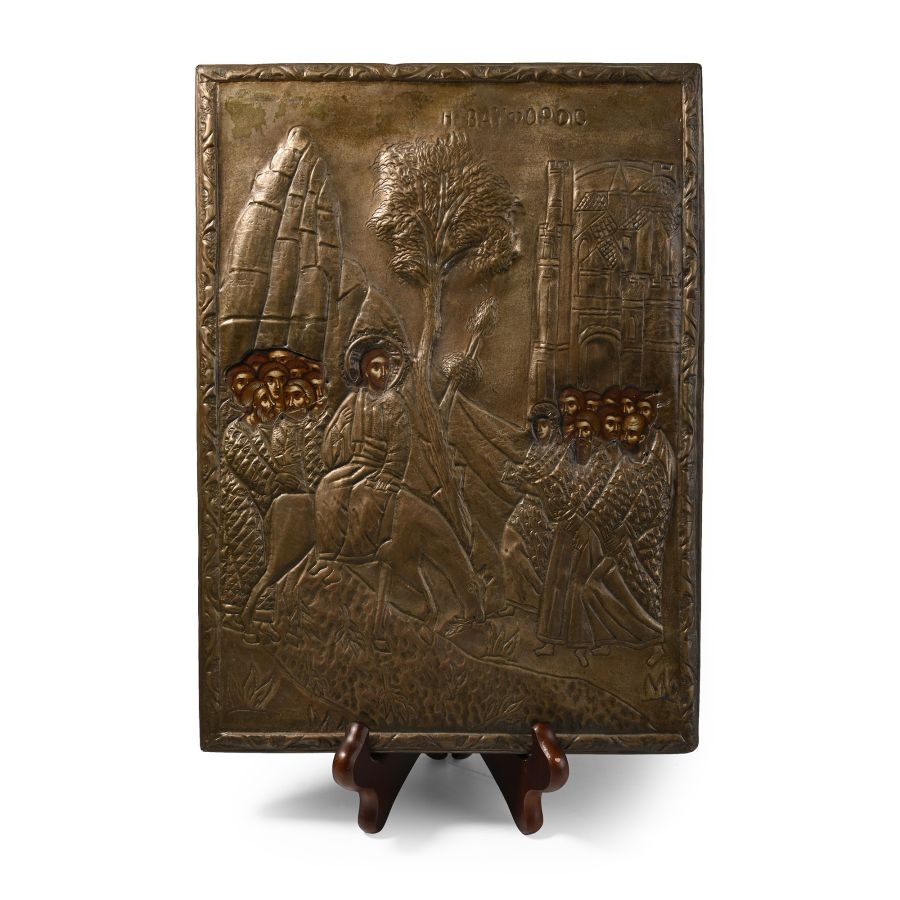
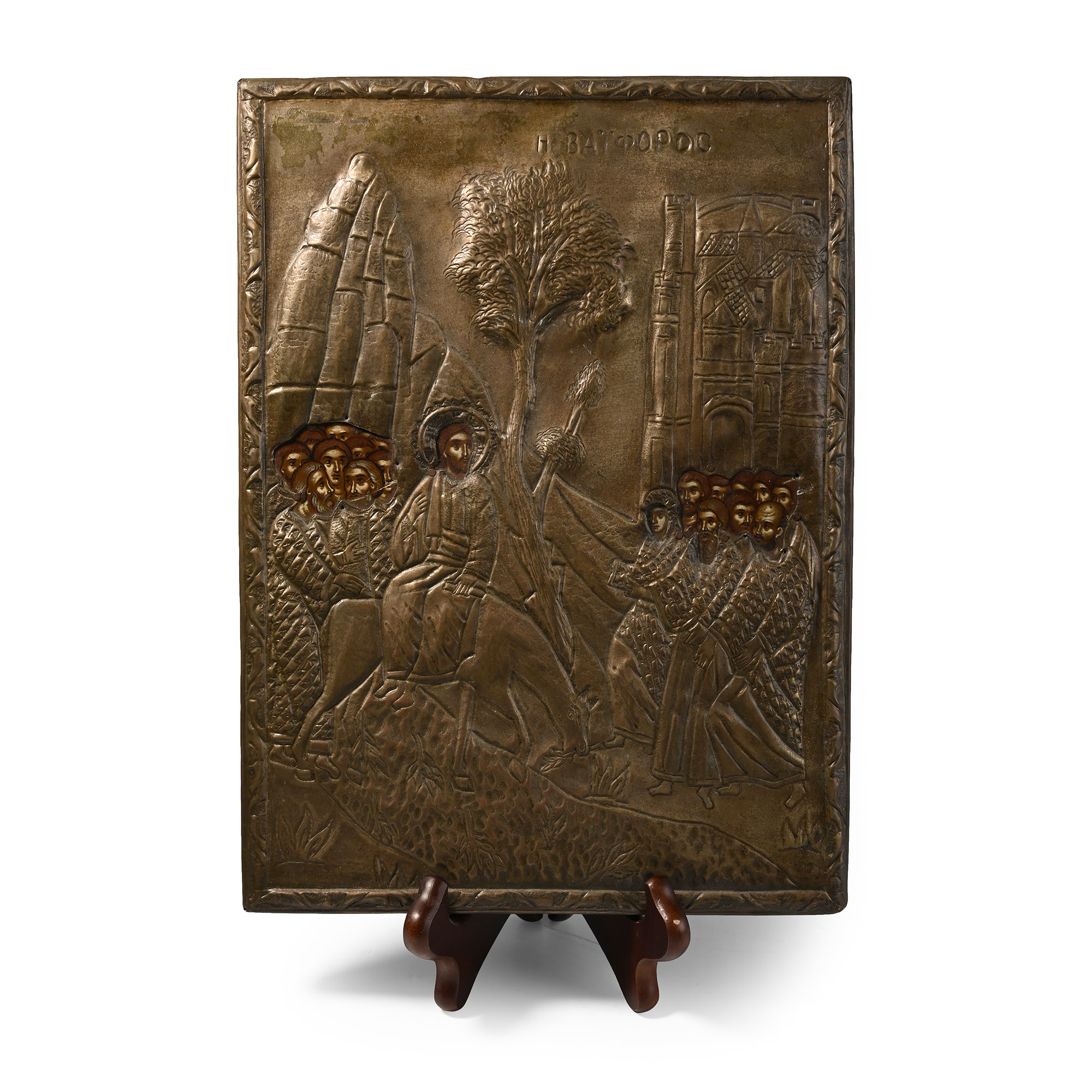
Icon with Riza of Entrance to Jerusalem
20TH CENTURY A.D.
11 3/4 x 8 7/8 in. (762 grams total including stand, Icon: 30.5 x 22.5 cm).
Painted on a wooden board and covered with a brass riza, with mounting panel to the reverse, depicting the entrance of Christ in Jerusalem on Palm Sunday riding a donkey; crowd within the city wall; followers of Christ in the gateway; Christ with golden nimbus and letters 'ω', 'C' reversed and 'Н'; Greek script title above reciting: 'Η ΒΑΙΦΟΡΟC (Βαϊοφόρος)' (the one who is riding the mule); the background with rocks, tree and the walls of Jerusalem; arabesque decoration to the borders and corners; accompanied by a wooden stand. [No Reserve]
ProvenanceEx David Miller, Hemel Hempstead, London, UK.
From the private collection of a West London, UK, gentleman, formed since the early 2000s.
See Turtsova, N.M., The Entry of the Lord into Jerusalem. Series 'Russian icon. Images and symbols' (in Russian), St. Petersburg, 2014.
FootnotesThe scene represents a well-known part of the Gospels that describe the entry of Jesus into Jerusalem. He makes a grand entrance into the city on a donkey to fulfil the prophecy of Zechariah, “Tell the city of Zion, look, your king is coming to you! He is humble and rides on a donkey and on a colt, the foal of a donkey.” The scene is synthetized in the Greek expression ‘Βαϊοφόρος'.
CONDITIONTimeLine Auctions follows a vetting process to ensure the authenticity and legality of all items, reinforcing our commitment to integrity and responsible trading. Each antiquity, antique, and coin lot undergoes thorough examination by a vetting committee of at least ten external specialists, professional trade association members, scientists, and archaeologists: Our Vetting Process
AUCTIONS:
TimeLine is a leading auction house specialising in antiquities, ancient art, collectables, natural history, coins, medals, and books. Our auctions offer museums, collectors, historians, and enthusiasts the opportunity to acquire unique and historically significant pieces.
-
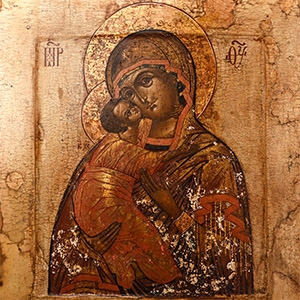
Painted Wooden Icon with the Virgin of Vladimir
Russia, 18th century A.D.Estimate: £1,200 - 1,700 (+bp*)
Opening Bid: £600
With veiled head and wearing a fringed golden maphorion mantle over a dark blue robe with gold cuffs, inclined towards the infant Jesus supported by her right hand; monograms and titling, on each side of her head 'ΜΡ ΘΥ' (Μήτηρ (τοῦ) Θεοῦ = Mother of God), over the child inscription in Greek letters 'ΙϹ ΧϹ' (ΙΗϹΟΥϹ ΧΡΙϹΤΟϹ = Jesus Christ), three letters (only two visible) inside the nimbus of Christ representing the continuous divine self-existence of Christ as God ('O ѾN' = The Only One who always exists); rectangular wooden board with mounting bar to reverse; Moscow School; old label on the back with inscription in Dutch 'A209 Moeder Gods van Wladimir'. 1.3 kg, 35.7 x 31 cm
Acquired on the UK art market. Private collection, London, UK.
The original icon prototype of these smaller icons was the icon of the Virgin Mother of Vladimir with the infant Jesus (the original preserved in the Tretyakov Gallery, Moscow), probably the most famous icon of Russia, which was thought to have been created in Constantinople in the early part of 1100s. This image is sometimes referred to as the ‘tenderness icon’, with artists attempting to show the close relationship of mother and son with their cheeks touching as they embrace. -
.jpg)
Chinese Style Enamelled Silver-Coloured Metal Pendant Necklace
20th century A.D.Sold for (Inc. bp): £26
Comprising an oval pendant set with a red cabochon, enamelled flower above, reverse with Chinese stamp for 'silver', clasp ring hallmarked '925'. 23 grams, 54 cm
From the family collection of a Hampstead gentleman; formerly acquired in the 1980s. -
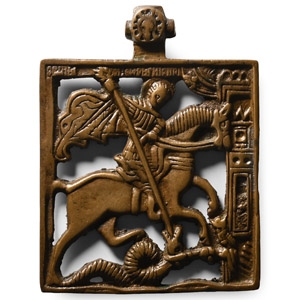
Russian Orthodox Bronze Travel Icon with Saint George
Circa 1700 A.D.Sold for (Inc. bp): £140
Showing Saint George on horseback, dispatching the dragon with a spear thrust; the Saint dressed in a soft cuirass and seated on a high-ended saddle secured by breast, rump, and belly straps; on the right, the walls of Trebisonda and on the bottom right the princess; Old Slavic inscription on the top, reciting Saint George of Cappadocia (Свято́й Гео́ргий Каппадоки́йский); at the top, the Christ Mandylion inscribed inside a cross. 71 grams, 87 mm
Acquired from Chris Martin-Zakheim, Iconastas, 5 Piccadilly Arcade, London SW1. From the private collection of a West London, UK, gentleman, formed since the early 2000s.
According to the Christian tradition, Saint George would have lived between the end of the 3rd century and the beginning of the 4th century: born into a noble Christian family, he became an officer in the Roman army and was then named a prefect by Diocletian. But when the same emperor decided to resume the persecutions, Saint George became a victim despite his important political rank. His role in the development of the faith is so important that he is included among the Great Martyrs of the Eastern Church and his fight against the dragon becomes a symbol par excellence of the fight for good which defeats evil.
