
Loading, please wait...
LOT 1488
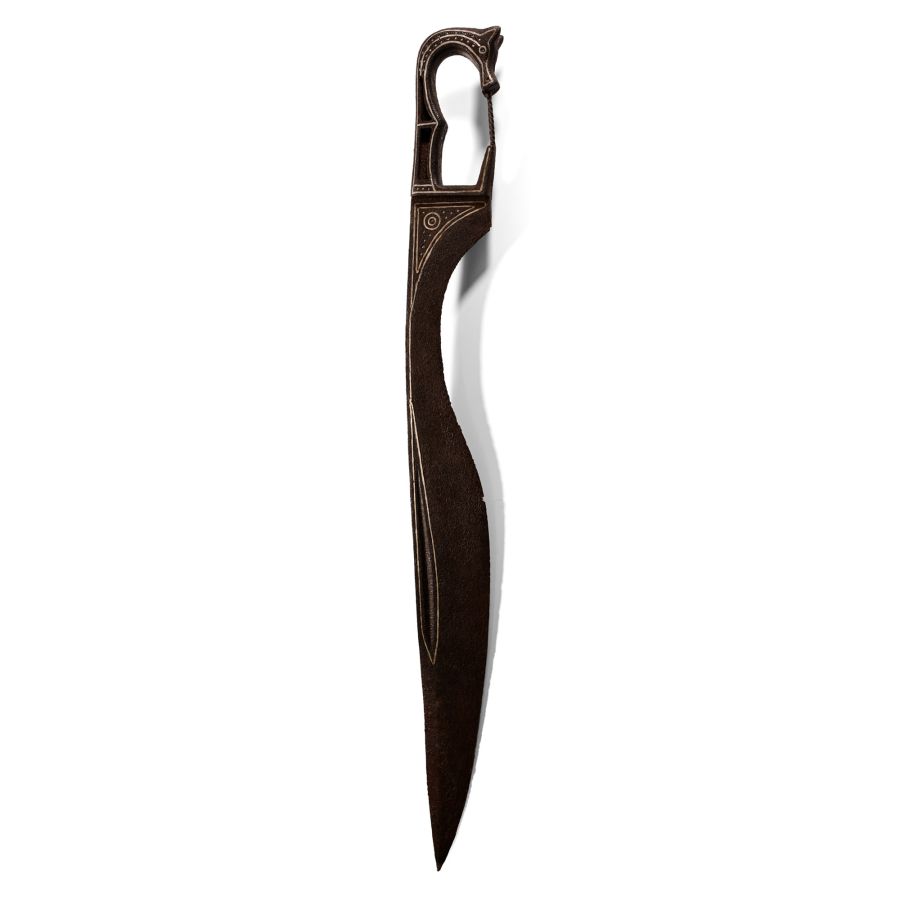
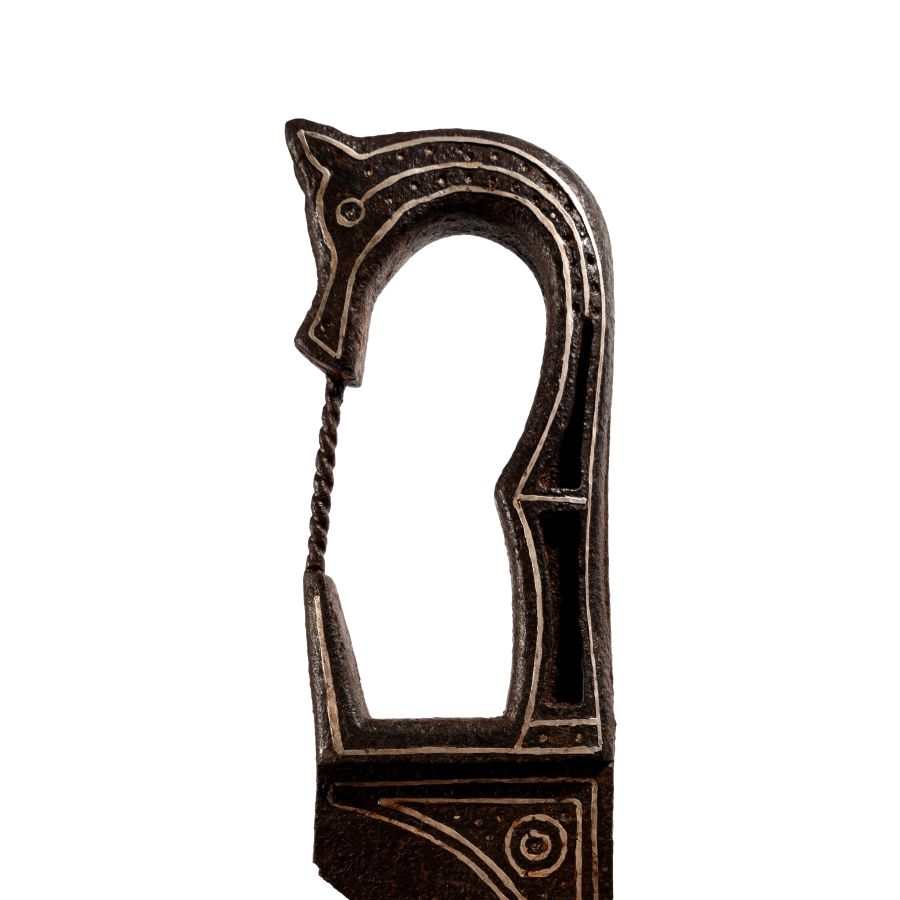
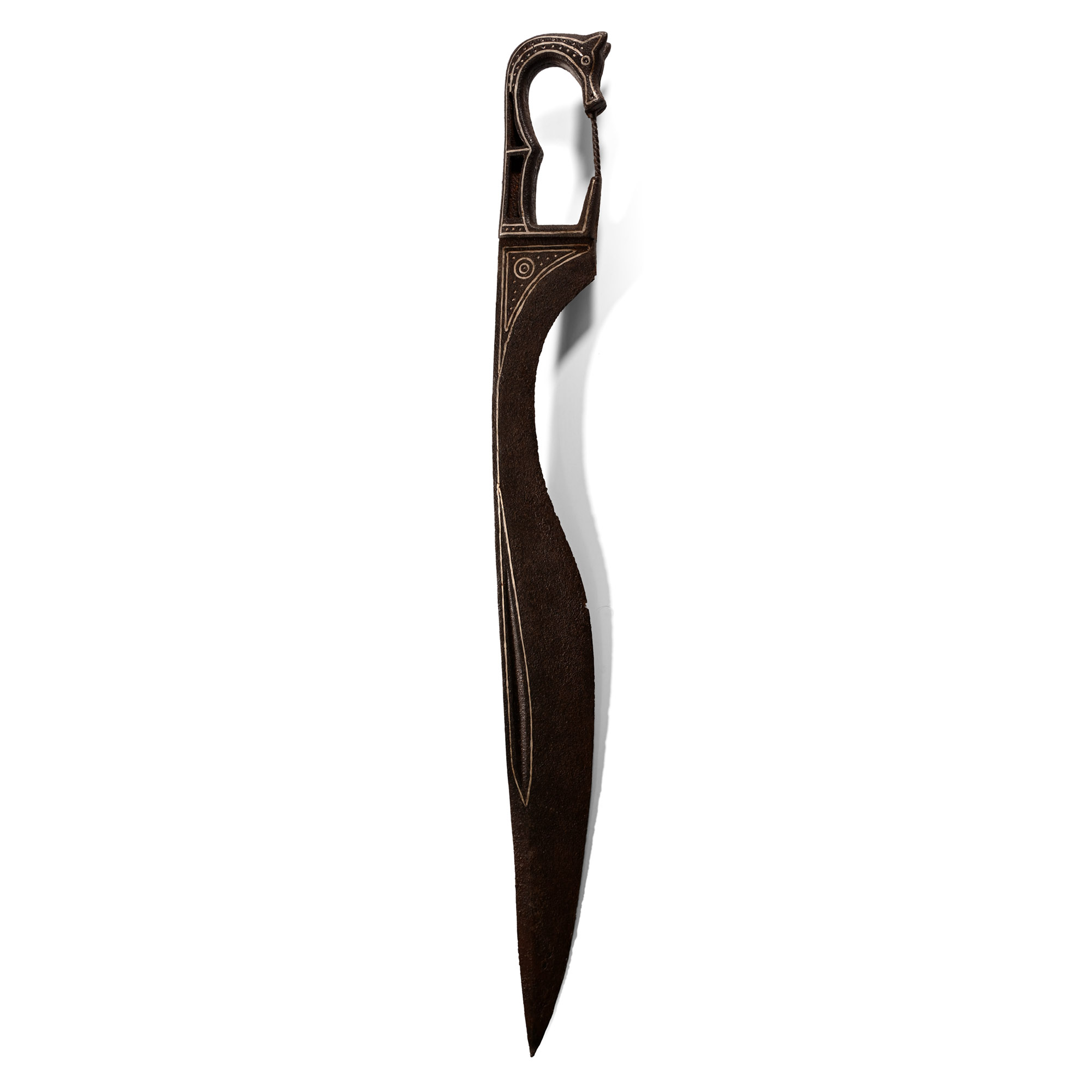
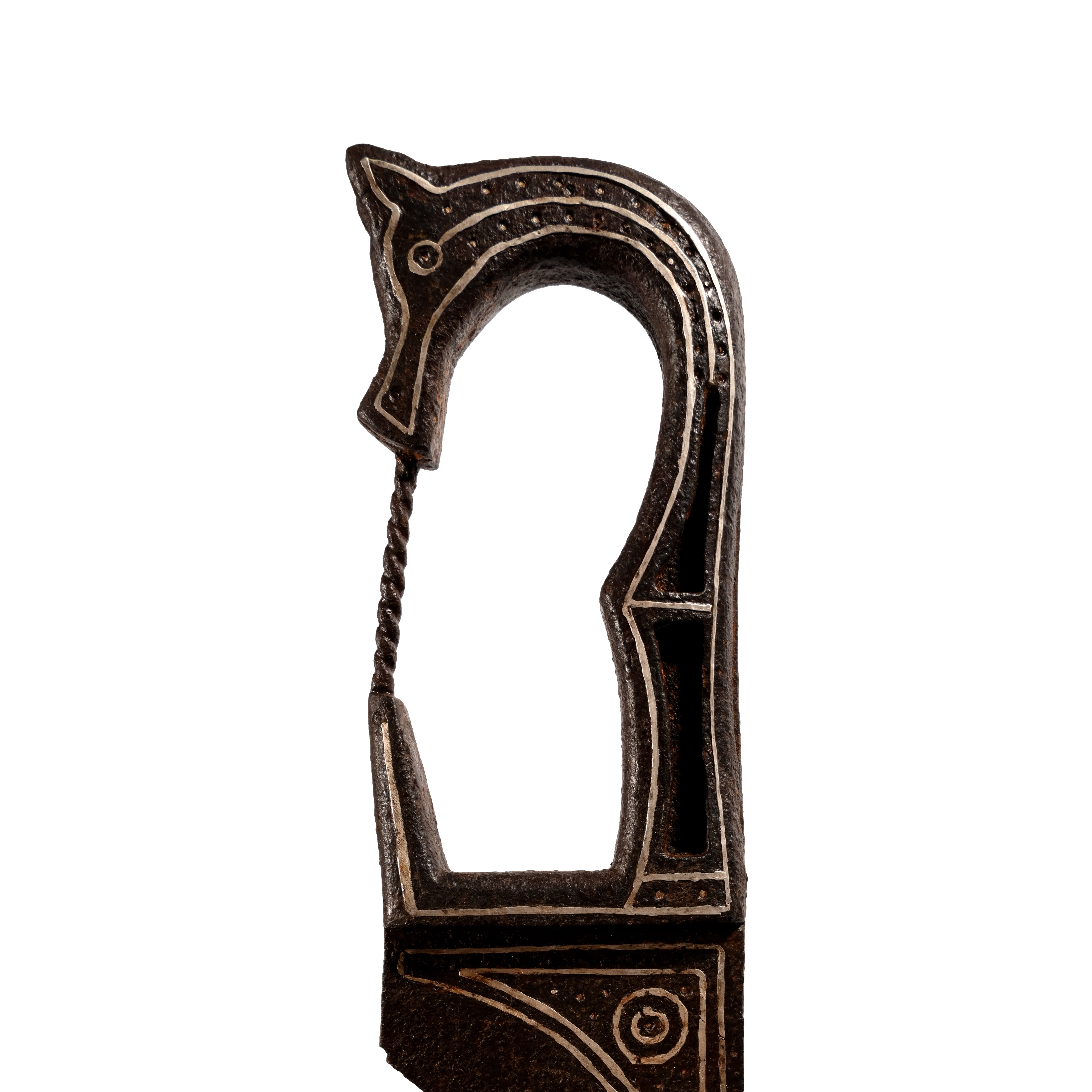
Ibero-Celtic Style Iron Falcata with Inlaid Decoration
19TH CENTURY A.D. OR EARLIER
22 3/4 in. (771 grams, 57.7 cm).
A single-edged machaira sword of falcata typology, the hilt formed as a gracefully curving horse's head and neck, the blade with deep grooves, inlaid with geometric ornaments on the hilt and blade.
ProvenanceEx White Collection, England, 1970s.
The Bonnhauser Collection, Zurich, 2003.
This lot is accompanied by an illustrated lot declaration signed by the Head of the Antiquities Department, Dr Raffaele D'Amato.
For originals see Quesada Sanz, F., El armamento Ibérico, Madrid, 1991; Quesada Sanz, F., Arma y símbolo: la falcata Ibérica, Alicante, 1992; Quesada Sanz, F., 'Patterns of interaction, Celtic and Iberian weapons in Iron Age Spain', in Celtic connections, volume 2, papers from the Tenth International Congress of Celtic Studies, Edinburgh, 1995, Edinburg, 2005.
FootnotesSince the 5th-4th century BC, the Iberian warriors armed themselves with round shields and single-edged swords (falcatas), gradually adopting the appearance of hoplite armies and the Etruscan version of the machaira. The latter type of sword was duly transformed into a completely new type, with a different size, shape and function, the falcata, which was already in use in the Iberian area by c. 490 BC. This falcata, a type of curved, one-edged sword of supposedly Greek origin, is generally accepted by the scholars as the 'national' weapon of the Iberians, usually suspended on the left side of the warrior, inside a sheath to which sometimes was attached a short knife. It was a terrible cut-and-thrust sword, with an average blade length of 45 cm.
CONDITIONTimeLine Auctions follows a vetting process to ensure the authenticity and legality of all items, reinforcing our commitment to integrity and responsible trading. Each antiquity, antique, and coin lot undergoes thorough examination by a vetting committee of at least ten external specialists, professional trade association members, scientists, and archaeologists: Our Vetting Process
AUCTIONS:
TimeLine is a leading auction house specialising in antiquities, ancient art, collectables, natural history, coins, medals, and books. Our auctions offer museums, collectors, historians, and enthusiasts the opportunity to acquire unique and historically significant pieces.
LOT 1488
Ibero-Celtic Style Iron Falcata with Inlaid Decoration
Estimate £800 - 1,000€930 - 1,160 (for guidance only)$1,080 - 1,350 (for guidance only)
-
.jpg)
Large Medieval Silver Inlaid Iron Spearhead
15th-16th century A.D.Sold for (Inc. bp): £1,300
Comprising: a hexagonal-section tapering socket, lentoid-section neck and leaf-shaped blade; inlaid silver-wire scrolled tendril detailing to the socket and neck. 693 grams, 42 cm
Private collection formed in Europe in the 1980s. Westminster collection, central London, UK. This lot has been cleared against the Art Loss Register database, and is accompanied by an illustrated lot declaration signed by the Head of the Antiquities Department, Dr Raffaele D'Amato.
The spearhead likely belonged to a family fighting in the Balkanic wars among Christian and Ottomans in the late 15th century A.D. Spears with such shape are dated to the 16th century and are defined by specialists as ‘schefflin’ type. The ornament of the blade imitates Ottoman decorative models. -
Roman Pompey the Great 'Battle of Munda' Lead Slingshot
1st century B.C.Sold for (Inc. bp): £546
Biconical lead slingshot (glans) with inscription in Latin letters 'CN' (Cneius) 'MAG' (Magnus) on one side, and 'IMP' for 'IMPERATOR' (victorious general) to the other side, i.e Gnaeus Pompeius Magnus Imperator (Pompey the Great the victorious general). 43.6 grams, 40 mm
Acquired on the UK art market. Property of a gentleman collector. This lot is accompanied by an illustrated lot declaration signed by the Head of the Antiquities Department, Dr Raffaele D'Amato.
The shot (Völling type 1C) is marked with the abbreviated name of Gnaeus Pompey; it was used in quantity at the Battle of Monda (or Munda) against Julius Caesar, 17th March 45 BC. The projectiles were made of different materials: lead (glandes) or in pottery or stone (lapides missiles). Sometimes they were signed with the name of the general, like our specimen. -
.jpg)
Marlik Bronze Spearhead
14th-10th century B.C.Sold for (Inc. bp): £195
With rounded shoulders and square-section mid-rib running to the tip; short tang. 280 grams, 38.5 cm
Acquired 1980-2015. Ex Abelita family collection. This lot is accompanied by an illustrated lot declaration signed by the Head of the Antiquities Department, Dr Raffaele D’Amato. This lot is accompanied by an illustrated lot declaration signed by the Head of the Antiquities Department, Dr Raffaele D'Amato.
The blade belongs to the type VI of Marlik spearheads according to the Khorasani classification, with a long blade and a short tang, slightly rounded shoulders and pronounced midrib. Such spearheads have been excavated from the Marlik Royal Cemetery by Dr Negahban in Tomb 15, Trench XIII G.
