
Loading, please wait...
_900x900.jpg "Iberian Bronze Statuette")
_200x200.jpg "Iberian Bronze Statuette")
.jpg "Iberian Bronze Statuette")
LOT 0079
Iberian Bronze Statuette
6TH-4TH CENTURY B.C.
4 5/8 in. (215 grams total, 11.8 cm high including stand).
Youthful male standing wearing a belted tunic with apron, arms spread wide, barefoot, bare-headed with short textured hair; mounted on a custom-made base.
ProvenancePrivate collection, Paris, France, assembled in the 1950s-1960s.
with Tessier-Sarrou & Associés, Paris, 2015.
European private collection.
Accompanied by a copy of an Art Loss Register certificate, no.S00107108.
Accompanied by a copy of French cultural export passport no.167803.
This lot has been checked against the Interpol Database of stolen works of art and is accompanied by a search certificate number no.12650-264612.
This lot has been cleared against the Art Loss Register database, and is accompanied by an illustrated lot declaration signed by the Head of the Antiquities Department, Dr Raffaele D'Amato.
Cf. similar in the Metropolitan Museum of Art under accession no.19.192.49.
CONDITIONTimeLine Auctions follows a vetting process to ensure the authenticity and legality of all items, reinforcing our commitment to integrity and responsible trading. Each antiquity, antique, and coin lot undergoes thorough examination by a vetting committee of at least ten external specialists, professional trade association members, scientists, and archaeologists: Our Vetting Process
AUCTIONS:
TimeLine is a leading auction house specialising in antiquities, ancient art, collectables, natural history, coins, medals, and books. Our auctions offer museums, collectors, historians, and enthusiasts the opportunity to acquire unique and historically significant pieces.
LOT 0079
Iberian Bronze Statuette
Estimate £4,000 - 6,000€4,640 - 6,960 (for guidance only)$5,400 - 8,100 (for guidance only)
-
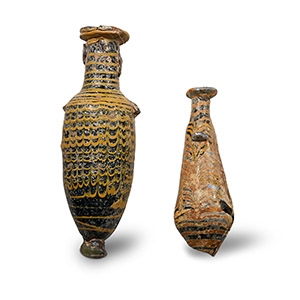
Greek Core-Formed Glass Vessel Group
2nd-1st century B.C.Sold for (Inc. bp): £312
With polychrome decoration and iridescent surfaces, comprising: an alabastron with fusiform body, conical foot and ledge handles, decorated with yellow feathering and trails; a blue amphoriskos with yellow festooning and trails, knop foot and everted rim; fragmentary. 197 grams total, 11.3-15 cm high
Acquired early 1990s. Ex private American collection; thence by descent. Private collection since 1998. This lot is accompanied by an illustrated lot declaration signed by the Head of the Antiquities Department, Dr Raffaele D'Amato. -
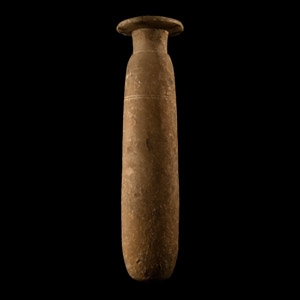
Greek Alabaster Alabastron
Circa 600 B.C.Sold for (Inc. bp): £650
With fusiform body, slender neck and broad flange rim, circumferential incised rings. 540 grams, 21 cm
Acquired in Germany, 1993. Private collection, Europe. This lot is accompanied by an illustrated lot declaration signed by the Head of the Antiquities Department, Dr Raffaele D'Amato. -
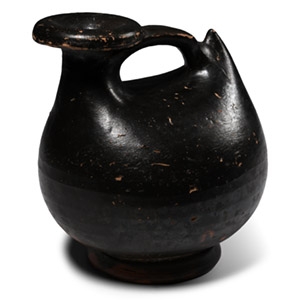
Greek Black Glazed Terracotta Askos
4th century B.C.Estimate: £400 - 600 (‡+bp*)
Opening Bid: £200
A pouring vessel with bulbous body and funicular spout, central strap handle. 160 grams, 97 mm high
Ex C.R., Ticino, before 1970. with Galerie Rhéa, Zurich, Switzerland. This lot is accompanied by an illustrated lot declaration signed by the Head of the Antiquities Department, Dr Raffaele D'Amato.
