
Loading, please wait...
LOT 0164
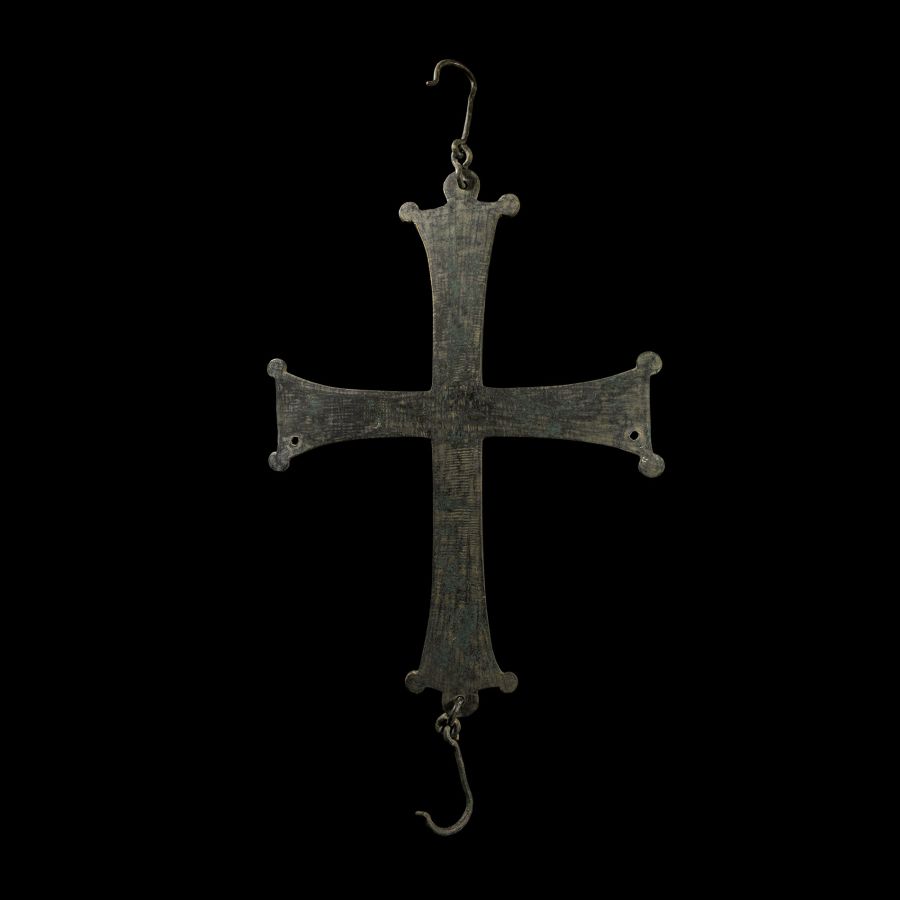
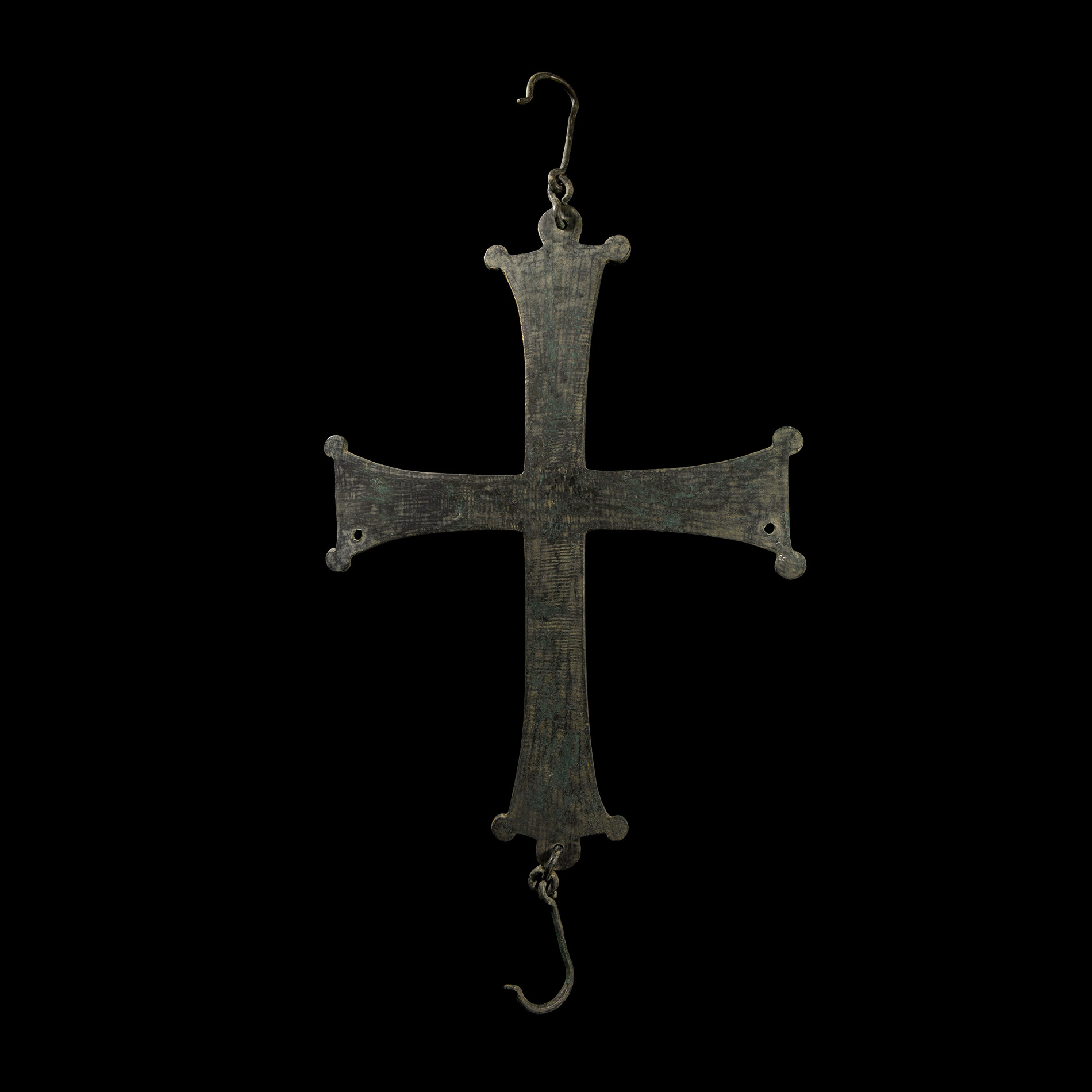
Huge Byzantine Hanging Bronze Lobed Cross
CIRCA 8TH-10TH CENTURY A.D.
31 3/4 in. (1.12 kg, 55.5 cm including hook).
Substantial cross pattée with pierced lobes to the vertical arms, each end provided with a link and hook; lateral arms pieced to accept similar links; intended for the suspension of polycandela multiple-candle chandeliers.
ProvenanceEx Surrey, UK, collection of a gentleman, 1960-2000s.
FootnotesIn 563 A.D., Paul the Silentiary visited Hagia Sophia in Constantinople and described the wondrous lighting effects, ‘Thus is everything clothed in beauty…no words are sufficient to describe the illumination in the evening: you might say that some nocturnal sun filled the majestic church with light.’ The church was lit by polycandela, an early type of candelabra that held glass oil lamps rather than candles. The lamps were either conical or shaped like round bowls with an elongated stem attached beneath. Amidst the burning of incense and the chanting of prayers, the flickering light must have helped to inspire pious devotion. Contemporaries certainly attest to this feeling and among the surviving accounts, that of Arculf, Bishop of Gaul, is particularly affecting. In 670 he went on a pilgrimage to Jerusalem and visited the Church of the Ascension, ‘…to the customary light of the eight lamps…on the night of the feast of the Lord’s Ascension it is usual to add innumerable other lamps; and under the terrible and wondrous gleaming of these, pouring out copiously through the shutters of the windows, all Mount Olivet seems not alone to be illuminated, but even to be on fire, and the whole city, situated on the lower ground nearby, seems to be lit up.’
CONDITIONTimeLine Auctions follows a vetting process to ensure the authenticity and legality of all items, reinforcing our commitment to integrity and responsible trading. Each antiquity, antique, and coin lot undergoes thorough examination by a vetting committee of at least ten external specialists, professional trade association members, scientists, and archaeologists: Our Vetting Process
AUCTIONS:
TimeLine is a leading auction house specialising in antiquities, ancient art, collectables, natural history, coins, medals, and books. Our auctions offer museums, collectors, historians, and enthusiasts the opportunity to acquire unique and historically significant pieces.
-
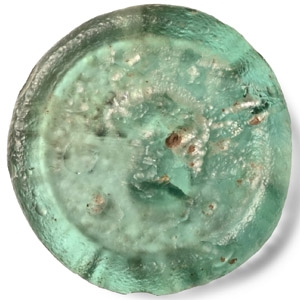
Byzantine Glass Weight with Eparches Inscription
Circa 6th-8th century A.D.Sold for (Inc. bp): £169
Discoid weight with low-relief portrait bust, Greek legend. 2.36 grams, 23 mm
From the property of late Mr SM, London, UK, 1969-1999. -
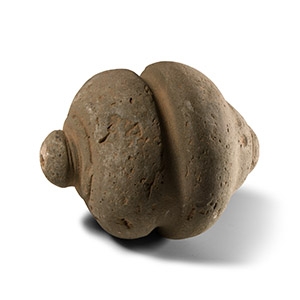
Byzantine 'Greek Fire' Ceramic Fire Bomb or Hand Grenade
9th-11th century A.D.Sold for (Inc. bp): £156
Piriform body with gusset to the equator, domed filler-hole, intended to be filled with explosive liquid and wick, used as a hand grenade. 431 grams, 10.6 cm
From a specialist collection of militaria, London, UK, collected 1990s onwards. Accompanied by an academic paper by military specialist Dr Raffaele D'Amato, dated 15 July 2019 and titled 'Eastern Roman Empire - Greek Fire Bomb or Hand Grenade (μεσαίον kακάβιον) 9th-11th century AD'.
Apart from the use of siphons or manual flame-throwers called cheirosiphona, special corps of Roman soldiers employed terracotta grenades, in the form of small jars, abundantly evidenced in archaeological excavations. They were called μεσαία kακαβιά or κυτροκακάβια where the former had a bulbous shape and the latter a more cylindrical form. -
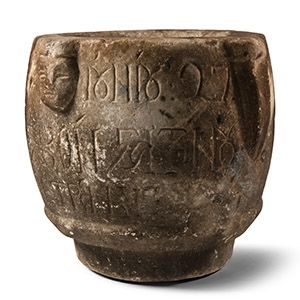
Byzantine Limestone Mortar with Faces and Later Dedication
Circa 14th-15th century A.D. and laterSold for (Inc. bp): £390
Drum-shaped body with narrow base, two vertical flanges running from the rim and between them two D-shaped male masks with low discoid caps; later inscribed: '1812 [ΕΤ]ΟΥ IΟΥ[ΛIΟΥ] 27 ІωÁΝΙΣ ΚΟΝΣΤΑΝΤΙΝΟΥ ΠΕΤΡΙΚΙ' (July the 27, year 1812 of Iohannes Konstantinos Petrikos). 11.15 kg, 22 cm wide
From a collection acquired on the UK art market from various auction houses and collections mostly before 2000. From an important Cambridgeshire estate; thence by descent.
