
Loading, please wait...
_900x900.jpg "Holy Land Ceramic Jar")
_200x200.jpg "Holy Land Ceramic Jar")
.jpg "Holy Land Ceramic Jar")
LOT 0837
Holy Land Ceramic Jar
EB I, CIRCA 3000 B.C.
4 in. (240 grams, 10 cm wide).
Formed with a carinated body, everted rim, handle with thumb rest and vestigial handles, rare.
ProvenanceFrom an important specialist collection formed in London, UK, before 1988.
CONDITIONTimeLine Auctions follows a vetting process to ensure the authenticity and legality of all items, reinforcing our commitment to integrity and responsible trading. Each antiquity, antique, and coin lot undergoes thorough examination by a vetting committee of at least ten external specialists, professional trade association members, scientists, and archaeologists: Our Vetting Process
AUCTIONS:
TimeLine is a leading auction house specialising in antiquities, ancient art, collectables, natural history, coins, medals, and books. Our auctions offer museums, collectors, historians, and enthusiasts the opportunity to acquire unique and historically significant pieces.
-
.jpg)
Western Asiatic Bronze Openwork Door Fittings
13th-14th century A.D.Sold for (Inc. bp): £780
Each discoid in plan with decoratively notched circumference, ogival centre with pierced ornament, concentric bands of incised annulets, chevrons and other geometric forms; each accompanied by a custom-made display stand. 1.03 kg total, 20-20.5 cm wide (1.5 kg total, 30.5 cm high each including stand)
Acquired 1960s-1970s. From a UK private collection, 1981. -
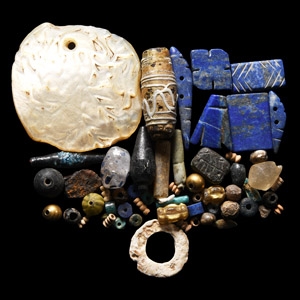
Western Asiatic Mixed Bead Collection
3rd-1st millennium B.C. and laterSold for (Inc. bp): £78
Comprising beads of various materials and shapes, including: lapis lazuli, gold glass, glazed faience, glass, gold and other beads; decorated with animals, floral compositions and geometric motifs. 44.5 grams total, 3-42 mm
Ex Robin Symes Gallery, pre 1999. -
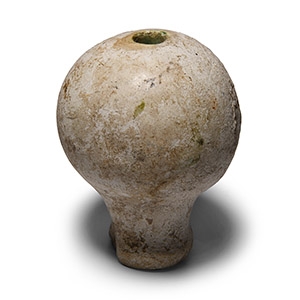
Western Asiatic Stone Mace Head
Circa 2nd-1st millennium B.C.Sold for (Inc. bp): £85
Of bulbous form with short neck; cylindrical socket for insertion of an organic shaft. 482 grams, 87 mm high
Acquired 1990s-early 2000s. East Anglian private collection.
