
Loading, please wait...
LOT 0071
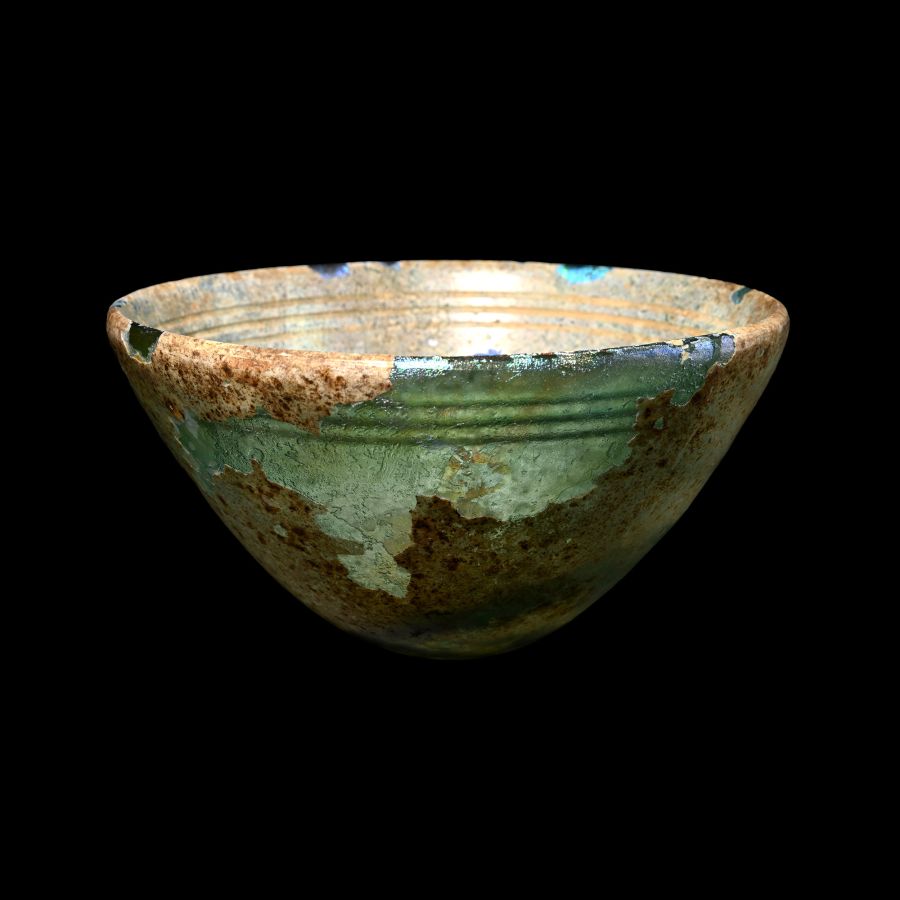
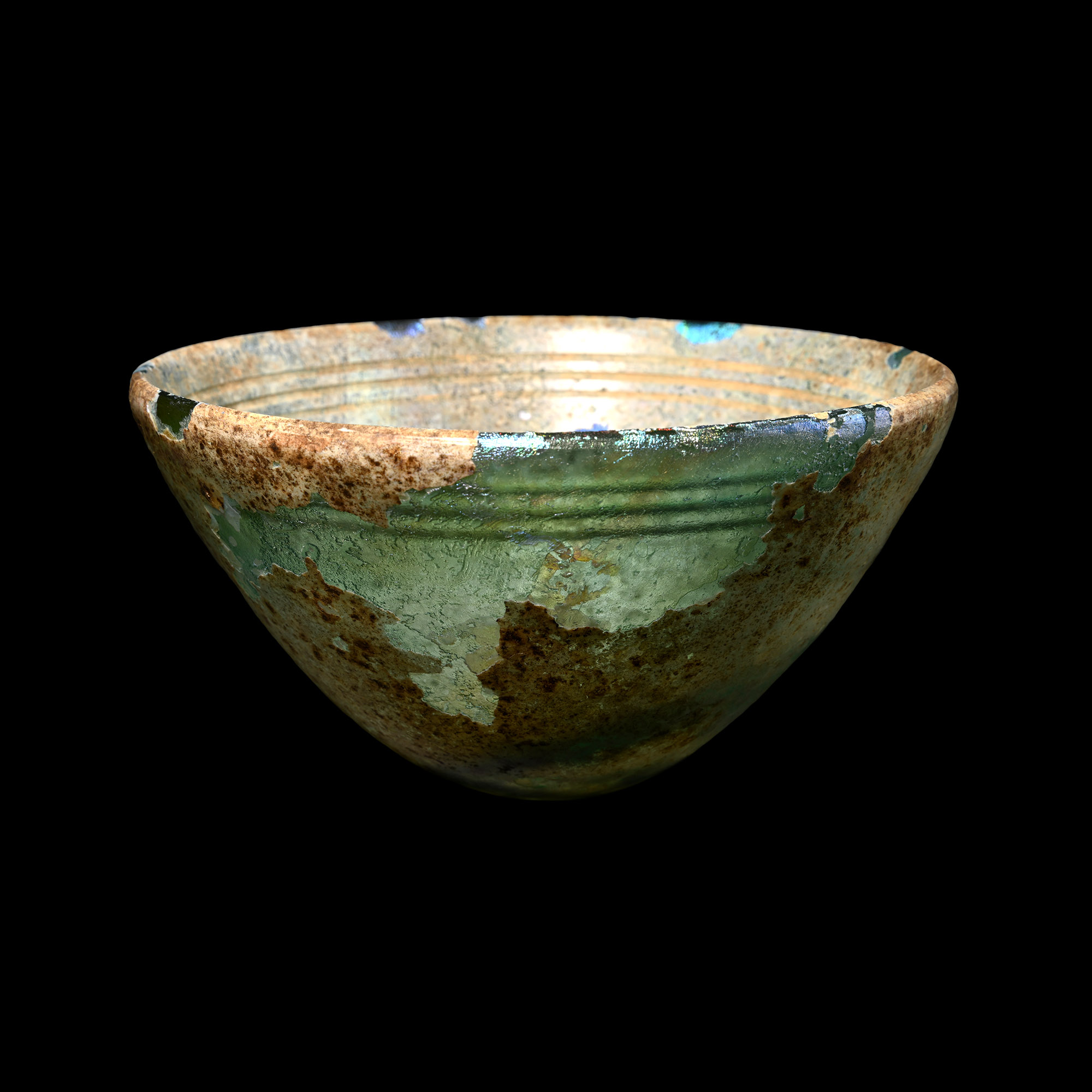
Hellenistic Iridescent Pale Aqua Glass Bowl
MID 2ND-EARLY 1ST CENTURY B.C.
6 1/8 in. (374 grams, 15.7 cm wide).
Conical in profile, aqua glass with three incised bands below the rim on the inner face.
ProvenanceDr Jutaro Kawabe, Nagoya, Japan, his collection formed in the 1960s-1970s.
with Hoshigaoka Gallery until the late 1990s.
Private collection, London, UK.
This lot has been checked against the Interpol Database of stolen works of art and is accompanied by search certificate number no.12949-245243.
Cf. similar bowl in the Metropolitan Museum of Art, New York, accession no.81.10.36.
FootnotesOn ancient glass, iridescence is the soft play of colour that develops as the surface ages and becomes silica-rich. Minute layers form over time and break light into shifting blues, greens and golds. It is not a modern finish but something time has drawn out of the material itself, so the pattern and palette are unique to each piece. Collectors prize good, stable iridescence because it lifts the form: ribs read more crisply, profiles glow, and simple vessels take on depth and movement. Museums now tend to preserve these surfaces rather than polish them away, recognising both their beauty and what they tell us about an object’s long life (though it is not, by itself, a dating test). For display, iridescent glass performs brilliantly under gentle, directional light, where the colours “turn” as the vessel is moved. Well-preserved, even iridescence of this quality is not common and adds materially to the presence—and desirability—of the piece.
CONDITIONTimeLine Auctions follows a vetting process to ensure the authenticity and legality of all items, reinforcing our commitment to integrity and responsible trading. Each antiquity, antique, and coin lot undergoes thorough examination by a vetting committee of at least ten external specialists, professional trade association members, scientists, and archaeologists: Our Vetting Process
AUCTIONS:
TimeLine is a leading auction house specialising in antiquities, ancient art, collectables, natural history, coins, medals, and books. Our auctions offer museums, collectors, historians, and enthusiasts the opportunity to acquire unique and historically significant pieces.
LOT 0071
Hellenistic Iridescent Pale Aqua Glass Bowl
Estimate £2,000 - 3,000€2,320 - 3,480 (for guidance only)$2,700 - 4,050 (for guidance only)
-
.jpg)
Greek Glass Cameo with Dolphin
Late 1st millennium B.C.Sold for (Inc. bp): £468
Ellipsoid in plan and plano-convex in section with low-relief dolphin modelled in the half-round. 2.75 grams, 26 mm
Acquired on the German art market, 1989-1995. with The Museum Gallery, 19 Bury Place, London, WC1, UK, 1998-2003. Property of a London based academic, 2003 to present. -
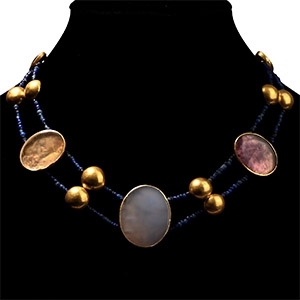
Late Hellenistic-Early Roman Gemstone, Gold and Glass Bead Necklace
Circa 2nd century B.C.-1st century A.D.Estimate: £3,500 - 4,500 (+bp*)
Opening Bid: £1,750
Restrung necklace with oval semi-precious stones and gold-domed appliqués; double strand of Roman spherical blue glass beads, varying in hues and tones, and to the top of each strand a single appliqué with a gold discoid plaque set with a garnet polished stone to the left and a vibrant green aventurine stone to the right; a double-domed appliqué behind each small plaque, and a larger discoid set with crystal on the left and pale amethyst to the right; central prominent chalcedony set discoid. 43 grams total, 44 cm including clasp
Acquired on the UK art market prior to 2000. This lot has been checked against the Interpol Database of stolen works of art and is accompanied by a search certificate number no.12947-246339. -
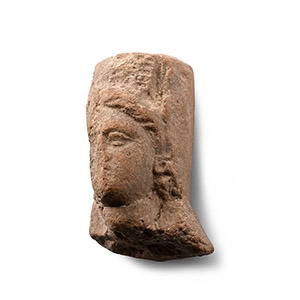
Greek Terracotta Head of a Goddess
5th-4th century B.C.Sold for (Inc. bp): £111
Moulded with piled hair and earring; from a Tanagra-type figure. 40.6 grams, 52 mm
Ex Amanda Barrie collection. From the property of a late Lincolnshire, UK, gentleman.
