
Loading, please wait...
LOT 0099
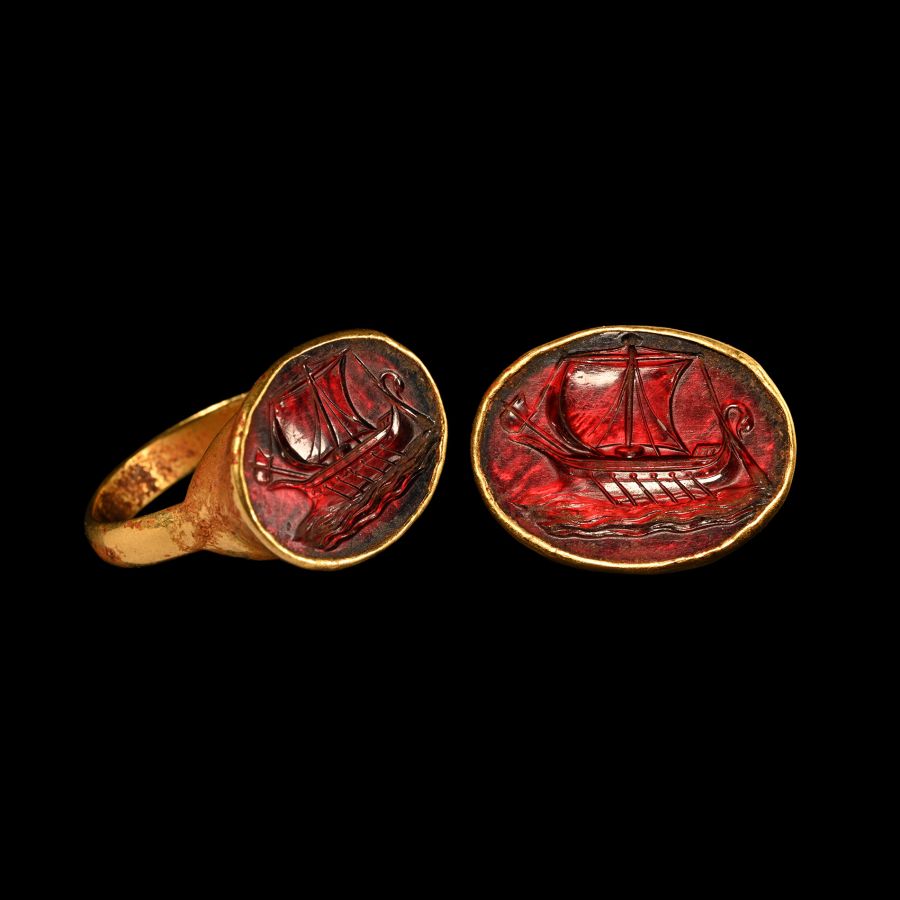
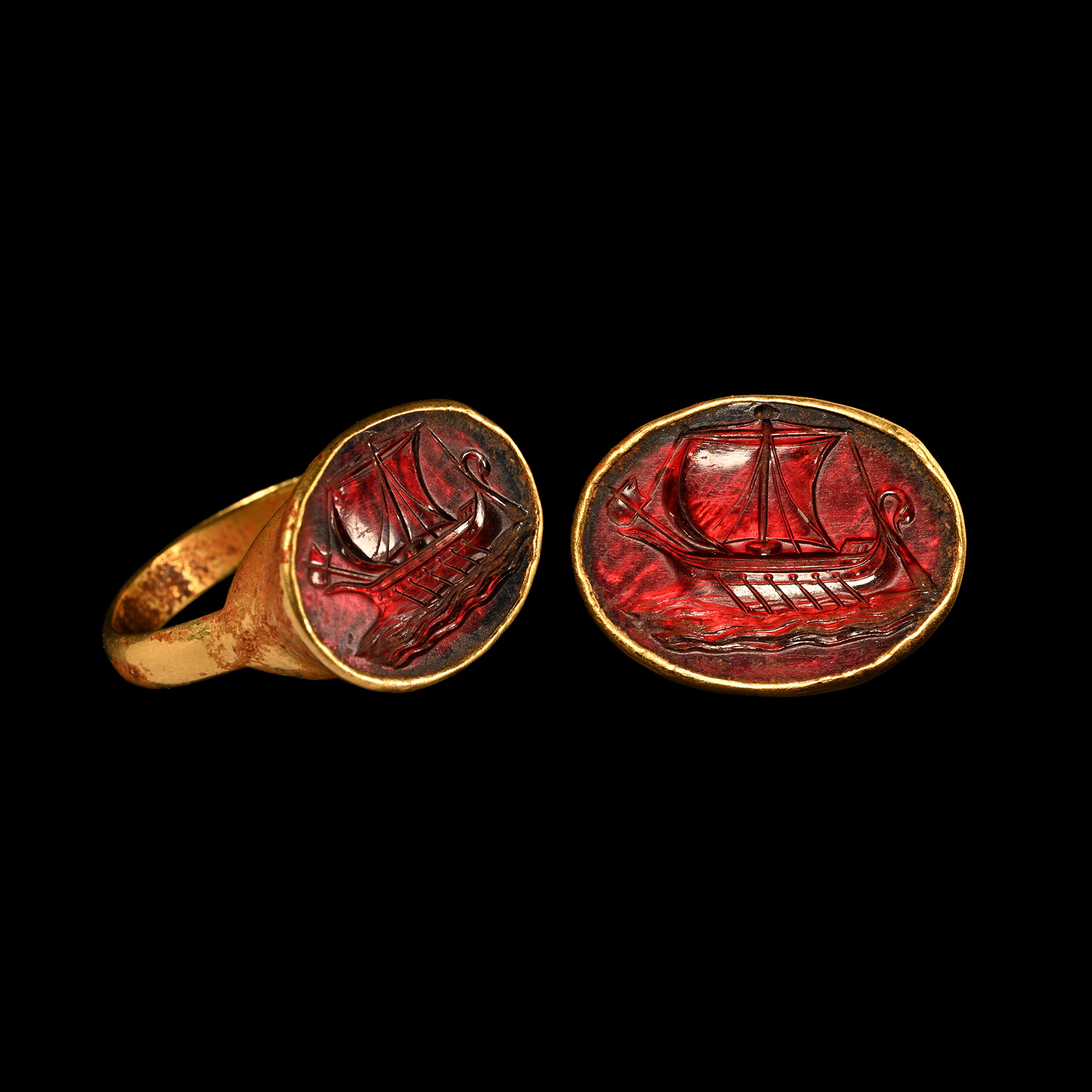
Hellenistic Gold Ring with Galley Gemstone
1ST CENTURY B.C.-2ND CENTURY A.D.
1 in. (7.51 grams, 24 56 mm overall, 18.18 mm internal diameter (approximate size British P 1/2, USA 7 3/4, Europe 16.86, Japan 16)).
With D-section hollow-formed hoop and flared ellipsoid bezel, set with a Roman intaglio depicting a war galley under sail.
ProvenanceOld private collection, 1970-1980.
Private collection of Mr S.A., Switzerland, 1990s, thence by descent.
Accompanied by an academic report by Dr Raffaele D'Amato.
This lot has been checked against the Interpol Database of stolen works of art and is accompanied by search certificate no.12122-211870.
Cf. Chadour, A.B., Rings. The Alice and Louis Koch Collection, volume I, Leeds, 1994, item 134, 143, 161, for type; see also images of similar ships in D'Amato, R., Imperial Roman Warships 193-265 AD, Oxford, 2017, pp.13, 14, 23.
CONDITIONTimeLine Auctions follows a vetting process to ensure the authenticity and legality of all items, reinforcing our commitment to integrity and responsible trading. Each antiquity, antique, and coin lot undergoes thorough examination by a vetting committee of at least ten external specialists, professional trade association members, scientists, and archaeologists: Our Vetting Process
AUCTIONS:
TimeLine is a leading auction house specialising in antiquities, ancient art, collectables, natural history, coins, medals, and books. Our auctions offer museums, collectors, historians, and enthusiasts the opportunity to acquire unique and historically significant pieces.
-
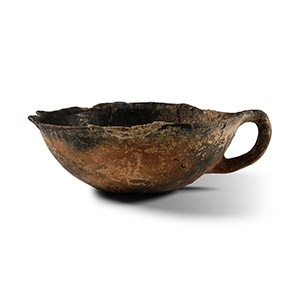
Cypriot Ceramic Drinking Bowl
Middle Bronze Age, circa 2000-1650 B.C.Sold for (Inc. bp): £143
Of reserved slip ware, comprising a shallow bowl with indented base, single loop handle; black glaze inside, red-brown colour outside; some restoration. 173 grams, 14.9 cm wide
Some restoration.
Ex Peter Negus collection (1920-2012). Acquired from Bonhams, London, 26 October 2007, no.354 (part). From an important Cambridgeshire estate; thence by descent. Accompanied by the original Bonhams lot tag and a much older tag with description and collection number DAA41.
The vessel belongs to a rare form of polished ware which originally was intended to achieve a two-tone effect. In the reserved slip ware, parts of the red slip was wiped away while it was still wet, revealing patches of the pale under surface. After this the whole surface was polished and the final result was a 'trick' decoration in which the negative patches appear to be positive pattern on the dark red surface. -
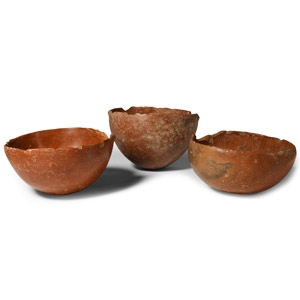
Cypriot Red Polished Ware Bowl Group
Early-Middle Bronze Age, circa 2700-1900 B.C.Sold for (Inc. bp): £130
Group of three hemispherical bowls with burnished surface, one with old collector's inked notation 'L.S./2.60'. 1.09 kg total, 14-15 cm
From a collection acquired on the UK art market from various auction houses and collections mostly before 2000. From an important Cambridgeshire estate; thence by descent. -
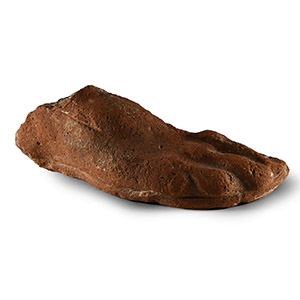
Etruscan Ceramic Votive Foot
4th-3rd century B.C.Sold for (Inc. bp): £91
Comprising the outer part of a right foot with elongated toes and anatomical detailing, base of a sandal visible on the outer edge. 351 grams, 19 cm
Acquired in Germany before 2000. English private collection.
This object belongs to impasto ceramics of red-brown typology, and it was probably an unfinished votive foot. It could have been part of a medium-size statuette, or an anatomical ex voto related to a temple deposit, linked with a health divinity. We have parallels in Veii, Vulci and in the whole of the Latial area.
