
Loading, please wait...
LOT 1485
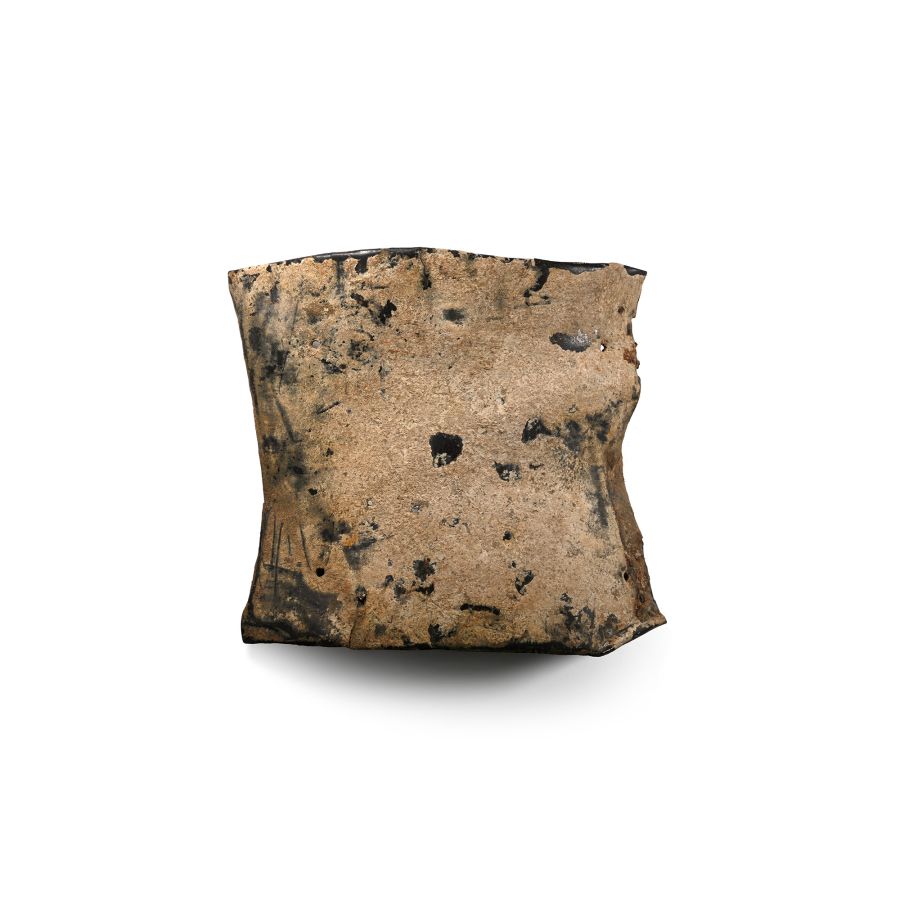
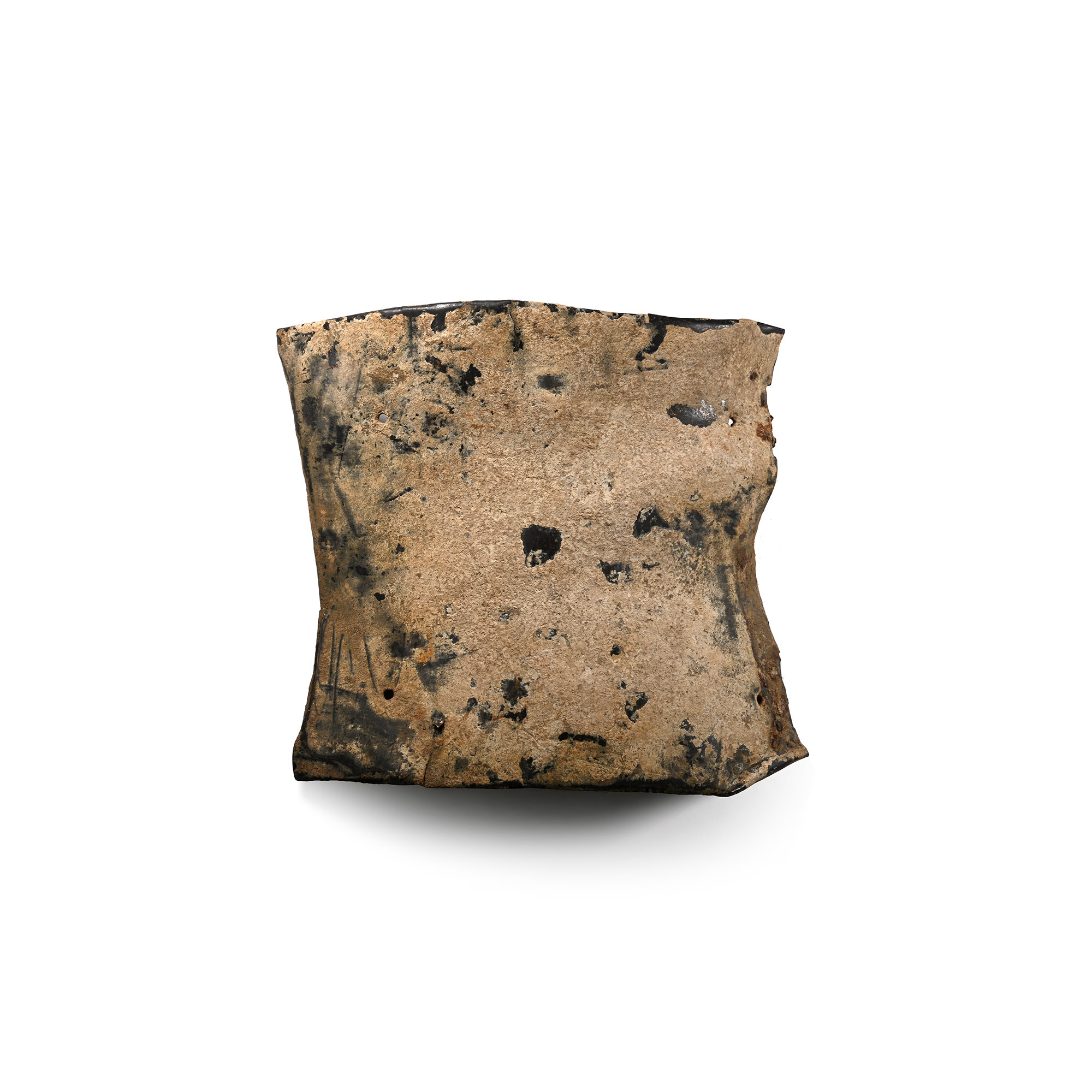
Hellenistic Bronze Cuirass Section
3RD-1ST CENTURY B.C.
8 1/4 in. (301 grams, 21 cm).
Possible flank right element of a composite cuirass for a kataphraktos (armoured horseman), part of the edge still preserved on three sides, fastening holes and part of the clasps for attaching the piece to the other parts of armour still visible. [No Reserve]
ProvenanceUK private collection, acquired in 1996.
This lot is accompanied by an illustrated lot declaration signed by the Head of the Antiquities Department, Dr Raffaele D'Amato.
Cf. Connolly, P., Greece and Rome at War, London, 2006, figs.p.55-56, for the typology of armour and similar fragments; for the type and composition of the Hellenistic heavy armours see Nikonorov, V. P., & Savchuk, S. A., ‘ New Data on Ancient Bactrian Body-Armour (In the Light of Finds from Kampyr Tepe)’ in Iran, 30, 1992, pp.49-54, figs.1-5.
FootnotesA near complete armour for cataphract was found in a French excavation in Al-Khanoum, a Hellenistic city in Afghanistan. The cavalry of Seleucid, Ptolemaic and other Hellenistic Kingdoms formed regiments of heavy armoured horsemen, who in the west, employed a combination of lamellar and segmented armour together with muscled armour of Greek type. Cataphract armour in the west had more Greek elements, for example more plate armour and less scale and lamellar.
CONDITIONTimeLine Auctions follows a vetting process to ensure the authenticity and legality of all items, reinforcing our commitment to integrity and responsible trading. Each antiquity, antique, and coin lot undergoes thorough examination by a vetting committee of at least ten external specialists, professional trade association members, scientists, and archaeologists: Our Vetting Process
AUCTIONS:
TimeLine is a leading auction house specialising in antiquities, ancient art, collectables, natural history, coins, medals, and books. Our auctions offer museums, collectors, historians, and enthusiasts the opportunity to acquire unique and historically significant pieces.
-
.jpg)
Ibero-Celtic Style Iron Falcata with Inlaid Decoration
19th century A.D. or earlierEstimate: £800 - 1,000 (+bp*)
Opening Bid: £400
A single-edged machaira sword of falcata typology, the hilt formed as a gracefully curving horse's head and neck, the blade with deep grooves, inlaid with geometric ornaments on the hilt and blade. 771 grams, 57.7 cm
Ex White Collection, England, 1970s. The Bonnhauser Collection, Zurich, 2003. This lot is accompanied by an illustrated lot declaration signed by the Head of the Antiquities Department, Dr Raffaele D'Amato.
Since the 5th-4th century BC, the Iberian warriors armed themselves with round shields and single-edged swords (falcatas), gradually adopting the appearance of hoplite armies and the Etruscan version of the machaira. The latter type of sword was duly transformed into a completely new type, with a different size, shape and function, the falcata, which was already in use in the Iberian area by c. 490 BC. This falcata, a type of curved, one-edged sword of supposedly Greek origin, is generally accepted by the scholars as the 'national' weapon of the Iberians, usually suspended on the left side of the warrior, inside a sheath to which sometimes was attached a short knife. It was a terrible cut-and-thrust sword, with an average blade length of 45 cm. -
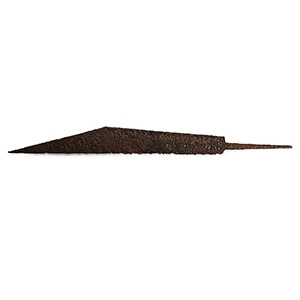
Large Viking Age Iron Broken-Backed Knife 'Seax' Blade
8th-10th century A.D.Sold for (Inc. bp): £117
With scooped forward edge, straight single edge and arched triangular back; transverse mounting tang. 208 grams, 37.5 cm
From a North American collection formed in the 1970s-1990s. This lot is accompanied by an illustrated lot declaration signed by the Head of the Antiquities Department, Dr Raffaele D'Amato.
This knife seems to be of type IV, like the one found in the Thames at Wandsworth. Based on its similarities with a specimen from Canterbury, it could be dated to the 8th century A.D. Underwood classifies these kind of knives under the typology C (angled back-curved cutting edge) dating them from the mid 6th to early 8th century A.D. -
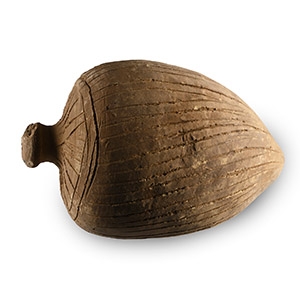
Byzantine 'Greek Fire' Ceramic Fire Bomb or Hand Grenade
9th-11th century A.D.Sold for (Inc. bp): £59
Piriform in profile with narrow point and domed mouth; incised line decoration to the body; intended to be filled with explosive liquid and wick, used as a hand grenade. 996 grams, 16 cm
From an important specialist collection, London, UK, 1990s onwards. Accompanied by an academic paper by military specialist Dr Raffaele D'Amato, dated 15 July 2019 and titled 'Eastern Roman Empire - Greek Fire Bomb or Hand Grenade (μεσαίον kακάβιον) 9th-11th century AD'. This lot is accompanied by an illustrated lot declaration signed by the Head of the Antiquities Department, Dr Raffaele D'Amato.
Apart from the use of siphons or manual flame-throwers called cheirosiphona, special corps of Roman soldiers employed terracotta grenades, in the form of small jars, abundantly evidenced in archaeological excavations. They were called μεσαία kακαβιά or κυτροκακάβια where the former had a bulbous shape and the latter a more cylindrical form.
