
Loading, please wait...
LOT 1426
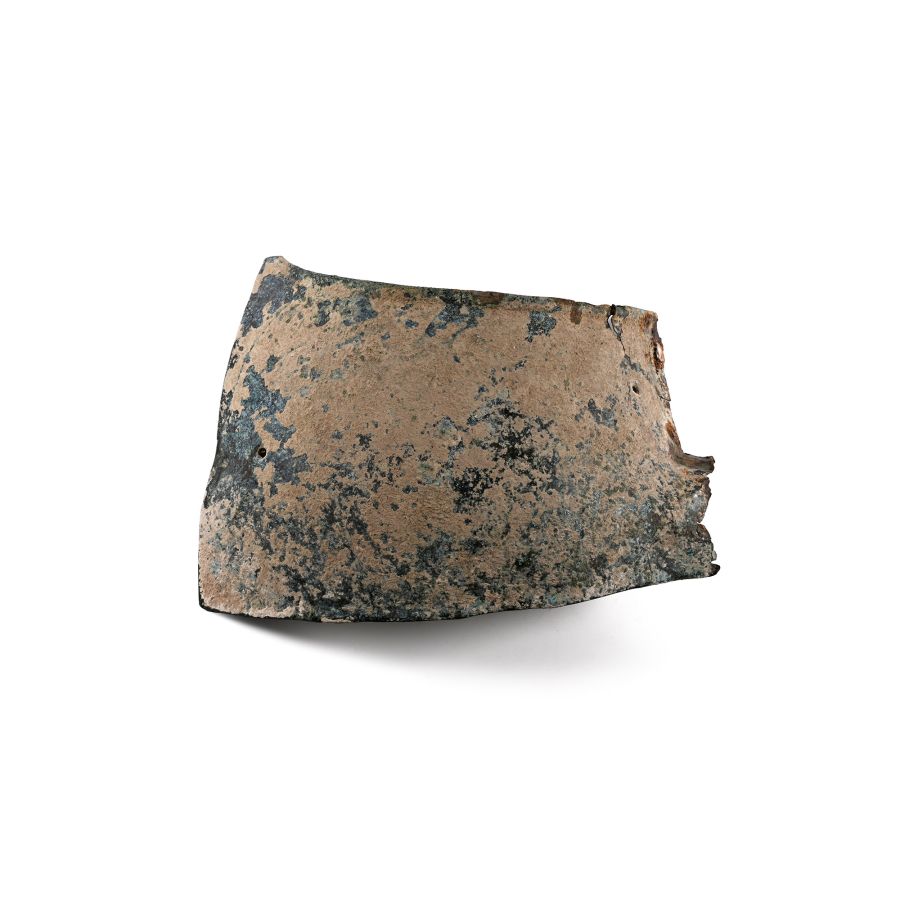
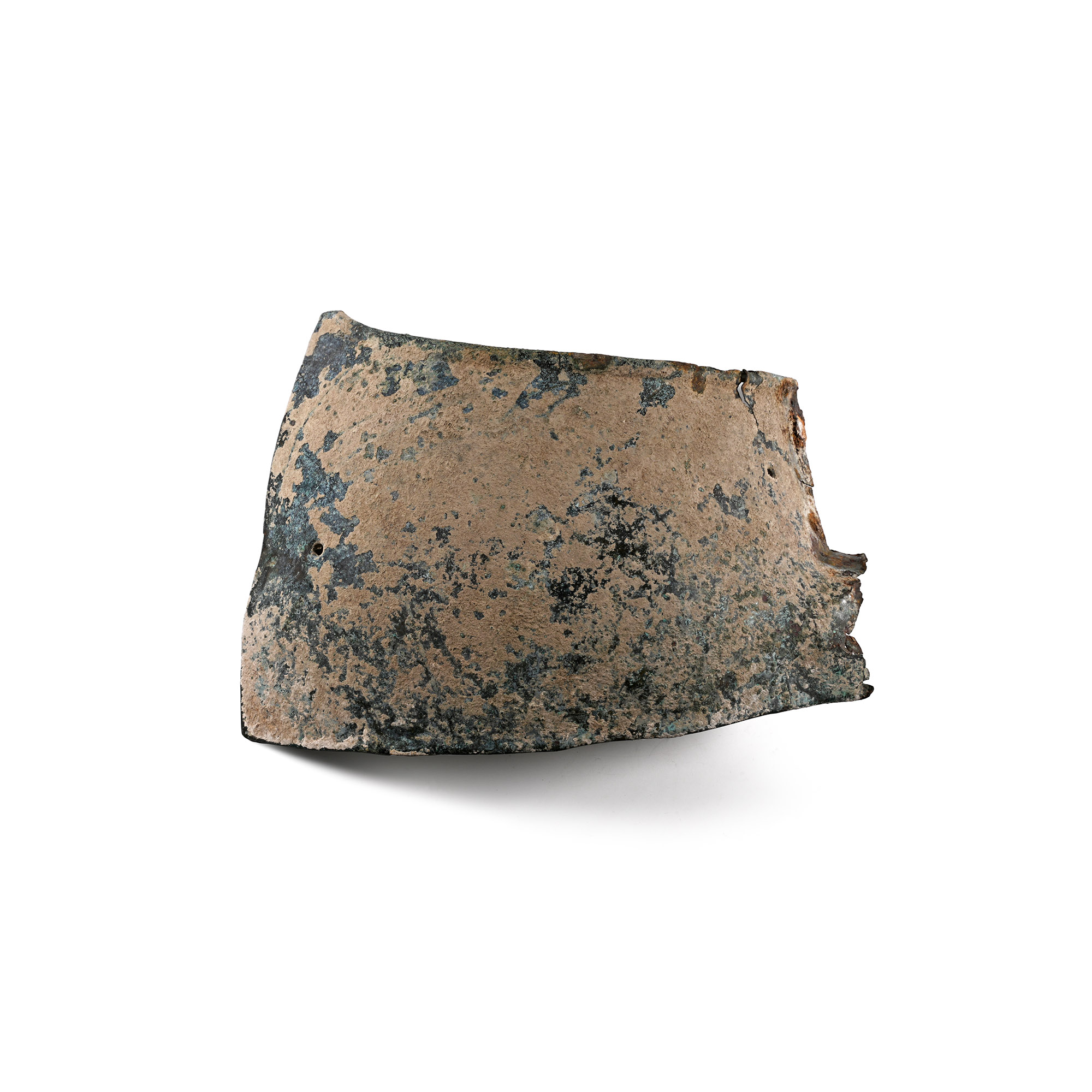
Hellenistic Bronze Cuirass Section
3RD-1ST CENTURY B.C.
8 7/8 in. (245 grams, 22.6 cm).
Possibly an upper right front element of a composite cuirass for a cataphract (armoured horseman), part of the edge around the neck and shoulders still preserved although fragmentary, part of the clasps for attaching the back section still visible. [No Reserve]
ProvenanceUK private collection, acquired in 1996.
This lot is accompanied by an illustrated lot declaration signed by the Head of the Antiquities Department, Dr Raffaele D'Amato.
Cf. Connolly, P., Greece and Rome at War, London, 2006, figs.p.55-56, for the typology of armour and similar fragments.
FootnotesA near complete armour for cataphract was found in the French excavations in Al-Khanoum, a Hellenistic city in Afghanistan. The cavalry of Seleucid, Ptolemaic and other Hellenistic Kingdoms formed regiments of heavy armoured horsemen, who in the west, employed a combination of lamellar and segmented armour together with muscled armour of Greek type. Cataphract armour in the West had more Greek elements, for example more plate armour and less scale and lamellar.
CONDITIONTimeLine Auctions follows a vetting process to ensure the authenticity and legality of all items, reinforcing our commitment to integrity and responsible trading. Each antiquity, antique, and coin lot undergoes thorough examination by a vetting committee of at least ten external specialists, professional trade association members, scientists, and archaeologists: Our Vetting Process
AUCTIONS:
TimeLine is a leading auction house specialising in antiquities, ancient art, collectables, natural history, coins, medals, and books. Our auctions offer museums, collectors, historians, and enthusiasts the opportunity to acquire unique and historically significant pieces.
-
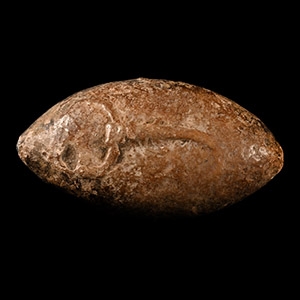
Hellenistic Rhodian Lead Slingshot with Scorpion
3rd century B.C.Sold for (Inc. bp): £598
Lentoid-section and depicting a stylised scorpion to one side, a type sometimes known to have the Rhodian legend ΚΑΛΑ to verso. 29.6 grams, 29 mm
From a Manchester, UK, collection, 1990s. This lot is accompanied by an illustrated lot declaration signed by the Head of the Antiquities Department, Dr Raffaele D'Amato.
Together with the Balearic slingers, Rhodian slingers were considered to be the best of the Hellenistic world, and they were also used in the Roman army. The slingshots with an image of a scorpion on one side and with an inscription ΚΑΛΑ on the other are believed to originate from the Island of Rhodes. On these sling bullets ΚΑΛΑ should be translated as “nice things.” Of course, ironically, these “nice things” were designed to kill enemies and to sting like a scorpion, and the message of those with the image of a scorpion could be understood, as proposed by M. Manov and N. Torbov, as: “nice things sting like a scorpion.” -
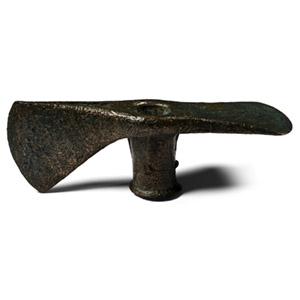
Large Luristan Socketted Bronze Adze
2nd-early 1st millennium B.C.Sold for (Inc. bp): £468
An adze-axe head with central shaft hole and curved blades, flange to socket. 570 grams, 16.5 cm
Acquired in the 1990s. Ex Abelita family collection. This lot is accompanied by an illustrated lot declaration signed by the Head of the Antiquities Department, Dr Raffaele D'Amato.
The adze-axe was a fundamental weapon of many Bronze Age cultures around the world. The form lends itself to dual purposes - for war and peace. As a tool, it functions in fabricating wood and as a weapon, its heavy mass and compact form make it a deadly striking and chopping weapon, even able to defeat light armour. -
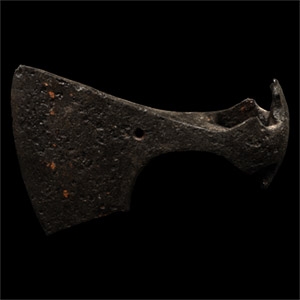
Viking Age Bearded Battle Axehead
Early 11th-12th century A.D.Sold for (Inc. bp): £234
A Baltic hand-forged iron axehead with scooped socket, broad blade with extension to the lower edge, hole to the blade. 532 grams total, axe: 14.7 cm
Acquired on the London art market, 1990s. Private collection, London. This lot is accompanied by an illustrated lot declaration signed by the Head of the Antiquities Department, Dr Raffaele D'Amato.
The more common weapons of Finno-Ugrian people were axes, commonly found from all Finnic areas, as well as spears. Among Baltic-Finnic people, especially in Finland and Karelia, knives called 'puukko' were common, as well as axes, spears, flat bows and longbows, while swords were usually imported from Germanic areas, Sweden or from elsewhere Scandinavia, some having often typically Scandinavian animal ornaments. Iron axeheads of this typology show a sub-trapezoidal asymmetrical blade, often perforated through the centre. They are characterised by two projecting spurs from the top and the bottom of the back of the shaft-hole.
