
Loading, please wait...
LOT 1513
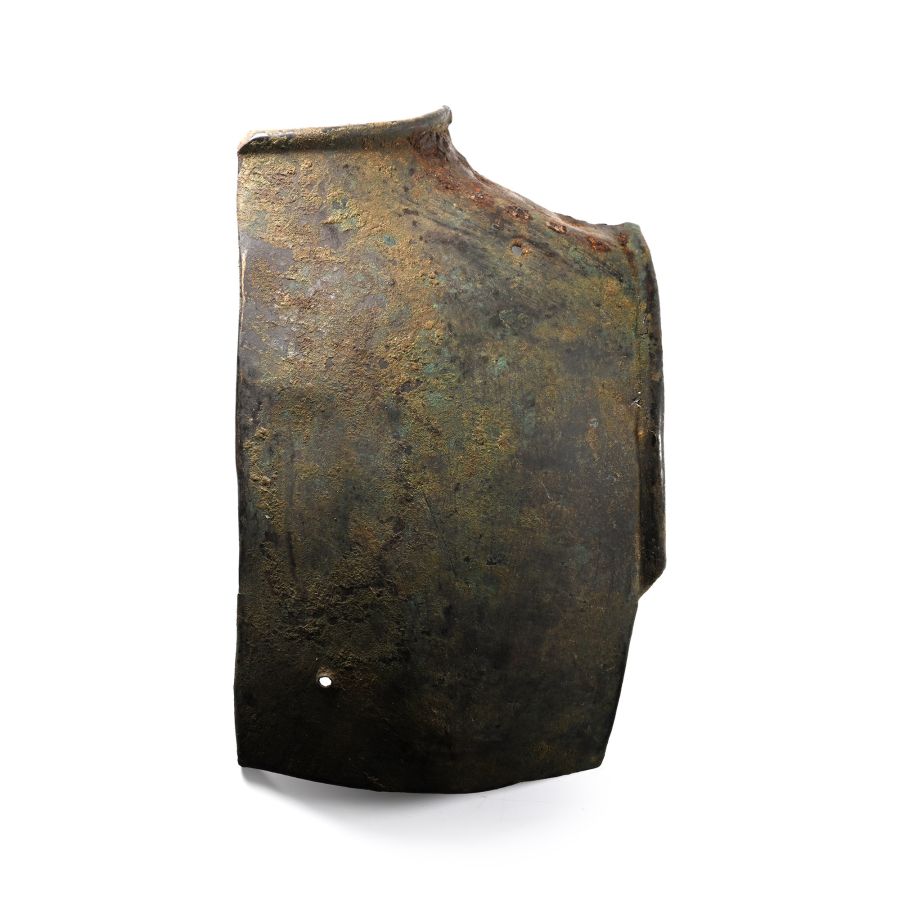
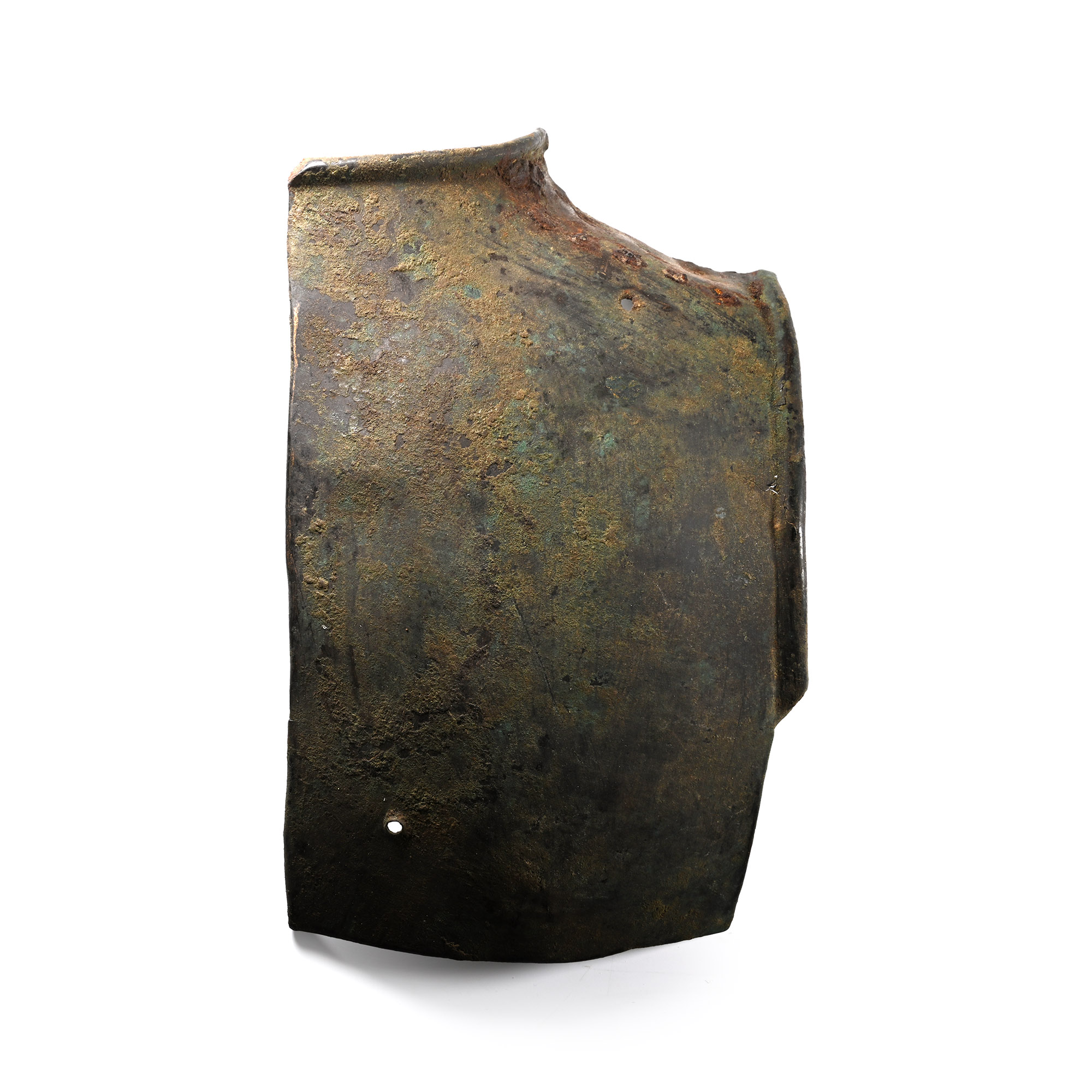
Hellenistic Bronze Cuirass Section
3RD-1ST CENTURY B.C.
9 in. (220 grams, 23 cm).
Possibly the upper right back element of a composite cuirass for a cataphract (armoured horseman), part of the edge around the neck and shoulders preserved, iron rivets and holes for attaching the shoulder straps still visible. [No Reserve]
ProvenanceUK private collection, acquired in 1996.
This lot is accompanied by an illustrated lot declaration signed by the Head of the Antiquities Department, Dr Raffaele D'Amato.
Cf. Connolly, P., Greece and Rome at War, London, 2006, fig.p.56, top right, for the typology of armour.
FootnotesA near complete armour for cataphract was found in the French excavations in Al-Khanoum, a Hellenistic city in Afghanistan. The cavalry of Seleucid, Ptolemaic and other Hellenistic Kingdoms formed regiments of heavy armoured horsemen, who in the west, employed a combination of lamellar and segmented armour together with muscled armour of Greek type. Cataphract armour in the West had more Greek element, for example more plate armour and less scale and lamellar.
CONDITIONTimeLine Auctions follows a vetting process to ensure the authenticity and legality of all items, reinforcing our commitment to integrity and responsible trading. Each antiquity, antique, and coin lot undergoes thorough examination by a vetting committee of at least ten external specialists, professional trade association members, scientists, and archaeologists: Our Vetting Process
AUCTIONS:
TimeLine is a leading auction house specialising in antiquities, ancient art, collectables, natural history, coins, medals, and books. Our auctions offer museums, collectors, historians, and enthusiasts the opportunity to acquire unique and historically significant pieces.
-
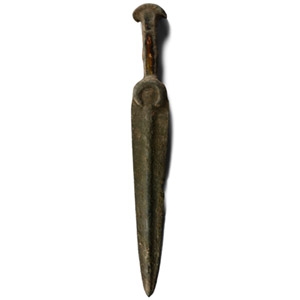
Marlik Type Bronze Dagger with Integral Hilt
14th-10th century B.C.Sold for (Inc. bp): £247
The blade with raised mid-rib and penannular guard, integral flanged hilt with organic inserts for the grip and crescentic pommel. 368 grams, 31.5 cm
Ex London art market, 1980-1990s. This lot is accompanied by an illustrated lot declaration signed by the Head of the Antiquities Department, Dr Raffaele D'Amato.
These daggers were cast in one-piece mould. Some scholars (Negahban) states that blade and grip were cast in one piece mould, and that the penannular guard was later cast onto the blade. However the main characteristic was the hilt and pommel open to accept organic inlays, here preserved. -
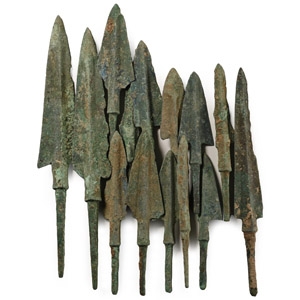
Luristan Bronze Arrowhead Collection
13th-6th century B.C.Sold for (Inc. bp): £169
A group of large tanged arrowheads mainly of triangular type. 319 grams total, 8.7-16.8 cm
Ex London art market, 1980-1990s. This lot is accompanied by an illustrated lot declaration signed by the Head of the Antiquities Department, Dr Raffaele D'Amato.
One category of the represented arrowheads has a sharp, flat blade, the ends of which extend to form wings or barbs, and a prominent midrib extending into a long tang with a stop; the blade shape varies from deltoid to more triangular. Another form has no barbs, but it has a prominent midrib extending to the tang, and a narrow leaf-shaped blade. -
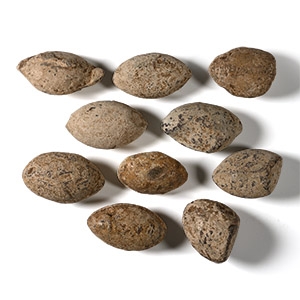
Graeco-Roman Lead Sling Shot Collection
5th-3rd century B.C.Sold for (Inc. bp): £208
Each a prolate spheroid, some with lettering and casting seam or sprue. 328 grams total, 21-32 mm
Acquired in the mid 1980s-1990s. Private collection, Switzerland, thence by descent. Private collection, since the late 1990s. This lot is accompanied by an illustrated lot declaration signed by the Head of the Antiquities Department, Dr Raffaele D'Amato.
