
Loading, please wait...
_900x900.jpg "Hellenistic Bronze Bowl")
_200x200.jpg "Hellenistic Bronze Bowl")
.jpg "Hellenistic Bronze Bowl")
LOT 0587
Hellenistic Bronze Bowl
LATE 2ND-EARLY 1ST CENTURY B.C.
6 1/4 in. (145 grams, 16 cm wide).
With high tin content, the body formed with a D-section wall and rounded base, damaged. [No Reserve]
ProvenanceAcquired 1980-2015.
Ex Abelita family collection.
Cf. Maierovskii III Burial-mound no. 4/2002, Burial no. 3B, Moscow, State Historical Museum, inv. no. 112873, list Б 2078/77, in Treister, M., 'Parthian and Early Sasanian 'Imports' in the Burials of the Nomads of Eastern Europe (2nd Century BCE-3rd Century CE)' in Choref, M.M., Materials in Archaeology and History of Ancient and Medieval Crimea, Moscow, 2018, pp.118-210, fig.4, 1-3, for a nearly identical bowl but with ornaments.
FootnotesSimilar segment-shaped silver bowls, sometimes with partial gilding and decorated on the inside have been found in many nomad mounds of the Caucasus and in the territories once dominated by the Arsacid Empire. They are attributed to Parthian workshops by Pfrommer and M. Treister.
CONDITIONTimeLine Auctions follows a vetting process to ensure the authenticity and legality of all items, reinforcing our commitment to integrity and responsible trading. Each antiquity, antique, and coin lot undergoes thorough examination by a vetting committee of at least ten external specialists, professional trade association members, scientists, and archaeologists: Our Vetting Process
AUCTIONS:
TimeLine is a leading auction house specialising in antiquities, ancient art, collectables, natural history, coins, medals, and books. Our auctions offer museums, collectors, historians, and enthusiasts the opportunity to acquire unique and historically significant pieces.
-
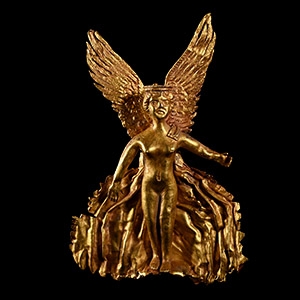
Greek Gold Figure of Nike from a Monumental Funerary Wreath
South Italian, 4th century B.C.Sold for (Inc. bp): £14,040
Formed as a composite figurine comprising: hollow-formed nude female figure with left arm extended to her side and fingers curled inwards, right hand at her side, hair drawn up in a chignon surmounted by an applied beaded-wire diadem; two sub-triangular wings each attached to the shoulder blades, with repoussé feather detailing to the obverse; broad D-shaped panel attached to the waist and rear of the legs, with radiating arch detailing; supplied with a custom-made display stand. 56 grams total, 92 mm including stand
Focquaert collection, Belgium, 1970s. European private collection. Accompanied by an academic report by Dr Raffaele D'Amato. This lot has been checked against the Interpol Database of stolen works of art and is accompanied by search certificate number no.12220-222337.
Similar statuettes were surmounting huge funerary wreaths, like the one from Armento (325-300 B.C. made in Southern Italy). The wreaths, composed of golden flowers, leaves, fruits, bees and Erotes, have a winged goddess, with all probability Nike, the Greek goddess of victory, as the central motif. It is possible that the wreath was given to the deceased as a prize after a successful competition, but the dimensions of the Nike show that it was an extremely rare artefact. These costly objects were financed by rich and powerful Mecenates, like Kreithonios, named in the inscription on the base of Nike from Armento. -
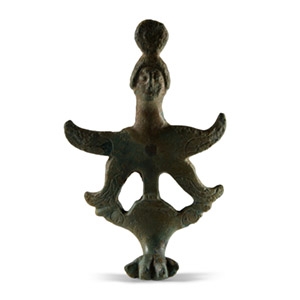
Etruscan Bronze Furniture Fitting
5th century B.C.Estimate: £300 - 400 (+bp*)
Opening Bid: £150
In the form of a harpy, comprising a facing female mask with lobed headdress on a tapering neck, crescentic lateral wings and tails with feather detailing, central column with claw foot; beneath, a scrolled panel developing to a four-toed claw; hollow to reverse of mask and claw, fixing stud and mounting ledge to reverse. 55 grams, 96 mm
Acquired in Germany, before 2000. English private collection. with Bertolami Fine Arts Ltd, Auction 88, no.162. -
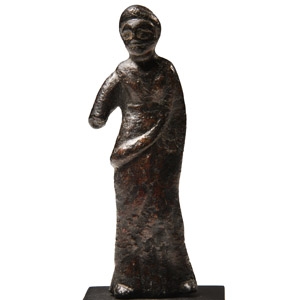
Italic Bronze Statuette of a Woman
3rd-1st century B.C.Sold for (Inc. bp): £98
Modelled in the round, standing with peplos dress and a large stola draped over the left shoulder and arm, extending to the knees; hair dressed in a chignon, transverse band below the breasts; mounted on a custom-made stand. 96 grams total, 86 mm including stand
From a collection acquired on the UK art market from various auction houses and collections mostly before 2000. From an important Cambridgeshire estate; thence by descent.
