
Loading, please wait...
LOT 1352
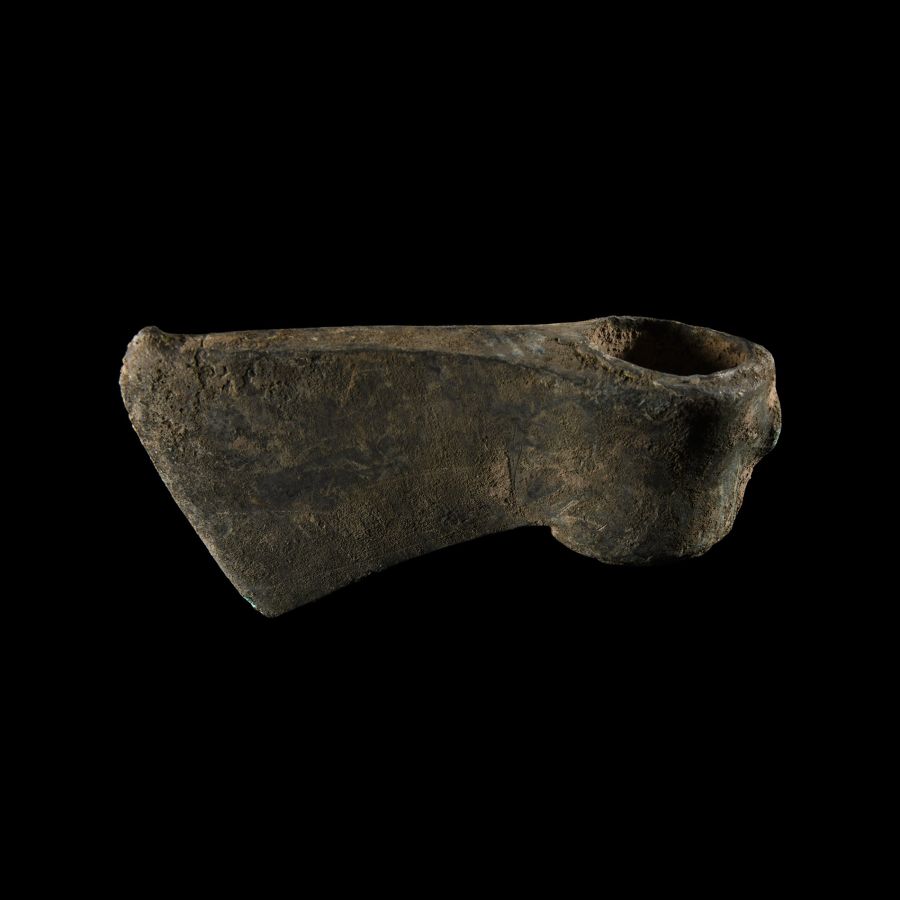
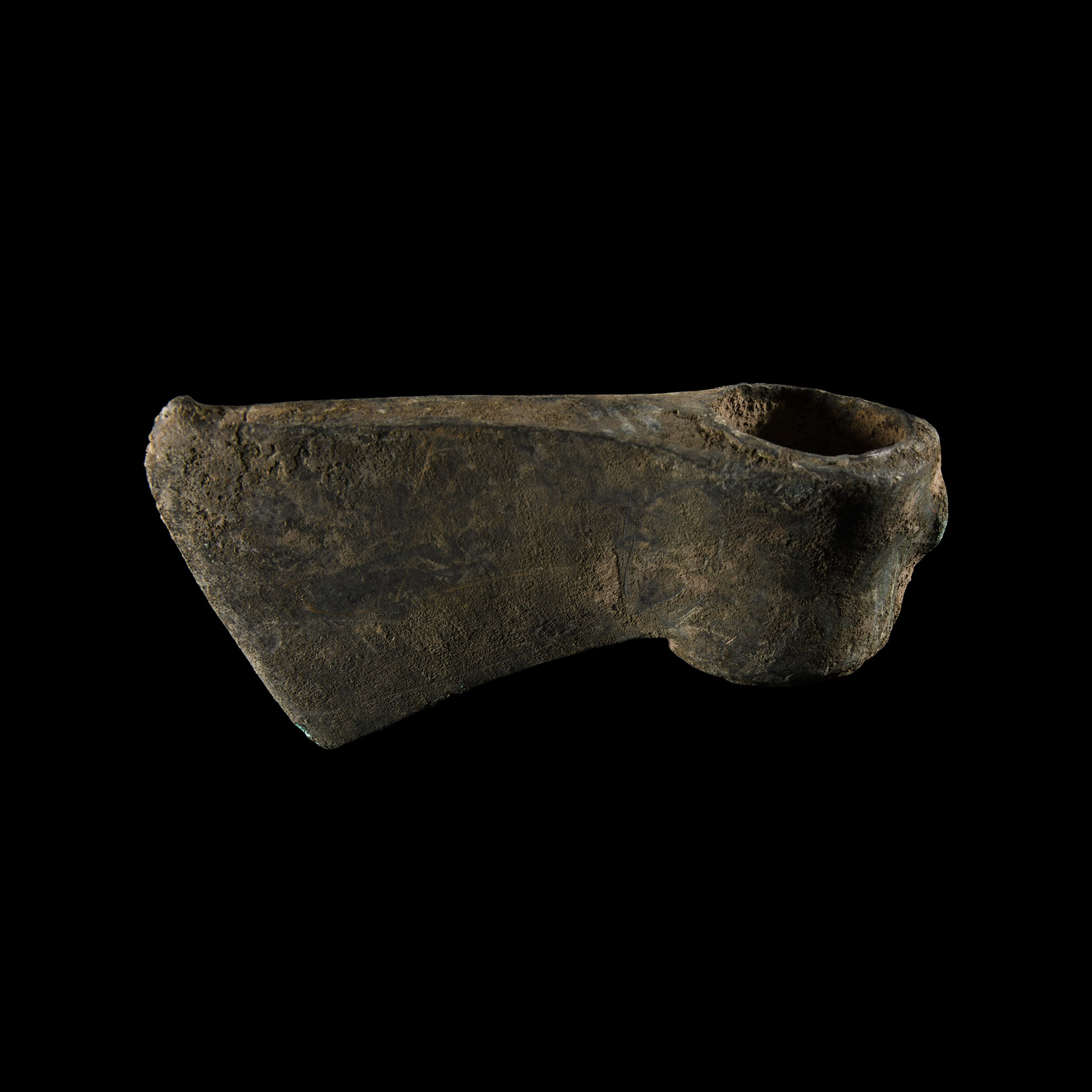
Heavy Western Asiatic Bronze Axehead
LATE 3RD MILLENNIUM B.C.
5 3/4 in. (741 grams, 14.5 cm).
With swept blade, large socket with shallow raised circumferential rib and a vertical rib to the rear.
ProvenanceAcquired 1980-2015.
Ex Abelita family collection.
For similar examples of axes see Gorelik, M., Weapons of Ancient East, IV millennium BC-IV century BC, Saint Petersburg (2003), pl.XX, no.44 (Mundigak, layer III, third quarter of the 3rd millennium B.C.).
FootnotesIn the middle of the 3rd millennium B.C., the most widespread types of axes were those made for splitting and those for cutting. In the last third of this millennium there emerged a sharp differentiation between such axes. Such a sharp division by function should be associated with the influence of the Syro-Palestinian tradition. Such differentiation, in the absence of some multifunctional forms, can be observed from the end of the 4th millennium B.C. and during the 3rd millennium B.C.
CONDITIONTimeLine Auctions follows a vetting process to ensure the authenticity and legality of all items, reinforcing our commitment to integrity and responsible trading. Each antiquity, antique, and coin lot undergoes thorough examination by a vetting committee of at least ten external specialists, professional trade association members, scientists, and archaeologists: Our Vetting Process
AUCTIONS:
TimeLine is a leading auction house specialising in antiquities, ancient art, collectables, natural history, coins, medals, and books. Our auctions offer museums, collectors, historians, and enthusiasts the opportunity to acquire unique and historically significant pieces.
LOT 1352
Heavy Western Asiatic Bronze Axehead
Estimate £100 - 140€120 - 160 (for guidance only)$140 - 190 (for guidance only)
-
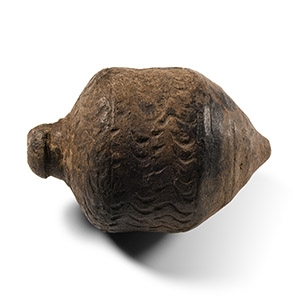
Byzantine 'Greek Fire' Ceramic Fire Bomb or Hand Grenade
9th-11th century A.D.Sold for (Inc. bp): £286
With domed filler-hole, broad shoulder, alternating bands of crescent impressed detailing; intended to be filled with explosive liquid and wick, used as a hand grenade. 242 grams, 10.1 cm
From a collection acquired on the UK art market from various auction houses and collections mostly before 2000. From an important Cambridgeshire estate; thence by descent. Accompanied by an academic paper by military specialist Dr Raffaele D'Amato, dated 15 July 2019 and titled 'Eastern Roman Empire - Greek Fire Bomb or Hand Grenade (μεσαίον kακάβιον) 9th-11th century AD'.
Apart from the use of siphons or manual flame-throwers called cheirosiphona, special corps of Roman soldiers employed terracotta grenades, in the form of small jars, abundantly evidenced in archaeological excavations. Such were the γανωτα, vessels (sometimes also of bronze) used for Greek fire. They were called μεσαία kακαβιά or κυτροκακάβια where the former had a bulbous shape and the latter a more cylindrical form. -
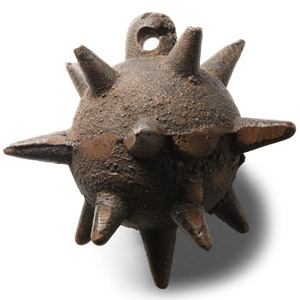
Iron Spiked Macehead
Circa 16th-17th century A.D.Sold for (Inc. bp): £221
Comprising a globular flail head with large suspension loop above and sixteen spiked projections to the sides. 829 grams, 89 mm
From a collection acquired on the UK art market from various auction houses and collections mostly before 2000. From an important Cambridgeshire estate; thence by descent.
The medieval flail was a weapon mainly used in Eastern Europe, probably created among the Steppe people and used by the Mongols, adopted by the Slavic people under the name of kisten. Such a weapon probably saw little use in Western Europe, where it is first represented in the 14th century in a fresco depicting the battle of Nineveh painted by Piero della Francesca, as a chain with three maceheads. In the poem Le Chevalier Délibéré written by Olivier de la Marche and published in 1486, there is an engraving representing a knight carrying a rather simple morning star with asymmetrically mounted quills and a single-ball flail of quills. It is thought that in the Middle Ages the nailed mace in general was used to break through and dismantle the armour of enemies who were then 'finished' with swords or daggers. -
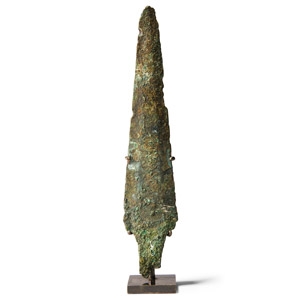
Western Asiatic Bronze Dagger
2nd millennium B.C.Estimate: £100 - 140 (‡+bp*)
Opening Bid: £50
With a narrow pointed blade and wide raised flange down centre, straight sides, well marked shoulders with narrow tang, one hole for rivet. 128 grams total, 17.6 cm high including stand
From the possessions of a member of a German princely family, gathered in the late 19th century, until the 1930s. with Auction House CUSP, Vienna, Auction Antique Art from Asia and from the Eastern Mediterranean, 16 June 2012, lot 75 [Part].
The type was technically more advanced than previous types of blades in the Near East, owing to the shape of the weapon, with its slightly convex sides widening out near the point, which combined the advantages of the leaf-shaped and straight-sided forms.
