


LOT 3642
Group of Ten [10] Roman Imperial AE Coins. Circa 3rd-4th century AD.
Various emperors. Condition as seen.(32.37gr total.).
ProvenanceAcquired in 1992.
Private collection, since the late 1990s.
TimeLine Auctions follows a vetting process to ensure the authenticity and legality of all items, reinforcing our commitment to integrity and responsible trading. Each antiquity, antique, and coin lot undergoes thorough examination by a vetting committee of at least ten external specialists, professional trade association members, scientists, and archaeologists: Our Vetting Process
AUCTIONS:
TimeLine is a leading auction house specialising in antiquities, ancient art, collectables, natural history, coins, medals, and books. Our auctions offer museums, collectors, historians, and enthusiasts the opportunity to acquire unique and historically significant pieces.
-

Romano-British Imitation of Constantius II BI Centenionalis. AD 337-361.
Sold for (Inc. bp): £33
Following uncertain mint. D N CONSTANTIVS P F AVG, pearl-diademed, draped and cuirassed bust to right / FEL TEMP REPARATIO, soldier standing to left, spearing fallen horseman, D in left field; uncertain mintmark in exergue. SCBC 750; see also Carson and J.P.C. Kent, 'A Hoard of Roman Fourth-Century Bronze Coins from Heslington, Yorkshire' in NC Vol. 11 (1971), p. 217 (Arles). 2.57gr, 16mm, 12h.
Good Very Fine.
Found Yorkshire, UK. From the private collection of Robin Sykes, Yorkshire, UK, formed since the late 1990s.
During the 4th century, the urban life in Britain was in serious decline and the supplies of currency from the Empire temporarily disrupted, so the local imitations of Constantius II and the usurper Magnentius became necessary to cover the deficit. -
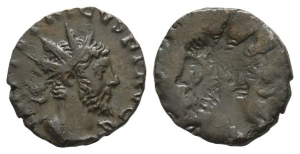
Tetricus I, Romano-Gallic Emperor BI Antoninianus. AD 271-274.
Sold for (Inc. bp): £46
Uncertain mint. IMP TETRICVS P F AVG, radiate and cuirassed bust to right / Incuse of obverse. 2.26gr, 17mm.
Very Fine. Brockage of obverse.
From a private, UK, collection in the 1980s. Property of a London, UK, antiquarian.
Brockage errors are caused when an already minted coin sticks to the coin die and impresses onto another blank that hasn't been struck yet, pressing a mirror image of the other coin into the blank. -

Roman Imperial, Terracotta Forger's Casting Mould. 3rd century AD.
Sold for (Inc. bp): £39
IMP C M AVR PROBVS P F AVG, radiate, draped and cuirassed bust of Probus to right / RESTITVT ORIE-NTIS, turreted female (the Orient) standing to right, presenting wreath to emperor standing to left, holding spear. 3.56gr, 27mm, 9h.
Condition as seen. Casting mould sharing types of different rulers.
From the collection of a gentleman, acquired on the London art market in the 1990s.
With an impression of the obverse on one side, and the reverse on the other, of the coin being counterfeited this ancient forger's casting mould would have been stacked with others, the molten metal being poured from above and allowed to cool.
