
Loading, please wait...
LOT 1542
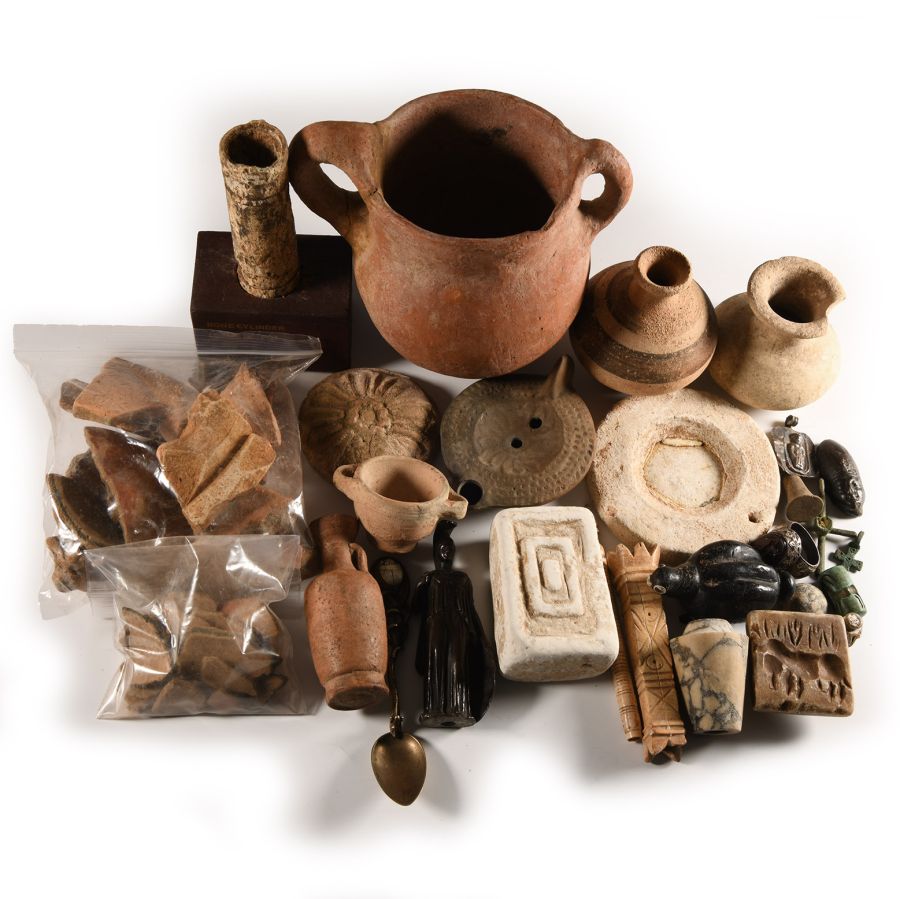
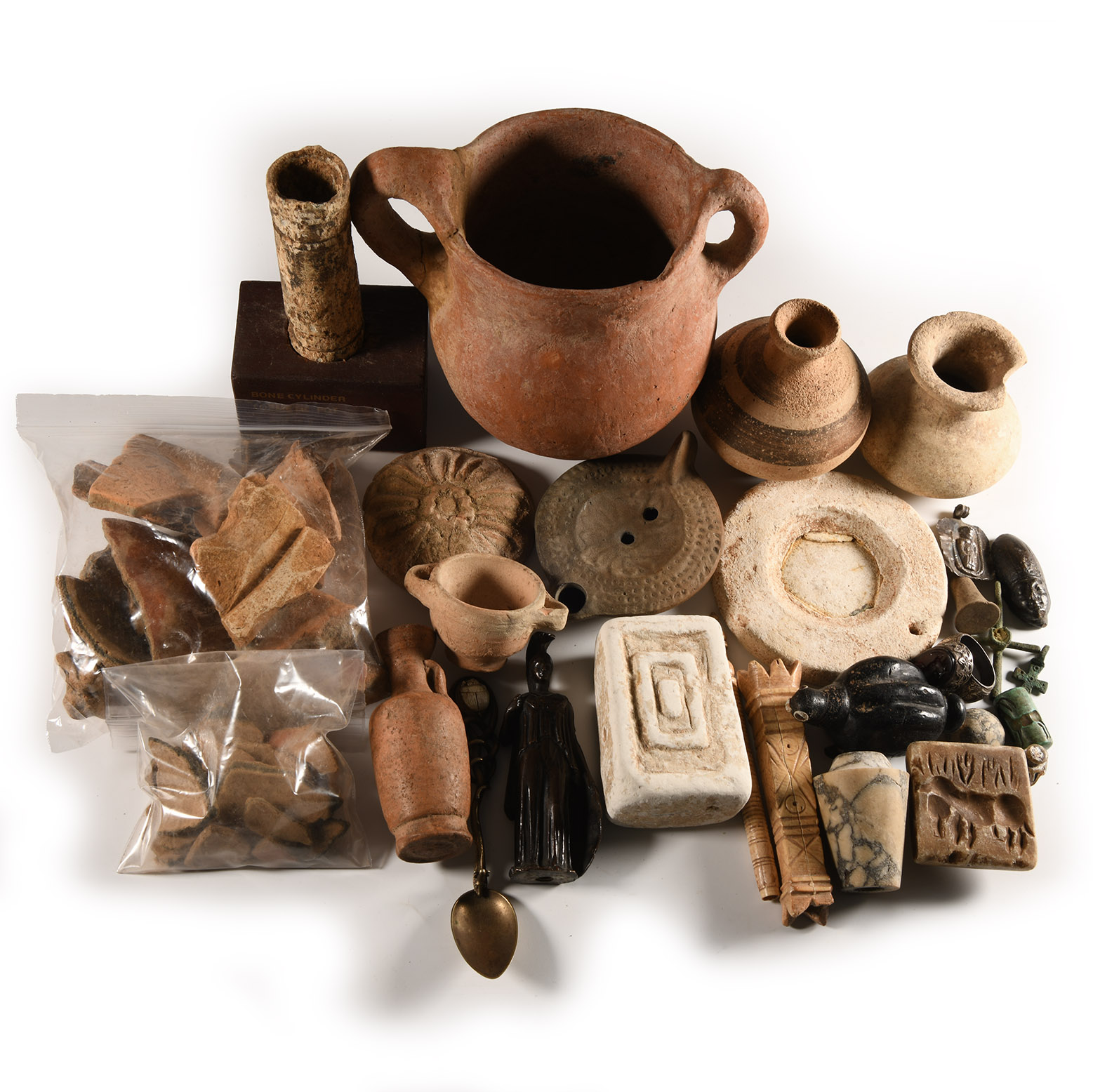
Group of Antiquities and Other Objects
2ND MILLENNIUM B.C.-20TH CENTURY A.D.
3/4 - 4 3/4 in. (2 kg total, 1.9-12 cm).
Comprising a Middle Bronze Age Cypriot vessel circa 2000-1600 B.C.; a Bronze Age two-handled vessel from the Holy Land; a votive mirror frame; a bronze statuette of Victory, and other items; some items after the antique. [50+, No Reserve]
ProvenanceThe Cypriot pot ex Leto Severis collection; the fragmentary pot ex Donald Simmonds collection; the bronze of Victory ex Michaelides collection.
with Roseberys, London, 26 October 2021, the majority of no.13.
Accompanied by a copy of the Roseberys catalogue listing.
TimeLine Auctions follows a vetting process to ensure the authenticity and legality of all items, reinforcing our commitment to integrity and responsible trading. Each antiquity, antique, and coin lot undergoes thorough examination by a vetting committee of at least ten external specialists, professional trade association members, scientists, and archaeologists: Our Vetting Process
AUCTIONS:
TimeLine is a leading auction house specialising in antiquities, ancient art, collectables, natural history, coins, medals, and books. Our auctions offer museums, collectors, historians, and enthusiasts the opportunity to acquire unique and historically significant pieces.
-

Large Bronze Age Spectacle Pendant
16th-10th century B.C.Sold for (Inc. bp): £780
Formed as two coils of lozenge-section rod with a loop between; hatched decoration on the ridges. 81.6 grams, 10.8 cm
Formerly in a Munich, Germany collection, formed in the 1970s. From a private UK collection. From the Horton collection, UK. -

Bronze Age Ceremonial Cup Stone Slab
Circa 2nd millennium B.C.Sold for (Inc. bp): £1,235
Irregular slab fragment with weathered upper face, cluster of seven cup-marks without surrounding rings. 50.6 kg, 57.5 cm
From a collection acquired on the UK art market from various auction houses and collections mostly before 2000. From an important Cambridgeshire estate; thence by descent.
The fragment plausibly represents one corner of an arrangement such as that at Tanum, Denmark (Milstreu & Dodd, 2018, fig.8) in which a cluster of shallow depressions forms a larger pattern. The depressions may have been used to collect dew or rainwater, visualised as a gift from the gods provided without human intervention, as well as for ceremonial uses. -
Bronze Age Looped and Socketted Axehead
Circa 8th century B.C.Sold for (Inc. bp): £176
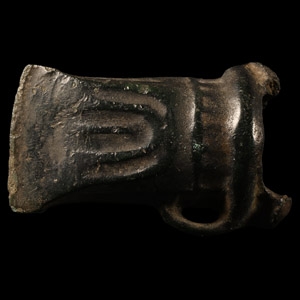
Comprising of a wedge-shaped body and convex cutting edge, ellipsoid mouth and collar moulding; three raised moulded ribs to each face; D-shaped moulded loop to one edge; likely a South-Eastern variant. 73.2 grams, 59 mm
Acquired on the London art market in the late 1980s-1990s. From the family collection of an East London, UK, gentleman.
