
Loading, please wait...
_900x900.jpg "Greek Terracotta Seated Shepherd")
_200x200.jpg "Greek Terracotta Seated Shepherd")
_900x900.jpg "Greek Terracotta Seated Shepherd")
_200x200.jpg "Greek Terracotta Seated Shepherd")
.jpg "Greek Terracotta Seated Shepherd")
.jpg "Greek Terracotta Seated Shepherd")
LOT 0667
Greek Terracotta Seated Shepherd
CIRCA 400 B.C.
6 1/8 in. (205 grams, 15.8 cm).
Hollow-formed statue showing a young shepherd wearing a short tunic and hooded cloak, holding an object in his right hand; rectangular slot on the reverse.
ProvenancePrivate collection Mr T.B., Zürich, Switzerland, before 1970.
with Galerie Rhéa, Zurich, Switzerland.
TimeLine Auctions follows a vetting process to ensure the authenticity and legality of all items, reinforcing our commitment to integrity and responsible trading. Each antiquity, antique, and coin lot undergoes thorough examination by a vetting committee of at least ten external specialists, professional trade association members, scientists, and archaeologists: Our Vetting Process
AUCTIONS:
TimeLine is a leading auction house specialising in antiquities, ancient art, collectables, natural history, coins, medals, and books. Our auctions offer museums, collectors, historians, and enthusiasts the opportunity to acquire unique and historically significant pieces.
LOT 0667
Greek Terracotta Seated Shepherd
Estimate £800 - 1,000€930 - 1,160 (for guidance only)$1,080 - 1,350 (for guidance only)
-
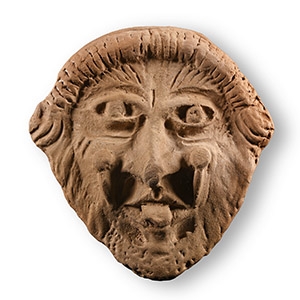
Greek Terracotta Face of a Gorgoneion
6th-5th century B.C.Sold for (Inc. bp): £1,040
With large eyes and applied pupils, accentuated nose and open mouth with protruding tongue, hair indicated with regularly disposed lines; repaired, western Greek workmanship; mounted on a custom-made display stand. 142 grams total, 15.5 cm including stand
Ex Mr M.Q.F, Horgen, Switzerland, 1971. with Galerie Rhéa, Zurich, Switzerland.
A Gorgoneion was a protective symbol in ancient Greek art that depicts the head of the Gorgon, a mythical creature with snakes for hair and a terrifying gaze that could turn people to stone. The Gorgoneion was believed to have the power to ward off evil and protect the person who wore it or displayed it. The image of the Gorgoneion was often used as an apotropaic symbol to ward off evil or bad luck. It was often depicted on shields, armour, or even as an architectural feature on buildings. The symbol was also sometimes used in jewellery, such as amulets or pendants, and was believed to bring good luck and protection to the wearer. The most famous depiction of the Gorgoneion is probably the one on the aegis of the goddess Athena. -
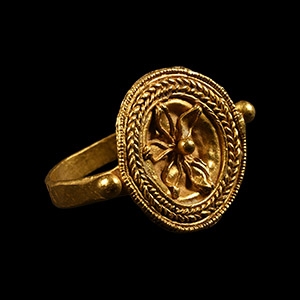
Greek Gold Ring with Rosette and Filigree
5th-4th century B.C.Sold for (Inc. bp): £2,210
With granule to each shoulder, discoid bezel with beaded wire rim, ropework band and central cinquefoil motif. 6.37 grams, 25.62 mm overall, 22.66 mm internal diameter (approximate size British R 1/2, USA 8 3/4, Europe 19.38, Japan 18)
Acquired in the mid 1980s-1990s. Private collection, Switzerland, thence by descent. Private collection, since the late 1990s. This lot has been checked against the Interpol Database of stolen works of art and is accompanied by a search certificate number no.12388-226931. -
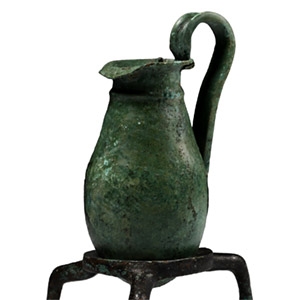
Greek Bronze Olpe
6th century B.C.Sold for (Inc. bp): £780
Pear-shaped body with rounded base, raised circumferential hoop at the neck and everted rim; applied high, ribbed handle with an engraved palmette at the base; accompanied by a stand. 145 grams, 12.5 cm (250 grams total, 15 cm including stand)
Private collection Dr L.M., Zurich, Switzerland. with Galerie Rhéa, Zurich, Switzerland.
