
Loading, please wait...
_900x900.jpg "Greek Terracotta Kantharos")
_200x200.jpg "Greek Terracotta Kantharos")
.jpg "Greek Terracotta Kantharos")
LOT 0043
Greek Terracotta Kantharos
4TH-3RD CENTURY B.C.
7 7/8 in. (421 grams, 20 cm high).
Trumpet-shaped cup with narrow stem and flared foot, two elaborate scrolled loop handles with lateral spurs, Side A: painted female profile busts each with detailed stephane and drop earrings, the hair dressed in a kekryphalos, flanked by two white cross or sword symbols; Side B: similar but lacking the swords.
ProvenanceFrom a German auction.
Ex Paris gallery, 2000s.
TimeLine Auctions follows a vetting process to ensure the authenticity and legality of all items, reinforcing our commitment to integrity and responsible trading. Each antiquity, antique, and coin lot undergoes thorough examination by a vetting committee of at least ten external specialists, professional trade association members, scientists, and archaeologists: Our Vetting Process
AUCTIONS:
TimeLine is a leading auction house specialising in antiquities, ancient art, collectables, natural history, coins, medals, and books. Our auctions offer museums, collectors, historians, and enthusiasts the opportunity to acquire unique and historically significant pieces.
LOT 0043
Greek Terracotta Kantharos
Estimate £1,500 - 2,000€1,740 - 2,320 (for guidance only)$2,030 - 2,700 (for guidance only)
-
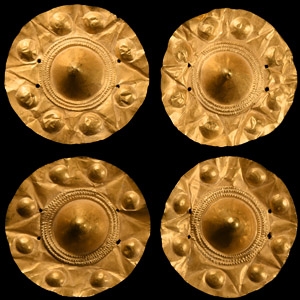
Sarmatian Gold Dress Mount Group
1st-3rd century A.D.Sold for (Inc. bp): £975
Each composed of a sheet-metal disc with central repoussé conical dome, concentric borders of faux strip twist wire; the edge with shallow domes and a sunburst motif, four fastening holes to each element. 14.75 grams total, 63-66 mm wide
From the collection of a North American gentleman, formed in the 1990s.
Ornamental discs of this type decorated the long dresses of Sarmatian princesses, arranged vertically on long garments, on shawls, and on the upper shoulders. They were fixed to the garments through sewing, using the fastening holes. -
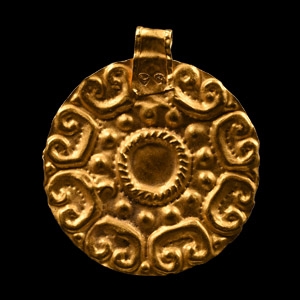
Mycenaean Gold Roundel Pendant
1350-1200 B.C.Sold for (Inc. bp): £1,170
Produced using repoussé technique, circular in shape with a design of scroll motifs to the outer edge; to the centre a roundel with ropework outline within a roundel of raised dots; applied gold loop for suspension. 1.04 grams, 30 mm
Acquired in the 1990's; cat.1704. From an important Mayfair, London, UK collection. -
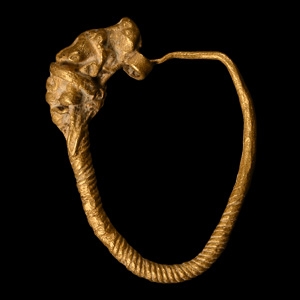
Greek Gold Animal-Headed Earring
4th-3rd century B.C.Sold for (Inc. bp): £312
The decoratively twisted hoop tapering toward the closure, cow or bull head modelled in the round with filigree ornament to the collar. 2.91 grams, 22.69 mm overall, 17.67 mm internal diameter (approximate size British E, USA 2 1/4, Europe 2.41, Japan 2)
From the collection of H.N., Milton Keynes, 1980s-1990s.
