
Loading, please wait...
LOT 0657
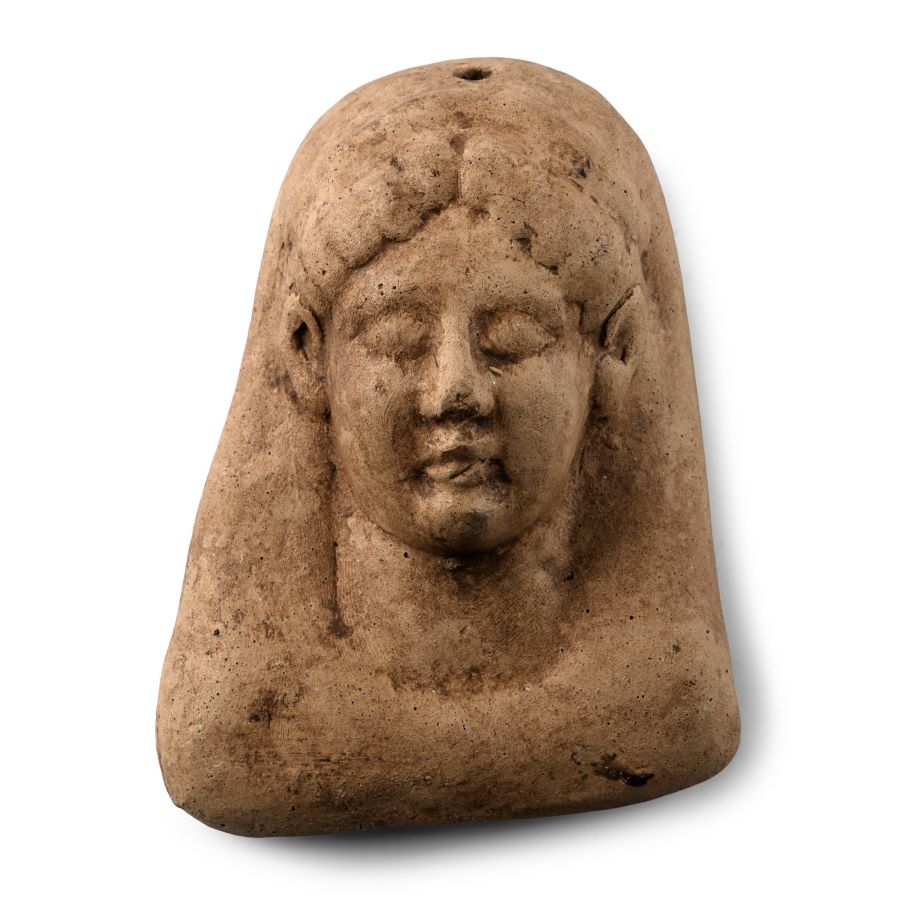
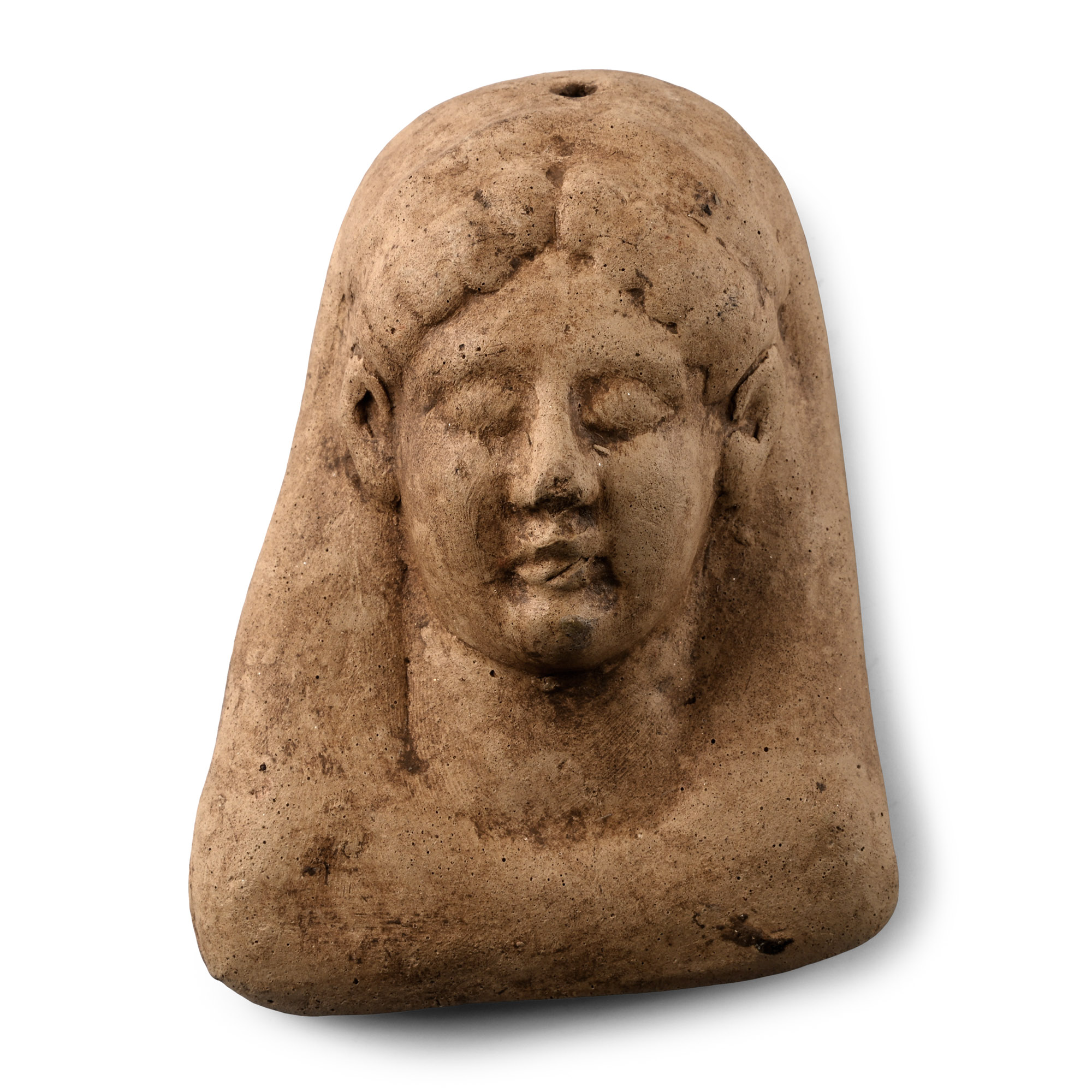
Greek Terracotta Female Protome
EARLY 5TH CENTURY B.C.
4 in. (126 grams, 10.3 cm).
Tongue-shaped in plan and hollow to the reverse; obverse with female bust in high-relief with row of curls on the brow emerging from beneath the palla head-covering. [No Reserve]
Provenancewith Archaeologia, Switzerland, before 1983.
Ex private North American collection.
London private collection, 2016.
Cf. Van Rooijen, G., Goddesses of Akragas, a study of terracotta votive figurines from Sicily, Leiden, 2021, no.163, for similar.
CONDITIONTimeLine Auctions follows a vetting process to ensure the authenticity and legality of all items, reinforcing our commitment to integrity and responsible trading. Each antiquity, antique, and coin lot undergoes thorough examination by a vetting committee of at least ten external specialists, professional trade association members, scientists, and archaeologists: Our Vetting Process
AUCTIONS:
TimeLine is a leading auction house specialising in antiquities, ancient art, collectables, natural history, coins, medals, and books. Our auctions offer museums, collectors, historians, and enthusiasts the opportunity to acquire unique and historically significant pieces.
-
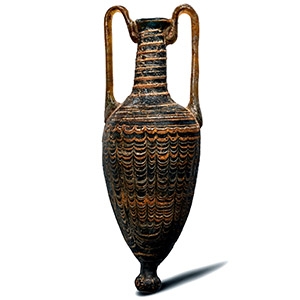
Greek Core-Formed Glass Amphoriskos
5th-3rd century B.C.Estimate: £2,500 - 3,500 (+bp*)
Opening Bid: £1,200
Elongated piriform amphora shape, tubular neck and everted rim, decorated with polychrome festooning and trails, applied amber-green handles and knop foot. 152 grams, 18 cm high
Acquired early 1990s. Ex private American collection; thence by descent. Private collection since 1998. This lot has been checked against the Interpol Database of stolen works of art and is accompanied by search certificate number no.12206-222129. -
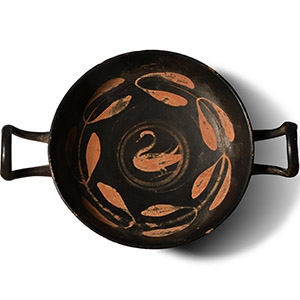
Greek Apulian Xenon Stemless Kylix Attributed to the Red Swan Group
South Italic, circa 4th century B.C.Sold for (Inc. bp): £715
Shallow with arched loop handles below the rim, low stepped foot; tondo with painted wreath of laurel leaves surrounding a standing swan in profile; to the outer face two horizontal sprigs of laurel leaves. 159 grams, 19.6 cm
Ex David Miller, Hemel Hempstead, London, UK. From the private collection of a West London, UK, gentleman, formed since the early 2000s. -
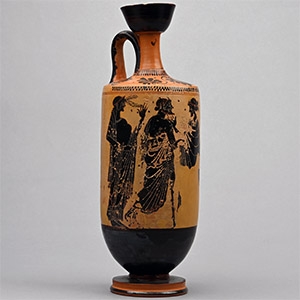
Greek Terracotta White-Ground Painted Lekythos Attributed to the Athena Painter
Circa 510-500 B.C.Estimate: £5,000 - 7,000 (‡+bp*)
Opening Bid: £2,700
Cylindrical with stepped foot, five palmettes above the shoulder, dynamic frieze of two men visiting two hetairai, each of the figures dressed in long pleated garments, at the centre of the scene, a hetaira on the right reaching towards the bearded male and gently touching his chin with her open hand, a tall draped table behind her with an amphora underneath and a standing bird on the top. 459 grams, 26.4 cm
H.A.C. (Herbert A. Cahn), 19 October 1979. Private collection, Bern, Switzerland. Accompanied by an original thermoluminescence analysis report no.N125q45 by Oxford Authentication. This lot has been checked against the Interpol Database of stolen works of art and is accompanied by a search certificate number no.12644-236376.
The Athena Painter is known as the painter who designed several Greek black-figure pottery works using the 5th-century BC white-ground technique. He specialized in lekythoi and refers to Athena as his main subject in his works. Together with the Theseus Painter, they continued the tradition of painting large lekythoi. His black figures are of high quality, and in addition to lekythoi, he decorated other potteries such as oenochoai. Some archaeologists say that he may have been the same person as the Bowdoin Painter of red-figure pottery, although they may have just worked in the same workshop.
