
Loading, please wait...
LOT 0563
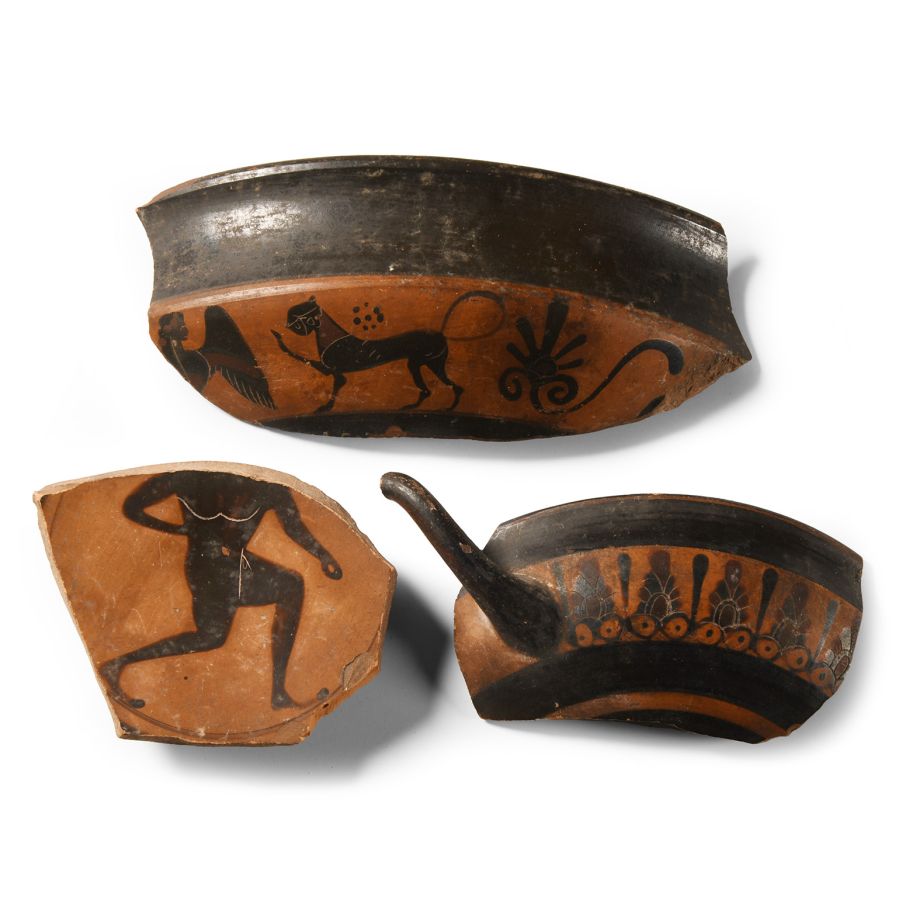
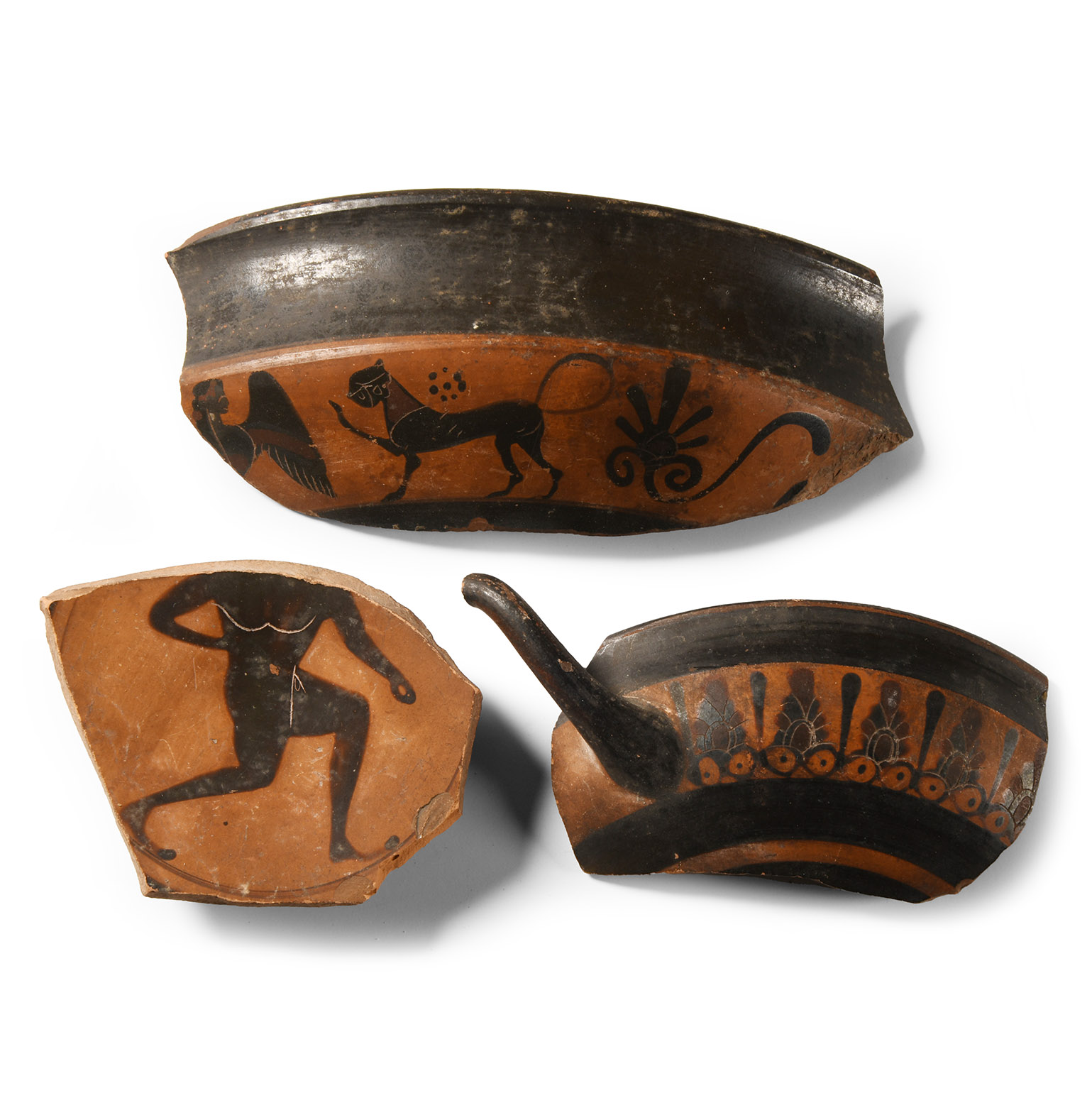
Greek Terracotta Attic Black Figure Vessel Fragment Group
6TH CENTURY B.C.
2 7/8 - 5 1/8 in. (106 grams total, 7.4-13 cm).
Comprising: carinated rim fragment from a bowl with reserved siren, panther, rosette and other ornament; bowl base with reserved advancing nude male or satyr on a red field, sgraffito detailing; skyphos rim fragment with part of the handle, reserved egg-and-dart band. [3, No Reserve]
ProvenanceFrom an early 20th century collection.
By descent the property of a UK lady.
Ian Wilkinson collection, Nottinghamshire, UK, formed since 1985.
Accompanied by a previous handwritten note including provenance.
Cf. Snyder Schaeffer, J., Ramage, H.N., Greenewalt, C.H. Jr., The Corinthian, Attic and Lakonian Pottery from Sardis, London, 1997, fragments ATT 36 and ATT 73, for similar.
FootnotesThe body of the panther resembles the style of the school of Sophilos, an Attic painter active circa 580-560 B.C. The naked image (a dancing satyr?) recalls the Attic black figure depictions of ithyphallic satyrs, with torso, arms, legs and incision for internal details in white paint, made around 500 B.C.
CONDITIONTimeLine Auctions follows a vetting process to ensure the authenticity and legality of all items, reinforcing our commitment to integrity and responsible trading. Each antiquity, antique, and coin lot undergoes thorough examination by a vetting committee of at least ten external specialists, professional trade association members, scientists, and archaeologists: Our Vetting Process
AUCTIONS:
TimeLine is a leading auction house specialising in antiquities, ancient art, collectables, natural history, coins, medals, and books. Our auctions offer museums, collectors, historians, and enthusiasts the opportunity to acquire unique and historically significant pieces.
LOT 0563
Greek Terracotta Attic Black Figure Vessel Fragment Group
Sold for (Inc. bp): £546
-
.jpg)
Cypriot Stone Goddess and Child Statue
Iron Age, 6th century B.C.Sold for (Inc. bp): £520
The female seated on a chair with arm-supports at the sides, wearing a long robe with ruched panel to the chest and pleated sleeves, the hair drawn up into a transverse band above the brow, surmounted by a tiara; hands across the waist holding an infant with head erect; mounted on a custom-made stand; repaired. 1.54 kg total, 24 cm high including stand
From a collection acquired on the UK art market from various auction houses and collections mostly before 2000. From an important Cambridgeshire estate; thence by descent.
The statuette probably represents the goddess of fertility, originally imported from Crete in the 11th century B.C. but whose iconography survived in Cyprus until the 5th century B.C. The tiara is a characteristic attribute of this divinity, related to the Greek Demeter. The statue is probably a votive statue propitiatory for births. -
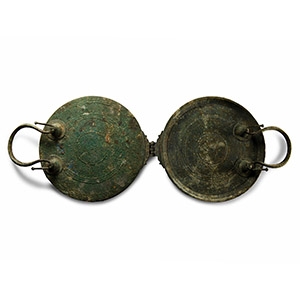
Greek Bronze Folding Travelling Mirror
Hellenistic, 2nd century B.C.Sold for (Inc. bp): £2,080
Discoid mirror with recess to obverse and reverse, each with a looped handle attached to two domed lugs, concentric rings and stepped rim; hinge to lower edge, recessed inner face to one disc and raised equivalent to the other with silvered finish. 305 grams, 12.8 cm
Acquired on the German art market, 1989-1995. with The Museum Gallery, 19 Bury Place, London, WC1A 2JB, 1998-2003. Property of a London based academic, 2003-present. This lot has been checked against the Interpol Database of stolen works of art and is accompanied by a search certificate no.12061-217502.
These kind of mirrors consisted of heavy circular discs with low cylindrical rims. They were made in pairs, and polished (and sometimes silvered) respectively on the recessed and flat sides, the latter being provided with a bevelled edge, into which the other fitted like a cover. Both polished surfaces were thus protected. The unpolished sides were ornamented with concentric-circle ornaments and concentric mouldings. -
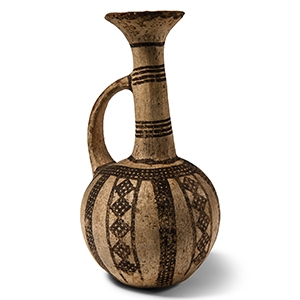
Cypriot White-Slip Ware Jug
Circa 1450-1200 B.C.Sold for (Inc. bp): £3,120
With bulbous body and slender tapering neck with strap handle to the rear, trumpet-shaped mouth; hatched bands and lozenges to the body and shoulder, multilinear rings to the neck; old collector's label marked '4' and '15.79' inked to the underside. 251 grams, 17.2 cm
Red-ink inscription '15.79' to the base suggesting it may have been deaccessioned from The Metropolitan Museum of Art. From an important Cambridgeshire estate; thence by descent.
